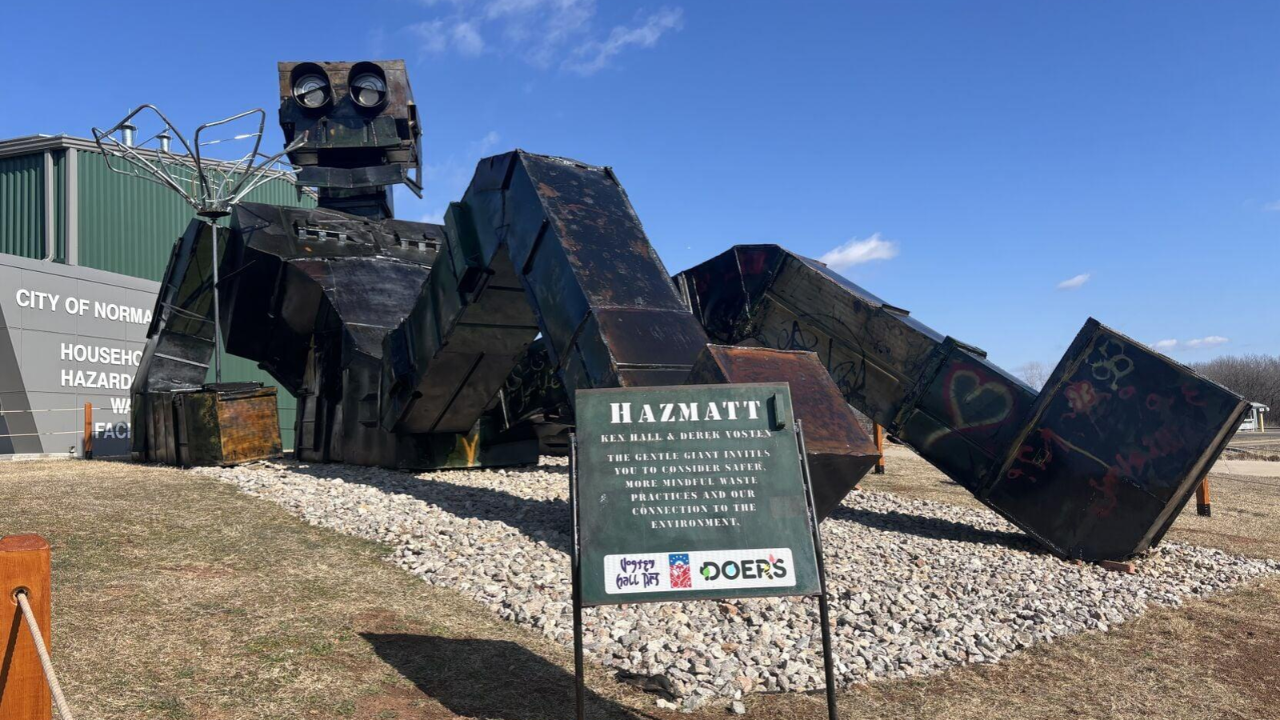
Standing twenty feet tall and weighing several tons, Hazmatt is a reclining steel sculpture built entirely from discarded dumpsters in Tulsa, Oklahoma, for just over $14,000. Created by local metal artist Matt Moffett, the piece sits lounging like a colossal, industrial sunbather—an absurdly relaxed monument made from the exact containers people use to hide their unwanted trash.
Most municipal art projects burn through hundreds of thousands of taxpayer dollars before a single shovel hits the dirt. They get bogged down in committee meetings, environmental impact studies, and consultant fees. Hazmatt bypassed the entire bureaucratic circus. By turning rusted commercial waste bins into a massive, resting figure, the project exposes the bloated economics of modern public art while proving that heavy-gauge scrap metal carries more cultural weight than polished bronze.
The Economics of Rust and Red Tape
Public art has a spending problem. Across American cities, commissioning a landmark sculpture typically starts at $100,000 and easily clears half a million once engineering stamps, liability insurance, and gallery commissions are factored in. Cities pay for prestige. They want clean lines, imported stone, and shiny stainless steel that looks good on a tourism brochure.
Hazmatt cost roughly the price of a used Honda Civic.
That $14,000 figure is not just a quirky trivia point; it is an indictment of how cities usually buy culture. When you strip away middlemen and source raw materials from the scrapyard, the math changes completely. Commercial dumpsters are built from heavy-duty, 10-gauge to 12-gauge structural steel designed to withstand hydraulic compactor trucks and decades of weather abuse. Buying that volume of new plate steel at retail prices would have blown the budget before Moffett even struck an arc with his welder.
By harvesting retired dumpsters, the build got pre-formed, industrial-grade steel for pennies on the pound. The dents, scrapes, and faded industrial paint were already baked into the metal. Instead of spending weeks artificially distressing new steel to give it character, the material arrived with its own history of Tulsa alleys and construction sites.
Engineering a Twenty-Foot Lounger
Building something this big out of trash is not as simple as stacking boxes and running a weld bead. Steel is unforgiving. A twenty-foot structure acts like a giant sail in Oklahoma’s notoriously violent plains winds, and a poorly balanced joint can turn a whimsical sculpture into a lethal collapse.
To make a reclining figure look effortless, the internal skeleton has to work overtime.
Load Distribution and Center of Gravity
Unlike a standing statue, which channels weight straight down into a single reinforced footing, a reclining giant spreads its mass horizontally across multiple contact points. The hips, elbows, and heels all bear different loads. If the ground settles unevenly after a heavy spring rain, the stress transfers directly to the welds at the waist and shoulders. Builders working with salvaged steel have to account for metal fatigue—microscopic cracks and weakened zones caused by years of heavy loads before the dumpster was ever scrapped.
Working Around the Trash
Welding clean, mill-scale steel is straightforward. Welding old dumpsters is a miserable, toxic grind. Every seam has to be aggressively ground down to bare metal to strip away layers of rust, dried grease, chipped enamel, and mystery residue. If you weld over contamination, you trap gas bubbles inside the joint, creating porosity that compromises structural integrity. Cutting into thick, warped dumpster walls with plasma cutters and angle grinders requires constant adjustments because old bins are never square; years of being slammed onto concrete pads twist the frames out of true alignment.
Why a Reclining Giant Hits Different
Walk through almost any American downtown and you will see the same visual clichés. Men on horses. Abstract swooshes of brushed aluminum. Severe, upright figures staring heroically toward an imaginary horizon. Traditional monuments are obsessed with power, hustle, and rigid posture.
Hazmatt is literally lying down on the job.
There is a sharp, dry humor in taking the ultimate symbol of municipal sanitation and industrial waste—a literal garbage bin—and posing it in a state of total leisure. It subverts everything people expect from a towering steel monument. Instead of demanding reverence, the sculpture invites people to laugh, walk up close, and inspect the welds. You can still see the side pockets where garbage truck forks used to slide in to lift the bins. Those functional scars were intentionally left visible, acting as a visual receipt of where the materials came from.
This approach taps directly into the upcycling and industrial folk-art movement that thrives in post-industrial cities. Places like Tulsa, built on oil, manufacturing, and heavy trades, have a deep cultural literacy when it comes to fabrication. Residents recognize the blue-collar labor required to wrestle heavy plate steel into a human form. A guy with a welding hood, a grinder, and a pile of scrap resonates far more deeply in an industrial town than a concept drafted on an iPad in New York and shipped in on a flatbed truck.
The Uncomfortable Truth About Scrap Art
Romanticizing scrapyard art is easy, yet it ignores real-world friction. Not every city can—or should—drop twenty-foot dumpster sculptures on street corners.
First, there is the maintenance trap. Untreated or partially painted salvage steel continues to oxidize. While a layer of surface rust protects the deeper metal in dry climates, water pooling inside upward-facing crevices—like a folded steel lap or a cupped hand—will eventually rot through the plate. Without proper drainage holes drilled into low points, rainwater freezes in the winter, expands, and splits welds apart from the inside out.
Second, liability laws make spontaneous scrap art nearly impossible on municipal property. City engineers demand stamped blueprints, wind-load calculations, and non-climbable surfaces so teenagers do not scale a twenty-foot steel arm at two in the morning and break their necks. Projects like Hazmatt usually survive only because they sit on private commercial property or partner with flexible local venues willing to shoulder the insurance risk that city halls run away from.
Third, the low price tag can accidentally devalue the artist’s labor. When headlines celebrate a "$14,000 sculpture," the public often assumes the artist made a tidy profit. In reality, after paying for crane rentals, welding wire, shielding gas, grinding discs, plasma consumables, and foundation concrete, a budget that tight leaves pennies per hour for the actual builder. It is a passion project subsidized by the artist’s own sweat, not a sustainable business model for full-time fabricators.
Reclaiming the Urban Landscape
Despite the bruises, scraped knuckles, and thin margins, Hazmatt accomplishes something multimillion-dollar civic rebranding campaigns routinely fail to do. It creates an immediate, unmistakable sense of place.
People do not drive across town to take selfies with a corporate plaza fountain. They do drive across town to stand next to a twenty-foot steel giant made of garbage bins. The sculpture turns industrial waste into a neighborhood landmark, proving that placemaking does not require massive capital—it requires sharp vision, heavy equipment, and the nerve to weld trash into something permanent.
Cities across the country are sitting on millions of tons of retired industrial steel while simultaneously complaining that they lack the funds to make their neighborhoods visually compelling. The raw materials for the next great public landmark are already sitting behind a local grocery store, waiting for someone with a cutting torch to drag them out.