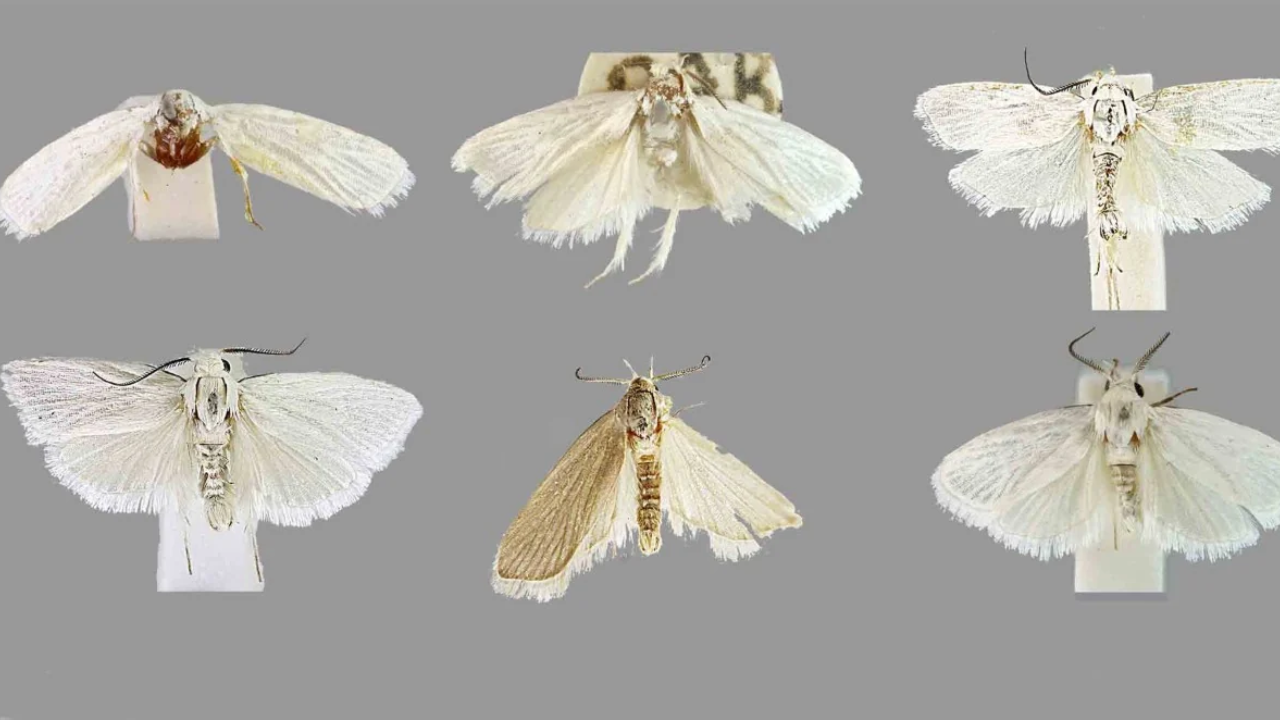
Most people think taxonomy happens in muddy rainforests with butterfly nets and headlamps. They're half right. A massive chunk of modern species discovery actually happens inside quiet, climate-controlled museum drawers where specimens have been sitting untouched for generations.
That's exactly how researchers just cracked open a 170-year-old biological mystery. By tracking down and examining a single moth specimen originally collected by famed Victorian naturalist Alfred Russel Wallace in the 1850s, entomologists managed to untangle a taxonomic mess and formally identify 11 brand-new species of moths.
It sounds like something out of an academic thriller. One dusty Victorian insect, pinned to a board before the American Civil War, held the exact physical blueprint scientists needed to separate lookalike species that had been lumped together for over a century.
The Victorian Specimen Sitting in Plain Sight
In the mid-19th century, Alfred Russel Wallace spent eight years traveling across the Malay Archipelago—modern-day Indonesia, Malaysia, and Singapore. While Charles Darwin was back in England agonizing over his manuscripts, Wallace was dodging malaria, surviving shipwrecks, and shipping tens of thousands of beetles, birds, and moths back to London.
Among those massive shipments was a small, visually striking moth.
Back in the 1850s and 1860s, Victorian taxonomists like Francis Walker at the British Museum worked at a breakneck pace to catalog Wallace's haul. They didn't have DNA sequencers. They didn't have high-powered scanning electron microscopes. They looked at wing patterns, scribbled a brief Latin description, pinned a label on the insect, and moved on to the next crate.
Because they relied purely on outward appearance, early naturalists made a classic mistake. They assumed that any moth sharing similar wing markings across Southeast Asia belonged to the exact same widespread species.
They were wrong. Dead wrong.
For 170 years, museum collections around the world filed hundreds of these moths under the same old name. Nobody questioned it because nobody went back to compare the modern specimens directly against Wallace's original "type specimen"—the single physical individual used to define a species when it's first named.
Why Lookalike Moths Fool Even Seasoned Experts
If you've ever spent time sorting through museum drawers of Lepidoptera, you know how frustrating cryptic species can be. Nature loves mimicry, and closely related insects often evolve nearly identical wing patterns to confuse predators or blend into the exact same tree bark.
To the naked eye, these moths look like carbon copies of each other. Same subtle brown and cream banding. Same wingspan. Same general silhouette.
When modern researchers decided to review this specific group of moths across Southeast Asia, they hit an immediate wall. They had dozens of specimens from Borneo, Sumatra, Peninsular Malaysia, and the Philippines, and the genetic data wasn't lining up with the old taxonomy.
DNA barcoding showed clear, distinct genetic splits between populations that looked identical on the outside. To figure out which genetic lineage actually deserved the original 19th-century name—and which ones were completely unknown to science—the team had to find Wallace's original moth.
Locating a specific Victorian specimen isn't as simple as typing a barcode into a database. Wallace's massive collection was split up over the decades, sold through natural history agents like Samuel Stevens, and scattered across institutions like the Natural History Museum in London and the Oxford University Museum of Natural History.
Once researchers tracked down Wallace's original specimen and examined it closely, everything clicked into place.
How Researchers Separated the 11 New Species
Finding Wallace's moth gave the scientists their anchor. Now they knew what the "true" original species actually looked like down to its microscopic anatomy.
From there, they used a combination of old-school dissection and modern molecular tools to sort out the rest of the drawer.
- Genital morphology: It sounds bizarre if you aren't an entomologist, but insect genitalia are the gold standard for identifying species. Moths operate on a strict "lock-and-key" mechanism so different species don't accidentally hybridize in the wild. Even when two moths have identical wings, their reproductive structures look completely different under a microscope.
- DNA barcoding: Researchers extracted tiny tissue samples from newer specimens to sequence the COI gene—a standard snippet of mitochondrial DNA used to tell animal species apart.
- Geographic mapping: When they overlaid the anatomical dissections with the DNA results and collection coordinates, distinct regional patterns emerged. What scientists previously thought was one wide-ranging moth was actually a complex of isolated species, each adapted to specific islands or mountain ranges across the Malay Archipelago.
By comparing every single specimen against Wallace's 170-year-old benchmark, the team proved that the original species was actually restricted to a much smaller geographic area than anyone realized. The remaining populations weren't just regional variations. They were 11 entirely distinct species that had been hiding in plain sight for more than a century.
The Museum Bottleneck Nobody Talks About
Honestly, this story exposes a massive blind spot in how we fund and talk about biodiversity science.
Whenever a tech billionaire or conservation group announces a plan to "catalog all life on Earth," the money almost always flows toward field expeditions and flashy AI camera traps. Nobody wants to fund the unglamorous work of paying taxonomists to sit in museum basements, dissect 19th-century insects, and fix old naming mistakes.
Yet natural history museums are sitting on millions of undescribed species right now.
Some estimates suggest the average "shelf life" of a newly discovered species—the time between when a collector nets it in the wild and when a taxonomist formally describes it in a journal—is over 20 years. In cases like Wallace's moth, that lag time stretches past a century and a half.
If you don't untangle these historical type specimens, modern conservation efforts fly blind. Think about what happens when 12 different species are accidentally lumped under one single name:
- False security on extinction risk: If a moth appears to live across six different countries, conservationists assume it's common and safe. Once you realize it's actually 12 separate species—some living on a single heavily logged island—several of them suddenly qualify as critically endangered.
- Broken ecological data: Environmental impact assessments rely on species lists. If an area's biodiversity is undercounted because lookalike insects are grouped together, developers and governments underestimate the true biological value of a forest before clearing it.
- Wasted genetic research: Biochemists studying insect compounds or evolutionary biologists mapping family trees get completely skewed results if their tissue samples are mislabeled under a catch-all Victorian name.
Why Alfred Russel Wallace's Collections Still Matter in 2026
It's easy to view Victorian naturalists as relics of a bygone era, especially when you consider the colonial history tied to 19th-century collecting. But from a strictly scientific standpoint, the physical specimens Wallace preserved are irreplaceable time capsules.
Many of the exact lowland rainforests where Wallace hung his moth sheets in the 1850s no longer exist. They've been cleared for palm oil plantations, timber, and urban sprawl. In some cases, a pinned insect in London or Oxford is the only surviving physical evidence of what an ecosystem looked like before industrial deforestation reshaped Southeast Asia.
Modern "museomics"—the practice of extracting fragmented DNA from century-old museum specimens—has turned these Victorian drawers into active genetic libraries. Even when a 170-year-old moth is too brittle to dissect easily, micro-CT scanning allows scientists to build 3D digital models of its internal anatomy without destroying a single scale on its wings.
Wallace himself would probably love this. He spent his entire life obsessed with how geographic barriers like deep ocean trenches and mountain ranges drive the evolution of new species—the exact phenomenon now known as the Wallace Line. Seeing his own 1850s specimens used to prove that island isolation created 11 distinct moth species is the ultimate validation of his life's work.
What You Can Actually Do With This
You don't need a doctorate in entomology or VIP access to the Natural History Museum in London to contribute to this kind of discovery. Taxonomy is facing a severe shortage of trained experts, and researchers rely heavily on outside help to flag weird regional variations.
If you want to support real biodiversity tracking right now, skip the generic charity donations and focus on direct action:
- Upload high-res insect photos to iNaturalist: Taxonomists actively scour platforms like iNaturalist when revising insect groups. Clear, well-lit photos of moths with a timestamp and GPS location regularly lead researchers to undescribed species.
- Support local natural history collections: When city budgets get tight, university herbaria and municipal museum collections are always the first things on the chopping block. Support institutions that keep physical collections open and digitized.
- Pay attention to micro-habitats: Next time you see two insects that look identical in your backyard or on a hike, look closer at what plants they're feeding on and the exact elevation you're standing at. Evolution hides in the tiny details.
Museums aren't dusty mausoleums for dead bugs—they're active research engines, and we've barely scratched the surface of what's sitting inside their drawers.


