Long before Tyrannosaurus rex ever took its first step, an absolute nightmare of a creature ruled the swamps.
We aren't talking about a dinosaur here. Dinosaurs didn't exist yet. In similar updates, take a look at: Why Calling Ukraine's Top General a Butcher Misses the Real War Strategy.
Roughly 280 million years ago, during the Early Permian period, a massive freshwater hunter sat at the top of the food chain. Paleontologists recently uncovered its fossilized remains in Namibia, and it's turning old textbook theories inside out.
The animal is called Gaiasia jennyae. It was an apex predator with a flat, toilet-seat-shaped skull, huge interlocking fangs, and a body stretching over 13 feet long. Weighing in near 2,865 pounds, this monster wasn't just big for its time. It was an anomaly that shouldn't have been thriving where scientists found it. BBC News has provided coverage on this critical subject in extensive detail.
The Swamp Monster That Survived the Polar Cold
For decades, the consensus among paleontologists was fairly simple. During the Early Permian, early four-limbed vertebrates—known as stem tetrapods—were supposed to be shrinking and fleeing toward equatorial regions. Earth was coming out of an ice age. The southern continent of Gondwana was cold, rugged, and supposedly inhospitable to massive, cold-blooded aquatic predators.
Gaiasia jennyae proved that theory completely wrong.
The discovery team, led by researchers including Dr. Jason Pardo and Dr. Claudia Marsicano, found the fossils in northern Namibia’s Gai-As Formation. Back in the Permian period, this region sat far south, roughly parallel to the northern tip of modern Antarctica.
It was cold. Ice sheets were nearby. Swamps froze over or stayed chilled for big chunks of the year.
Yet, Gaiasia didn't care. It didn't just survive in these high-latitude waters—it dominated them.
Most tetrapod fossils from this era come from equatorial coal swamps in North America and Europe. Scientists had naturally assumed that large, aggressive species only evolved near the equator where the water was warm and prey was abundant. Finding a nearly 3,000-pound predator near the Antarctic circle caught the scientific community totally off guard.
It turns out that life at the poles was thriving far earlier than anyone gave it credit for.
Built Like a Giant Suction Trap
If you swam past Gaiasia, you wouldn't have had time to panic.
It didn't chase prey with high-speed swimming. It hid along the muddy floor of cold lakes and river basins, waiting for fish or smaller early tetrapods to wander too close.
Here is how its terrifying feeding mechanism worked:
- Suction power: Its skull was exceptionally wide and flattened. By opening its massive jaw wide, it created a low-pressure vacuum that sucked water and prey directly into its mouth.
- Interlocking fangs: The front of its jaws packed large, backward-curving teeth designed to trap wriggling prey instantly.
- Structural strength: The rear jaw joints were heavily reinforced, allowing it to slam its mouth shut with crushing force despite underwater resistance.
Think of it as a cross between a giant salamander, an alligator, and a vacuum cleaner lined with blades. Once something was pulled inside that wide mouth, it wasn't getting out.
Why This Discovery Matters to Modern Science
Fossils like Gaiasia jennyae do much more than give us cool museum display ideas. They rewrite evolutionary timelines.
Before this find, researchers thought stem tetrapods were mostly replaced by more modern groups like early reptiles and mammal ancestors during the Permian. Gaiasia belonged to a far older evolutionary lineage that scientists thought had already faded into obscurity or stayed tiny.
Seeing a primitive, archaic stem tetrapod reach giant sizes tens of millions of years after its relatives were supposed to be declining proves something critical: evolutionary success isn't a straight line.
Old groups don't simply vanish when new ones appear. Under the right environmental conditions, primitive lineages can hold onto top-predator roles for millions of years longer than predicted.
The Ice Age Connection
Understanding how ecosystems responded to warming climates 280 million years ago gives us direct context for modern climate shifts.
The Early Permian was a period of major planetary transition. Earth was shifting out of an ice age into a warmer, drier global climate. By studying how animals like Gaiasia lived in ice-adjacent swamps, paleontologists can track how biodiversity reshuffled across latitudes during global climate shifts.
If giant apex predators were thriving near the icy poles during a warming trend, it suggests that polar ecosystems during ancient ice-melting phases were far more complex and resilient than our climate models previously assumed.
How Paleontologists Uncovered the Remains
Finding a fossil like this takes years of painstaking field work.
Namibia’s desert landscape today looks nothing like the damp, icy swamp it was 280 million years ago. The Gai-As Formation consists of weathered mudstones and siltstones that require careful navigation.
Researchers spotted fragments of the fossilized skull sticking out of the rock. Extracting a skull over two feet long, along with parts of the spine and ribs, meant hauling heavy stone blocks out of remote terrain.
The species name reflects both its origin and a tribute:
- Gaiasia: Named after the Gai-As rock formation where the crew dug up the skeleton.
- jennyae: Named in honor of Professor Jenny Clack, a pioneering British paleontologist who spent her career studying early tetrapod evolution and died in 2020.
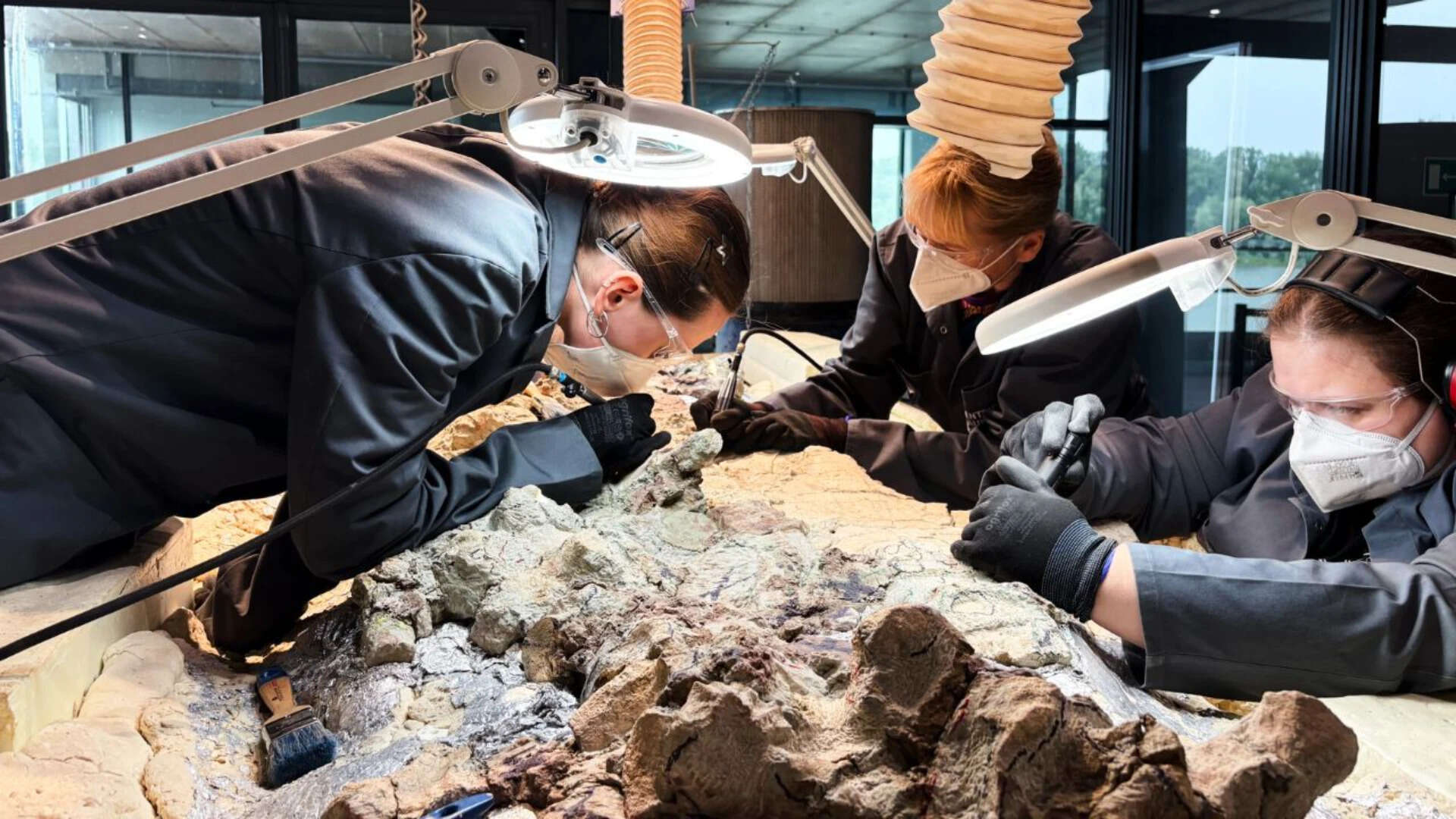
The discovery team spent months cleaning the matrix rock off the bones back in the lab, using delicate pneumatic chisels under microscopes. What they revealed was a remarkably preserved skull that preserved fine details of the jaw structure, sensory lines, and tooth attachment points.
How It Compares to Dinosaurs
People often mistake any large prehistoric creature for a dinosaur. It's an easy mistake to make, but Gaiasia predates the first true dinosaurs by nearly 50 million years.
To put that time gap in perspective:
- Gaiasia jennyae lived around 280 million years ago.
- The earliest dinosaurs appeared around 230 million years ago.
- Tyrannosaurus rex lived around 66 million years ago.
That means Gaiasia is further away in time from T. rex than T. rex is from us today.
While dinosaurs were land-dwelling reptiles with upright legs positioned under their bodies, Gaiasia was a sprawling, semi-aquatic stem tetrapod closely connected to the early bridge between fish and true land animals. It spent almost its entire life submerged in water because its heavy body couldn't handle long walks on dry land.
What to Keep in Mind About Ancient Predators
When reading about sensational fossil finds, it's easy to get caught up in the dramatic monster descriptions. But real paleontology is about ecological structure.
Here are three key takeaways to remember when evaluating Permian fossil updates:
- Size estimates are educated ranges: Weight figures like 2,865 pounds come from biomechanical scaling models based on skull dimensions and vertebral thickness. They aren't exact weights from a bathroom scale, but rather statistically solid estimates based on living analogs like giant salamanders and crocodilians.
- Gaps in the fossil record are real: Most fossil discoveries happen in places with easy access and good erosion. Huge areas of South America, Africa, and Antarctica haven't been fully explored for Permian fossils yet.
- Evolutionary trees change fast: A single big discovery in an unexpected region can disprove decades of assumed evolutionary pathways overnight.
If you want to track ongoing paleontology research, check published peer-reviewed studies directly in journals like Nature or follow updates from primary research institutions like the Field Museum in Chicago and the University of the Witwatersrand in South Africa. They regularly release open-access papers detailing these discoveries as fresh field seasons yield new bones.