Dirt does not care about fairness. It holds the rain, yields the corn, and absorbs the sweat of whoever works it, entirely indifferent to the bloodlines or birth orders of the people standing on top of it.
Yet in the American Midwest, dirt is never just dirt. It is a ledger of love, a scorecard of worth, and, far too often, the match that burns a family to the ground.
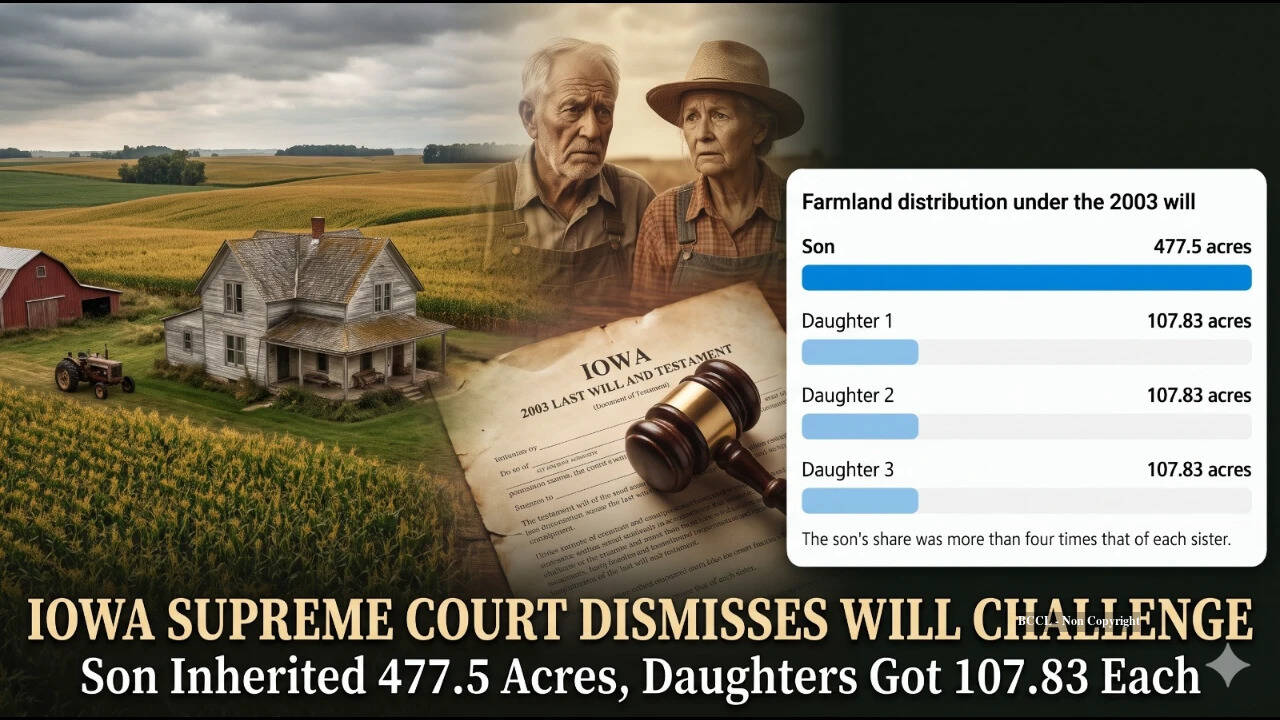
Consider a recent ruling out of the Iowa Court of Appeals, a decision that reads like dry legal boilerplate on paper but carries the heavy, unmistakable scent of diesel fuel, autumn harvest, and a fractured dinner table. At the center of the dispute was a family farm—roughly 691 acres of rich Iowa soil. When the patriarch died, his will did not split the empire down the middle. Instead, it awarded 477 acres to his son, leaving 107 acres each to his two daughters.
Four hundred and seventy-seven. One hundred and seven.
To an outsider looking at a spreadsheet, that math looks like a slap in the face. It looks like a relic from an era when women were expected to marry into someone else's acreage while the boy carried on the family name. The daughters challenged the will, arguing what grieving, blindsided children often argue when the numbers do not add up: that their father lacked the mental capacity to make such a lopsided choice, or that the brother had whispered in an aging man’s ear until the ink dried in his favor.
The Iowa court looked at the evidence, weighed the testimony, and said no. The will stands.
If you grew up anywhere near a grain elevator, you already know why that verdict feels both deeply unjust and entirely inevitable.
The Invisible Ledger of Sweat Equity
To understand why an Iowa judge upheld a four-to-one split of generational wealth, you have to step off the pavement and into the mud of how family farms actually survive.
I have watched this exact scenario play out across county lines for decades, sitting at kitchen tables covered in worn oilcloth while elderly parents try to solve an impossible math problem. Imagine a hypothetical family—let’s call them the Millers—to see how the trap is set long before a lawyer ever drafts a will.
Arthur Miller owns 700 acres. He has three children: Sarah, Claire, and David. Sarah moves to Chicago to become an accountant. Claire becomes a nurse in Des Moines. Both women call every Sunday, bring their kids home for Thanksgiving, and love their father fiercely. David, meanwhile, never leaves. He stays in the county. While his sisters are building 401(k)s and climbing corporate ladders in air-conditioned offices, David is earning a fraction of their salaries, waking up at four in the morning to pull a calf out of a snowbank, and sinking every spare dollar back into seed, fertilizer, and repairing a combine that breaks down every October like clockwork.
For thirty years, Arthur pays David just enough to keep the lights on in his modest farmhouse, promising him—sometimes out loud, sometimes through a silent nod across a tractor hood—that one day, the land will be his.
This is the concept farm transition planners call "sweat equity," though in practice, it feels more like an unwritten mortgage paid in decades of lost weekends and ruined knees. When Arthur finally dies, his estate is worth millions on paper. Yet there is almost no cash in the bank. Everything is tied up in the black soil beneath their boots.
If Arthur divides the 700 acres equally—233 acres each—David is finished. You cannot run a modern, commercially viable row-crop operation on a third of a farm unless you buy out your siblings. At current Iowa land values, where prime farmland regularly fetches ten to fifteen thousand dollars an acre, David would have to take on millions of dollars in debt just to buy back the very fields he has spent his adult life tending. He would have to sell the land to pay off his sisters, effectively liquidating the family farm to achieve "fairness."
So Arthur makes a brutal choice. He leaves the bulk of the acreage to the son who stayed, giving the daughters smaller parcels—enough to generate steady cash rent from a tenant farmer, enough to serve as a financial cushion, yet nowhere near equal.
Arthur thinks he is saving the farm. To Sarah and Claire, sitting in a sterile probate attorney's office weeks after the funeral, it feels like their father put a price tag on his children and decided their brother was worth four times as much.
When Equal Is Not Equitable
The legal battle in Iowa hinges on a distinction that tears families apart every single week in probate courts across the country: the difference between equal and equitable.
Under Iowa law—and the law of nearly every state in the union—a parent has the absolute right to be unfair. Let that sink in. Unless a spouse is being disinherited, the law does not require a parent to divide assets evenly among their children. A father can leave ninety percent of his estate to one child, ten percent to another, and nothing to a third, simply because he felt like it.
When a disgruntled heir walks into court to overturn an unequal will, they cannot simply point at the math and demand justice. They have to prove one of two things: lack of testamentary capacity or undue influence.
Proving a lack of capacity is a steep hill to climb. The challenger must show that at the exact moment the parent signed the will, they did not understand what they owned, who their natural heirs were, or what the document actually did. Memory lapses do not count. Asking the same question three times at lunch does not count. Even a formal diagnosis of early-stage dementia does not automatically void a will if the person had a lucid interval when the pen hit the paper.
Undue influence is even harder to pin down. It requires proving that the favored child effectively hijacked the parent’s free will, substituting their own desires for the parent’s true intentions. Simply taking care of an aging father, driving him to doctor appointments, or working alongside him every day does not constitute undue influence. In fact, courts routinely view that daily proximity as the exact reason a parent legitimately chose to leave that child more.
In the Iowa case involving the 477-to-107 split, the court looked at the whole picture. They examined medical records, witness testimony, and the history of the farm. When an adult child has spent years operating the farm, the legal system views a lopsided inheritance not as a symptom of manipulation, but as a rational business decision designed to keep an agricultural enterprise intact.
The law looks at logic. Families look at love. And the gap between the two is where inheritances go to die.
The Ghost in the Machine of Generational Wealth
There is a historical shadow hanging over every one of these disputes, and pretending it does not exist only makes the wounds fester longer.
For generations, American agriculture operated on a rigid, unspoken rule: the boys got the dirt, and the girls got the dishes. Even when daughters worked the fields alongside their brothers, drove grain trucks during harvest, and kept the farm's books, the assumption remained that the son was the true heir. When a daughter married, she became someone else's responsibility.
Today, women own or co-own nearly half of all farmland in the Midwest, often inheriting it as surviving spouses or through modern, egalitarian estate plans. Yet the cultural memory of that old bias is still fresh. When a modern daughter opens a will and sees she has been given 107 acres while her brother receives 477, she does not just see a modern farm-viability calculation. She sees the ghost of primogeniture. She sees a system that still quietly values a son's labor over a daughter's devotion.
Conversely, the son sees his sisters showing up at the eleventh hour to claim equity in a business they never had to bleed for. He remembers the years he could not afford a family vacation because the grain markets tanked, while his sisters posted photos from beaches and bought suburban homes with steady, predictable paychecks. To him, their demand for an equal third feels like someone asking for half the harvest after ignoring the planting and the weeding.
Both sides are entirely right. Both sides are completely blind to the other's reality.
The Silence That Kills Families
If you want to know the real villain in the Iowa court case, it is not the brother who took the 477 acres. It is not the sisters who sued him. It is the silence of the father while he was still alive.
Farmers are legendary for their stoicism. They will talk for three hours about tile drainage, soybean futures, and the hydraulic pressure on a John Deere planter, yet they will go to their graves without ever holding a forty-five-minute family meeting about what happens when they die.
The math of farm succession is unforgiving, but the psychology of it is entirely preventable. Consider what happens when a parent refuses to explain their reasoning while they are still sitting at the head of the table:
- The surprise turns into suspicion. When children learn about an unequal split for the first time from a lawyer's letter, their brains immediately search for a conspiracy. If Dad never mentioned giving David four times the land, then David must have coerced him when his mind started slipping.
- Grief gets weaponized. Instead of mourning their father together, the siblings channel their raw, unprocessed grief into depositions, subpoenas, and interrogatories. Every childhood slight is resurrected and entered into the court record.
- The farm bleeds cash anyway. Even when the favored heir wins in court—as the son did in Iowa—the victory is often hollow. Appellate litigation costs hundreds of thousands of dollars. Legal fees eat into the very operating capital the lopsided will was meant to protect, while the family name becomes gossip at the local coffee shop.
The tragedy is that a single, uncomfortable conversation five years earlier could have defused the bomb. Had the father sat his three children down and laid out the cold numbers—showing them the debt load, the slim profit margins, and the reality that dividing 691 acres three ways would force a public auction—the daughters might still have felt a sting. Nobody likes getting less. But they would have heard the reasoning from their father’s own mouth, while he was sharp, clear-eyed, and fully in command of his faculties.
How to Divide the Indivisible
Estate planning attorneys who specialize in agriculture will tell you that the worst way to treat your children fairly is to treat them equally. True fairness requires acknowledging different roles, different sacrifices, and different needs. Yet achieving it without triggering a civil war requires deliberate architecture, not a last-minute scribble on a standard will.
When a family business or a massive tract of land is the primary asset, smart planners separate ownership from management, or they use financial tools to balance the scales outside the dirt itself.
Life insurance is the classic equalizer. A parent can leave all 691 acres to the farming son, ensuring the operation survives intact, while naming the two off-farm daughters as the sole beneficiaries of a million-dollar life insurance policy. The son gets the dirt and the daily headaches; the daughters get tax-free cash they can invest however they please, without having to worry about hailstorms or interest rates.
Another path involves putting the land into a Limited Liability Company (LLC) or a family trust. Under this structure, all three children own equal shares of the entity, but the operating agreement gives the farming son a long-term, below-market lease and the right of first refusal to buy out his sisters over twenty years at a fixed, manageable interest rate. The daughters get a steady stream of passive income; the son gets operational control and a realistic path to full ownership without drowning in bank debt.
None of these solutions work, however, if the parent treats the estate plan like a state secret. Transparency is the only true antidote to a will contest. When a parent documents their rationale—sometimes even attaching a personal letter of instruction to the will explaining why the assets were divided unevenly—they strip away the oxygen that fuels undue influence lawsuits. A judge reading a clear, articulate letter written by a healthy parent five years before their death will almost never overturn the estate plan.
The Harvest That Remains
In the end, the Iowa Court of Appeals did what courts are designed to do. It looked at the statutes, reviewed the record, and honored the written wishes of a dead man. The son walked away with his 477 acres. The daughters walked away with their 107 acres each.
On a plat map, the lines are drawn cleanly. Every boundary is surveyed, every deed is recorded at the county courthouse, and the property taxes will be paid on time next spring.
Yet anyone who has ever driven past a farmstead where the siblings no longer speak knows that the court's ruling did not settle anything that truly matters. The tractors will still roll out of the machine shed in April. The corn will still push through the black dirt in May, indifferent to the lawyers' fees and the bitter testimony left behind in the courtroom. And three siblings will spend the rest of their lives looking at the exact same horizon, seeing entirely different worlds.