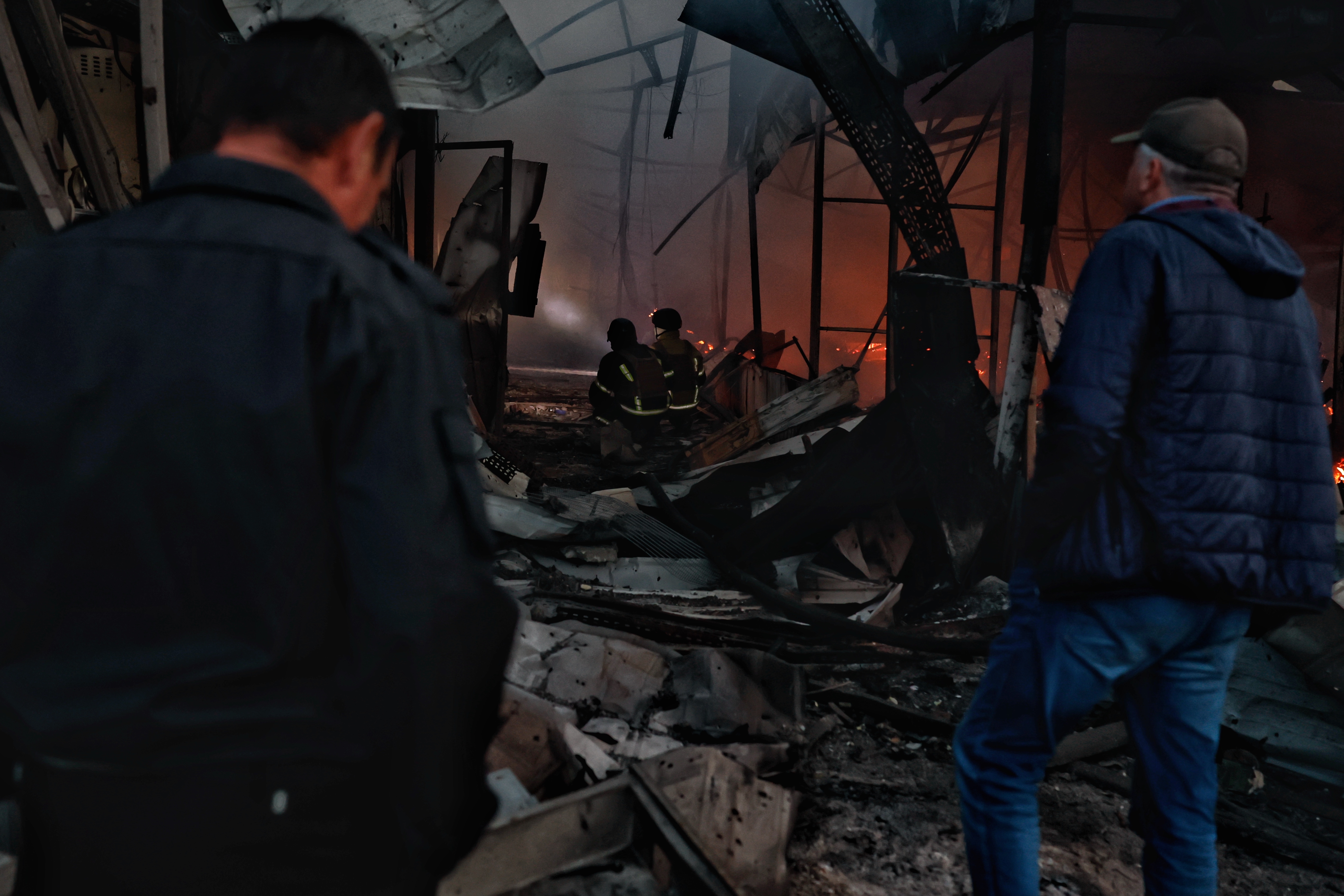
Another barrage has torn through Ukrainian urban centers, leaving at least eight dead and compounding the pressure on depleted anti-air batteries. President Volodymyr Zelensky has once again renewed urgent pleas for advanced air defense supplies. But looking past the immediate casualties reveals a deeper, grinding structural failure in how Western military aid is delivered, sustained, and rationed.
The mathematics of modern attrition are brutal. When Moscow fires a mixed package of cruise missiles, ballistic weapons, and loitering munitions, the financial and logistical burden falls disproportionately on the defender. Interceptors like Patriot or NASAMS batteries cost millions per unit. Standard cruise missiles produced domestically within sanctioned supply chains cost a fraction of that to manufacture. This economic asymmetry creates a slow-motion strangulation. Ukraine does not merely lack the raw hardware; it lacks the deep, industrial reserves required to sustain an enduring war of aerial attrition without continuous, unhindered replenishment. For another view, see: this related article.
The Interceptor Deficit
Western capitals often frame the debate around single numbers. They announce the delivery of one battery here or a dozen launchers there. These announcements play well on evening news broadcasts. They obscure the reality on the ground.
A battery is not a static shield. It is a complex ecosystem requiring continuous maintenance, specialized radar calibration teams, secure communication links, and, above all, a steady stream of ammunition. When a launcher expends its ready rack during a multi-wave night assault, reloading takes time. If the pipeline from allied stockpiles slows down due to political gridlock or bureaucratic inertia, those windows of vulnerability widen. Similar insight regarding this has been provided by Reuters.
Strategic command centers face agonizing choices during every major strike. Do you allocate scarce interceptors to protect critical energy infrastructure, or do you redeploy them to shield densely populated residential zones?
- Energy hubs keep hospitals running and populations warm.
- Residential zones absorb the immediate human cost of missed strikes.
There are never enough assets to cover both adequately. Every deployment decision is an exercise in triage.
The Industrial Lag
Why can factories in allied nations not simply ramp up production overnight? The answer lies in decades of post-Cold War downsizing. Defense manufacturing is not like turning out consumer electronics. It requires specialized rare earth metals, highly certified machinists, and multi-year supply chains for precision guidance components.
When production lines were scaled back in the 1990s and 2000s, the institutional knowledge went with them. Rebuilding that capacity takes years, not months. While defense contractors in the United States and Europe have signed multi-billion-dollar contracts to expand output, the delivery schedules stretching into the late 2020s do not match the urgency of today's radar screens.
Furthermore, the doctrine governing these weapons systems was never designed for protracted peer-to-peer conflict. Western air defense philosophy historically assumed complete air superiority achieved rapidly through offensive counter-air operations. Defending a massive geographic expanse against relentless saturation attacks from a stationary posture requires a fundamentally different capability set.
The Diplomatic Impasse
Zelensky's renewed appeals carry a distinct note of exhaustion. The diplomatic dance has become predictable. A major strike occurs. Civilian casualties mount. Condemnations are issued from foreign capitals. New promises of assistance are floated, debated, and eventually approved. Yet the physical arrival of the hardware lags months behind the political announcement.
This friction stems from the fear of escalation. Policymakers in Washington and Berlin constantly weigh the risk of direct confrontation against the moral imperative of saving lives. Every shipment of high-end military hardware is scrutinized for its potential to provoke a wider regional conflict.
This hesitation grants the aggressor a crucial strategic advantage. Initiative belongs to the side willing to absorb economic pain and mobilize its entire industrial base for war production.
The Human Toll Beneath the Sirens
Statistics sanitize violence. Eight dead sounds like a ledger entry. On the ground, it means shattered apartment blocks, unexploded ordnance resting in children's playgrounds, and emergency workers digging through concrete with bare hands because heavy machinery cannot reach the inner courtyards.
The psychological toll is equally corrosive. Constant sirens erode community resilience. Schools operate out of damp subway stations. Hospitals rely on humming diesel generators that threaten to fail at any moment.
Without a reliable shield against high-speed ballistic threats, Ukrainian cities remain giant firing ranges. The gap between what is promised in diplomatic communiques and what is delivered to frontline battery commanders is measured in human lives. Until that gap closes, the cycle of mourning and renewed appeals will continue, unbroken by changing seasons or shifting political tides.