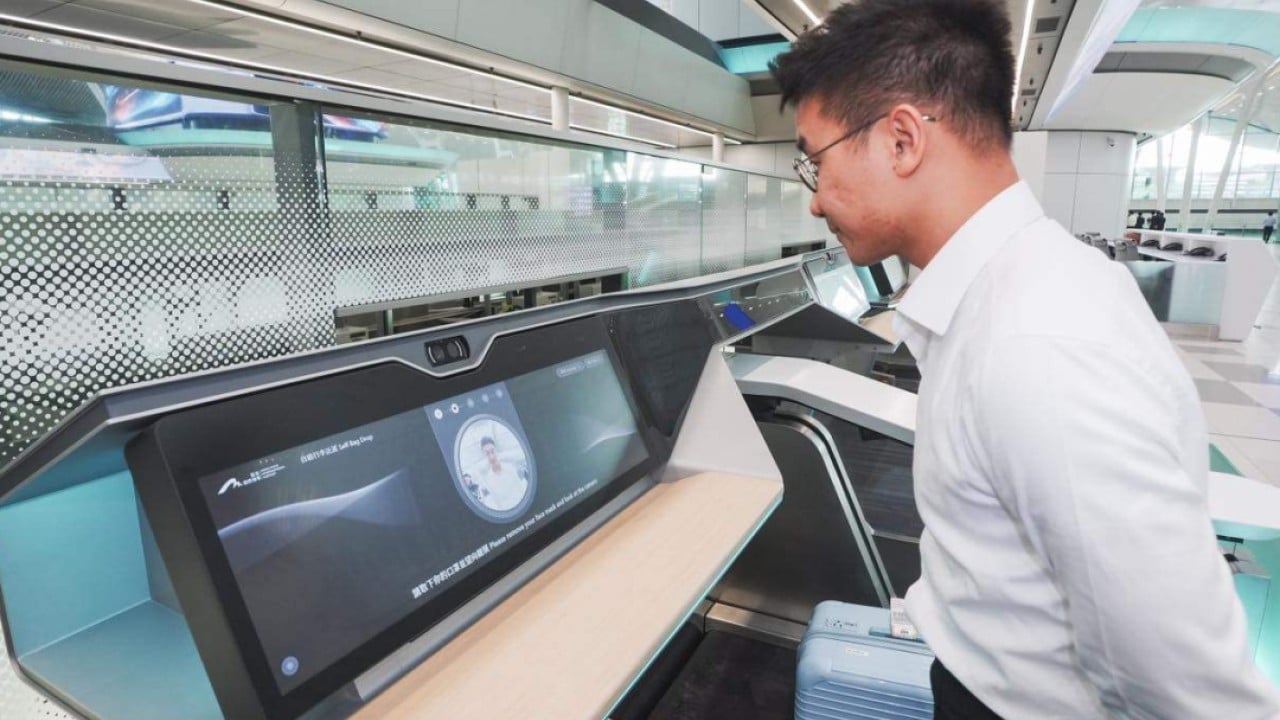
Hong Kong International Airport is betting its future on a lie. The blueprint for the rebuilt Terminal 2 promises an automated paradise where facial recognition, biometric gates, and autonomous baggage systems transport you from the curb to the cabin without human friction. Transport officials look at these digital blueprints and see efficiency.
They are looking at the wrong metrics.
The aviation industry suffers from a collective delusion that technological integration equals operational speed. It does not. Having audited transit infrastructure investments for over fifteen years, I have seen major hubs sink billions into biometric tracking only to watch their actual throughput stall. Terminal 2 is setting up to be a masterclass in this exact failure.
When you replace human adaptability with rigid digital gates, you do not eliminate lines. You merely shift where the bottlenecks happen.
The Myth of the Frictionless Journey
The standard industry pitch for smart terminals relies on a flawed premise: that the human element is the primary drag on airport capacity.
Look at the mechanics of an automated biometric gate. On paper, a camera scans your face, matches it to an e-passport, and opens the barrier in less than seven seconds. In a controlled testing lab with tech-savvy software engineers, this works beautifully.
In the real world, the system encounters reality. A traveler with a sleeping toddler, a passenger whose passport photo was taken ten years ago, or a tourist who simply freezes when the digital screen flashes an error message. When a human agent encounters these anomalies, they resolve them with cognitive flexibility in seconds. When an automated gate encounters them, the system halts.
What happens next? The passenger tries again. And again. Then a supervisor has to be called over from three lanes away to manually override the terminal. The seven-second transaction just became a three-minute blockade. Multiply that by thousands of passengers during a morning departure wave, and the entire multi-million-dollar concourse backs up into the retail zone.
We are spending billions to replace adaptive human labor with brittle, binary logic. The result is an illusion of progress that crumbles under the slightest operational stress.
Where the Dollars Actually Go
The rush to automate is rarely driven by genuine passenger data. It is driven by the capital expenditure trap.
Airports operate on long-term infrastructure cycles. It is incredibly difficult to secure budgets for boring, unglamorous fixes like expanding the physical footprint of a security hall or redesigning the tarmac layout to reduce taxi times. But slap the word smart or automated onto a proposal, and the capital funding flows freely.
Consider the financial reality of these deployments:
| Investment Type | Upfront Cost | Failure Point | Impact on Actual Speed |
|---|---|---|---|
| Biometric Smart Gates | Extremely High | Software glitches, lighting changes, user error | Negative to Neutral |
| Autonomous Baggage Sorting | Massive | Mechanical jams, tag misreads | Neutral |
| Expanded Physical Security Lanes | Moderate | Staffing shortages | Highly Positive |
The data from global hub upgrades over the last decade shows a troubling trend. When London Heathrow opened Terminal 5, its advanced baggage handling system famously collapsed on day one due to a mismatch between real-world baggage volumes and the software’s idealized processing algorithms. More recently, airports across Europe and the US that rushed to install advanced computed tomography (CT) security scanners found that while passengers no longer had to remove liquids, the machines themselves took longer to process each bag, resulting in longer lines, not shorter ones.
We are buying expensive toys to solve spatial problems.
The Privacy Tax and Systemic Fragility
There is a darker operational truth that airport executives refuse to discuss on the record: the massive data liability.
To run a fully biometric departure terminal, Hong Kong’s Terminal 2 must constantly capture, process, and cross-reference high-resolution facial scans with airline manifests and government databases. This requires an incredibly complex network architecture. Every connection point between an airline's check-in system, the airport's central server, and immigration control is a potential point of failure.
When an analog airport experiences a computer glitch, agents can still check passports, look at paper tickets, and keep the line moving. When a fully integrated digital terminal suffers a network outage or a software desynchronization, the entire operation grinds to an absolute halt. You cannot manually override ten thousand faces.
Furthermore, the operational friction of maintaining data compliance is a massive drag on resources. Cyber security protocols require constant patching, updates, and downtime. The infrastructure becomes so heavy that adapting to sudden changes—like a sudden shift in international entry requirements—takes months of software recoding instead of a simple morning briefing for the floor staff.
Dismantling the Premise of Efficient Tech
People frequently ask: Can we not just fix the software to make the airport faster?
This question misunderstands the nature of transit hubs. The constraint on airport efficiency is almost never the speed of the data processing; it is the physical laws of human movement and spatial geometry.
You can scan a passenger's face in half a second, but that does not change how long it takes an elderly traveler to lift a heavy carry-on bag into an overhead bin. It does not change the physical distance between the check-in desk and Gate 60. By focusing entirely on digital interfaces, airport planners are ignoring the physical realities of the terminal.
True efficiency comes from spatial simplicity. It comes from wide corridors, intuitive signage that does not require a smartphone to decode, and flexible staffing models that put human eyes where the chaos is happening.
If you want to speed up departures, stop buying facial recognition cameras. Build wider security checkpoints. Design baggage drop-offs that do not require a computer science degree to navigate. Fire the consultants who sell you dashboard software and hire more people to direct the crowds.
The smart airport of the future is not one filled with screens, scanners, and automated barriers. It is the one that understands that the fastest way to get from point A to point B is a straight line, not an algorithm.
Stop automating the bottlenecks. Eliminate them.