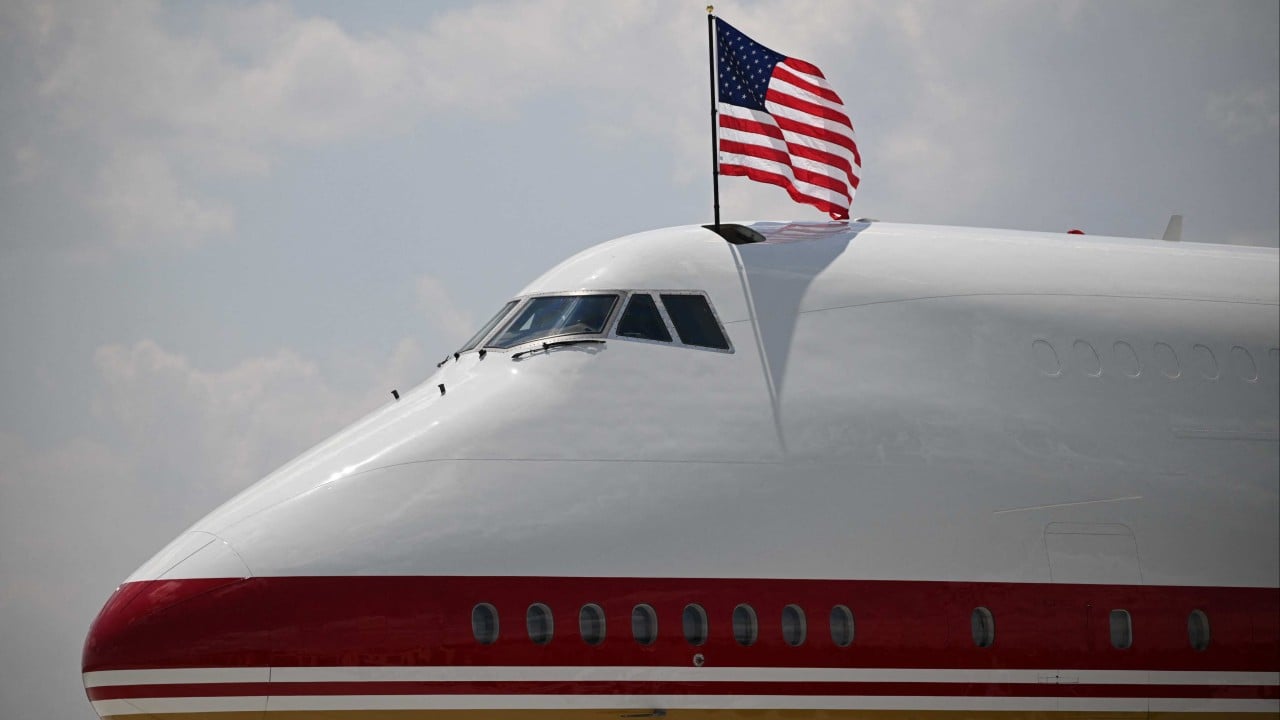
The tarmac at Palm Beach International Airport holds a humid glare that can make even the most solid objects look like a mirage. On a recent morning, two titans of aviation sat baking under that Florida sun, offering a stark, wordless study in contrasts.
On one side sat a Boeing 757, tail number N757AF. It is old. It is loud. It is wrapped in a deep, familiar livery of black, red, and white, with the word TRUMP emblazoned across the fuselage in massive, unmissable gold lettering. To aviation purists, it is an relic of a bygone era of commercial flight, a retrofitted 1990s workhorse kept alive by obsessive maintenance and sheer willpower. To its owner, Donald Trump, it is "Trump Force One"—a flying extension of his own brand, an aluminum castle complete with 24-karat gold-plated fixtures and silk-lined walls.
Just a short distance away sat the challenger. A sleek, pristine Boeing 737-800 BBJ. It carried no ostentatious branding. Its pedigree was royal, having previously served the state of Qatar. It was modern, efficient, and packed with the kind of state-of-the-art avionics that make pilots smile. It was, by every objective measure of modern corporate travel, the superior machine.
Then, without fanfare, the logistics shifted. The Qatari jet was quietly sidelined. The old 757 rumbled to life, its twin Rolls-Royce engines letting out that characteristic, earth-shaking whine. Trump was moving back to his old faithful.
This is not a story about aviation logistics. It is a story about the unseen gravity of human habit, the psychology of power projection, and what happens when modern efficiency collides with a worldview built entirely on branding.
The Relic and the Upgrade
To understand why a billionaire politician would ditch a newer, more efficient aircraft to climb back into a thirty-year-old cockpit, you have to look past the spec sheets.
Consider the sheer mechanics of the modern corporate jet. The Qatari-linked Boeing Business Jet represents the pinnacle of modern, medium-range VIP travel. It burns less fuel. It requires fewer maintenance hours per flight hour. It can land on shorter runways with ease, quietly slipping in and out of regional airports without drawing the eyes of the world. It is the choice of the modern global elite—subtle, high-performing, and friction-free.
But subtle is not a word in the Trump vocabulary.
The 757 is a different beast entirely. Originally designed in the late 1970s to fly high-density routes between major hubs, it is heavily overpowered. Pilots affectionately refer to it as the "flying pencil" or the "hot rod" of the skies because of its incredible climb rate. When those Rolls-Royce RB211 engines throttle up, you don't just hear it; you feel it in your sternum.
For a decade, that specific noise was the soundtrack to a political movement. It was the backdrop of the 2016 campaign, looming over airport hangars like a mechanical deity. When Trump stepped out of that specific door, framed by the massive gold letters, it was a carefully curated piece of political theater.
When the 757 was grounded for maintenance in New York, forcing a pivot to the smaller, white Qatari jet, something vital was lost in translation. The modern jet lacked the theater. It lacked the weight.
The Cost of Staying in Character
Every pilot knows that airplanes do not like to sit on the ground. Corrosion creeps into the wings. Seals dry out. Electronics grow finicky. For a long stretch, Trump’s 757 sat on a ramp at Stewart International Airport in Newburgh, New York, missing an engine and wrapped in protective plastic. Rumors swirled that the cost of bringing the old bird back to life was too high, that even for a man of immense wealth, the math simply didn’t work anymore.
The world had changed. Fuel prices fluctuated wildly. The aviation industry was moving toward whisper-quiet, ultra-efficient carbon-fiber composites. The Qatari jet represented that new world. It was a practical, plug-and-play solution for a heavy travel schedule.
But practical is a terrible narrative hook.
Imagine a luxury car collector who owns a brand-new, silent, autonomous electric sedan, yet chooses to drive a roaring, gas-guzzling 1970s muscle car to a crucial business meeting. The electric car is safer, smarter, and cheaper to run. But the muscle car tells the world exactly who he thinks he is.
The decision to swap back to the 757 is a testament to the power of nostalgia and the refusal to yield to efficiency. Bringing the old plane back into service required a massive investment: new engines, completely overhauled digital flight decks to meet modern FAA mandates, and thousands of hours of meticulous inspections. It was a logistical nightmare hidden behind a curtain of privacy.
The Invisible Stakes of the Tarmac
There is a unique loneliness to an empty airport ramp at midnight. For the crews who maintain these massive machines, the choice of aircraft isn't about politics or branding; it is about survival.
The aviation world is governed by rigid, unyielding physics. An older airframe requires a massive tail of support staff, specialized mechanics who know the quirks of a 1990s Boeing, and a steady supply of increasingly rare spare parts. When Trump chooses the 757 over the Qatari jet, he isn't just choosing a seat; he is choosing to mobilize an entire ecosystem of vintage aviation support.
Consider what happens next: every flight requires precise weight and balance calculations, massive fuel loads that dwarf the consumption of the smaller 737, and a conscious acceptance of operational constraints. The 757 cannot land just anywhere. It demands space. It demands attention.
And perhaps that is precisely the point. The Qatari jet, with its clean lines and anonymous white paint, allowed its passenger to slip through the sky unnoticed. For a man whose entire life has been an war against obscurity, anonymity is a fate worse than a high maintenance bill.
The roaring engines of the resurrected 757 are a declaration. The old plane is back because the old narrative requires it. As the sleek, efficient Qatari jet sits silent in the background, a relic of modern pragmatism, the loud, gold-lettered castle ascends once more into the clouds, burning through the sky on a tank full of premium fuel and pure nostalgia.