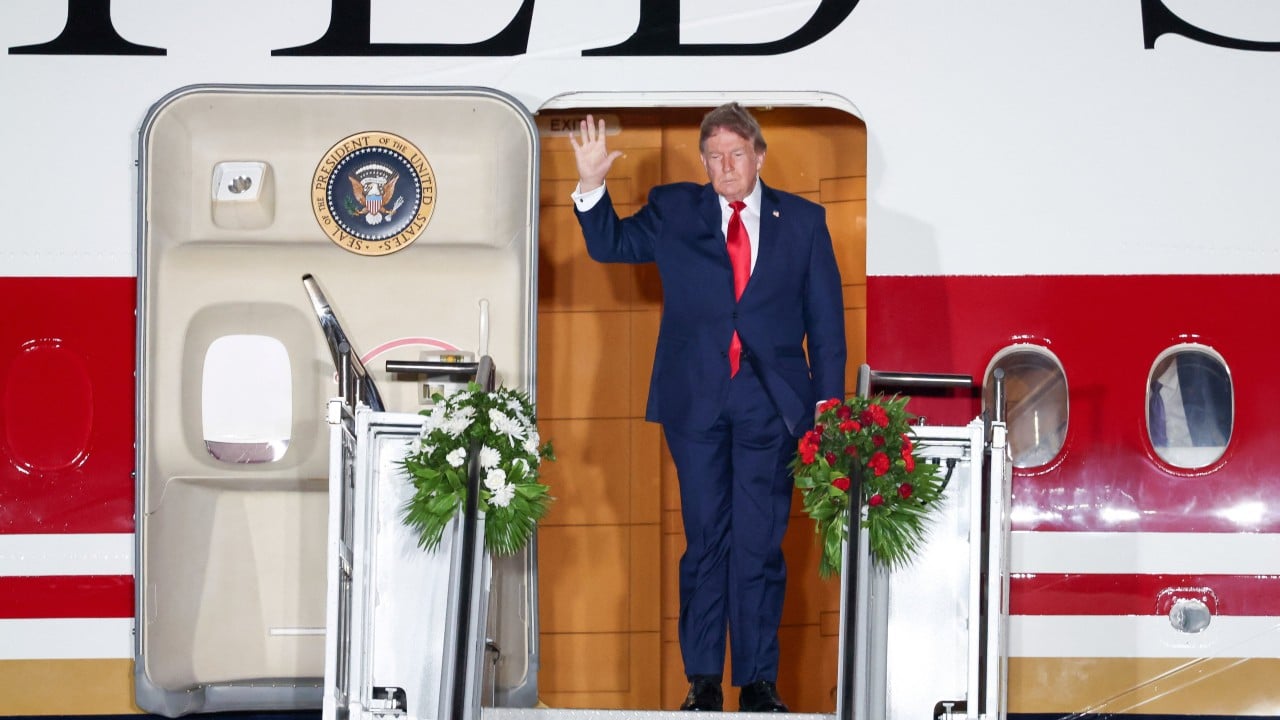
When President Donald Trump touches down in Shenzhen for the 2026 Asia-Pacific Economic Cooperation summit, the resulting optical collision will define modern geopolitics far better than any trade communique ever could. On one side sits the undisputed global capital of battery-powered mobility, a metropolis where BYD and its domestic rivals have turned internal combustion engines into a shrinking minority on city streets. On the other sits the American presidential motorcade, led by a diesel-guzzling, nine-ton armored limousine known as the Beast, arriving alongside the massive, four-engine Air Force One. It is a literal clash of industrial philosophies—heavy American steel and fossil-fuel brute force rolling directly into the heart of China’s green-tech supply chain.
Most coverage of presidential travel treats the logistics as mere background noise, a checklist of Secret Service protocols and diplomatic pageantry. That misses the real story. The machinery moving the American president around southern China is an intentional projection of industrial power, yet its arrival in Shenzhen exposes the widening technological and ideological fault lines between Washington and Beijing. Understanding why this specific hardware matters—and what is actually rolling down the tarmac—requires stripping away the surface-level spectacle and looking at the engineering, procurement delays, and industrial policy underneath.
The Heavy Metal Reality of the Presidential Fleet
To appreciate the sheer physical contrast hitting Shenzhen Bao’an International Airport, you have to look at the specifications of the vehicles involved. The presidential state car, operated by the United States Secret Service and built by General Motors under a specialized government contract, is not a modified luxury sedan. It is a heavy-duty commercial truck chassis disguised as a Cadillac.
Weighing between 15,000 and 20,000 pounds—roughly four times the mass of a standard full-size SUV—the Beast is engineered to survive ballistic impacts, chemical attacks, and improvised explosive devices. Moving that much armor requires immense low-end torque and absolute mechanical reliability in austere conditions. Consequently, the vehicle relies on a massive, traditional internal combustion engine—specifically a heavy-duty Duramax diesel powerplant—paired with run-flat, Kevlar-reinforced tires. Range anxiety is not an acceptable risk when extracting a head of state from an active threat zone.
The aircraft carrying the president presents an equally stark contrast to Shenzhen's obsession with ultra-high-efficiency propulsion. For decades, the call sign Air Force One has been synonymous with the VC-25A, two heavily modified Boeing 747-200B airframes that entered service in 1990. Those aging four-engine jumbos have long been slated for replacement by the VC-25B, a pair of converted Boeing 747-8i aircraft equipped with upgraded defensive systems, hardened electronics, and modern General Electric GEnx engines.
The Procurement Drag Behind the New Jets
Yet the phrase "new Air Force One" carries a complicated reality that defense analysts know well. Boeing’s fixed-price contract to deliver the two VC-25B jets has been plagued by supply chain bottlenecks, engineering rework, security clearance shortages, and billions of dollars in cost overruns. Originally scheduled for delivery in 2024, the timeline slipped repeatedly into 2027 and 2028, prompting intense pressure from the White House and the Air Force to accelerate the schedule or explore interim alternatives.
Whether the president steps off a delayed VC-25B airframe or one of the veteran VC-25A workhorses in November 2026, the aviation footprint remains decidedly heavy metal. A 747 burns roughly 3,000 to 4,000 gallons of jet fuel per hour. Alongside the primary presidential jet, a fleet of Boeing C-17 Globemaster III military cargo planes must fly ahead to haul the Beast, spare limousines, communication vans, and Marine One helicopters into southern China.
It is a logistical footprint measured in hundreds of tons of aviation fuel and diesel. And it is landing in a city that has spent the last fifteen years systematically eliminating tailpipes.
Inside Shenzhen’s Electric Fortress
Shenzhen is not merely a participant in the electric vehicle transition. It is the undisputed command center of the global EV supply chain.
Headquartered in the city's Pingshan District, BYD—Build Your Dreams—has grown from a modest mobile phone battery manufacturer in the 1990s into the world’s largest seller of plug-in vehicles, overtaking Tesla in global battery-electric volume and dominating China’s domestic auto market. By 2017, Shenzhen had already become the first major city on earth to electrify 100 percent of its public bus fleet—more than 16,000 vehicles—followed shortly thereafter by its entire fleet of over 21,000 taxis.
Today, walking the wide boulevards of Futian or Nanshan feels remarkably quiet. Green license plates, which designate new energy vehicles in China, outnumber traditional blue plates across vast stretches of the urban core. Charging hubs capable of pushing hundreds of kilowatts into lithium-iron-phosphate (LFP) blade batteries sit beneath highway overpasses and inside shopping mall basements.
| Metric | Presidential Motorcade (The Beast) | Shenzhen Urban Mobility Standard (BYD) |
|---|---|---|
| Propulsion System | Heavy-duty turbo-diesel V8 | Blade LFP battery-electric / DM-i hybrid |
| Vehicle Curb Weight | 15,000 to 20,000 lbs (armored) | 3,800 to 5,200 lbs (passenger/fleet) |
| Primary Design Priority | Ballistic survival and autonomous range | Thermal efficiency, cost scale, and fast charging |
| Energy Infrastructure | Dedicated military fuel tankers | Public megawatt-scale DC fast-charging grids |
| Manufacturing Philosophy | Bespoke, low-volume defense contracting | Vertically integrated mass automation |
The contrast is more than aesthetic. It represents two fundamentally different theories of industrial survival.
Why Batteries Cannot Power a Presidential Limousine
A common talking point among clean-tech enthusiasts is that the U.S. government should electrify the presidential fleet to signal commitment to modern engineering. That argument collapses the moment you examine the physics of armored protection.
Batteries are heavy. A standard commercial electric pickup truck carries a battery pack weighing roughly 1,800 to 2,900 pounds just to move a 6,000-pound unarmored frame 300 miles. If you attempt to wrap that vehicle in five inches of military-grade steel, ceramic composites, and multi-layered ballistic glass—plus an independent oxygen supply, night-vision optics, and encrypted satellite communications—the curb weight skyrockets past nine tons.
To move a nine-ton electric limousine at highway speeds while running continuous electronic countermeasures and climate control, you would need a battery pack weighing nearly two tons on its own. That creates a punishing weight spiral:
- Added battery mass demands heavier suspension components, larger brakes, and thicker structural framing.
- Increased total weight degrades acceleration and off-road capability if the motorcade has to jump a curb or push through a blockade.
- Thermal runaway risks present an unacceptable vulnerability under ballistic or explosive attack, as punctured lithium-ion cells can ignite into self-sustaining chemical fires that conventional suppression systems struggle to extinguish.
Diesel fuel, by contrast, packs an energy density roughly forty times higher per kilogram than current lithium-ion chemistry. A full tank of diesel can be refilled in under four minutes from an accompanying Secret Service support truck, keeping the vehicle operational indefinitely without relying on local electrical grids—especially in a foreign adversary's territory where plugging a presidential asset into municipal infrastructure is an obvious cybersecurity non-starter.
The Geopolitical Subtext of the Tarmac Arrival
When Beijing selected Shenzhen to host the November 2026 APEC Economic Leaders’ Meeting, the choice was anything but accidental. Historically, China has favored Beijing or Shanghai for major diplomatic summits. Putting the world’s top economic leaders—including the President of the United States—inside Shenzhen is a calculated flex of technological sovereignty.
Four decades ago, Shenzhen was a cluster of fishing villages and agricultural communes across the border from Hong Kong. Designated as China’s first Special Economic Zone in 1980, it became the workshop of the world, assembling cheap electronics and garments for Western brands. By bringing APEC to Shenzhen in 2026, Chinese leadership is forcing foreign delegations to confront what the city has become: an indigenous innovation powerhouse that no longer relies on Western intellectual property to build world-leading hardware.
Tariffs, Supply Chains, and Industrial Friction
The timing of this arrival lands squarely atop an intensifying trade and industrial standoff. Washington has erected steep tariff walls—reaching 100 percent on Chinese electric vehicles—alongside strict domestic content rules designed to keep Chinese batteries, critical minerals, and connected vehicle software out of the North American market. The core argument from American policymakers is twofold: Beijing’s state subsidies have created massive industrial overcapacity that threatens Western manufacturing, and modern connected vehicles are essentially rolling sensor platforms capable of harvesting sensitive geospatial and communications data.
Rolling the Beast through Shenzhen’s streets puts the physical manifestation of both arguments on full display.
On one hand, the American delegation relies on legacy aerospace and heavy-automotive manufacturing—sectors where the United States still commands unmatched military and heavy-lift superiority, even as commercial competitors close the gap. On the other hand, the convoy will pass directly past factories, research campuses, and showrooms operated by BYD, Huawei, and DJI—companies that represent China’s successful push up the value chain into high-margin, high-tech manufacturing.
Even the route from the airport to the summit venues underscores the divergence. The Secret Service routinely sweeps motorcade routes for radio-frequency interference, cellular tracking, and remote detonation threats. In Shenzhen, those protective details will operate inside one of the most densely networked smart-city environments on the planet, where autonomous delivery vans, vehicle-to-infrastructure traffic sensors, and 5G-connected EVs constantly broadcast telemetry.
What Detroit and Washington Actually Watch For
Behind the closed doors of the summit, trade negotiators will debate tariffs, semiconductor export controls, and agricultural purchases. Yet for automotive and defense analysts watching the footage from Shenzhen, the real takeaway has nothing to do with diplomatic speeches.
Detroit’s legacy automakers—General Motors, Ford, and Stellantis—are currently locked in an existential struggle to build profitable electric vehicles without relying on Chinese battery components or LFP cell licensing. They are trying to fund that transition using profits generated by high-margin, heavy-duty pickup trucks and large SUVs—the exact mechanical cousins of the chassis underneath the Beast.
Meanwhile, Shenzhen’s industrial ecosystem has moved past the question of whether electric drivetrains can compete with internal combustion. Chinese automakers have already shifted the battleground to solid-state battery prototypes, 1,000-volt charging architectures, and end-to-end autonomous driving software priced for mass-market sedans rather than luxury flagships.
When Air Force One’s engines spool down on the Shenzhen tarmac and the Beast rolls out of the C-17 cargo hold onto Guangdong asphalt, the cameras will capture a striking visual paradox. America’s most protected leader will travel in a fortress powered by twentieth-century combustion technology, surrounded by an escort of gas-burning SUVs, moving through a twenty-first-century metropolis that has largely left the internal combustion engine behind. Neither side is blinking, and neither industrial model is backing down.