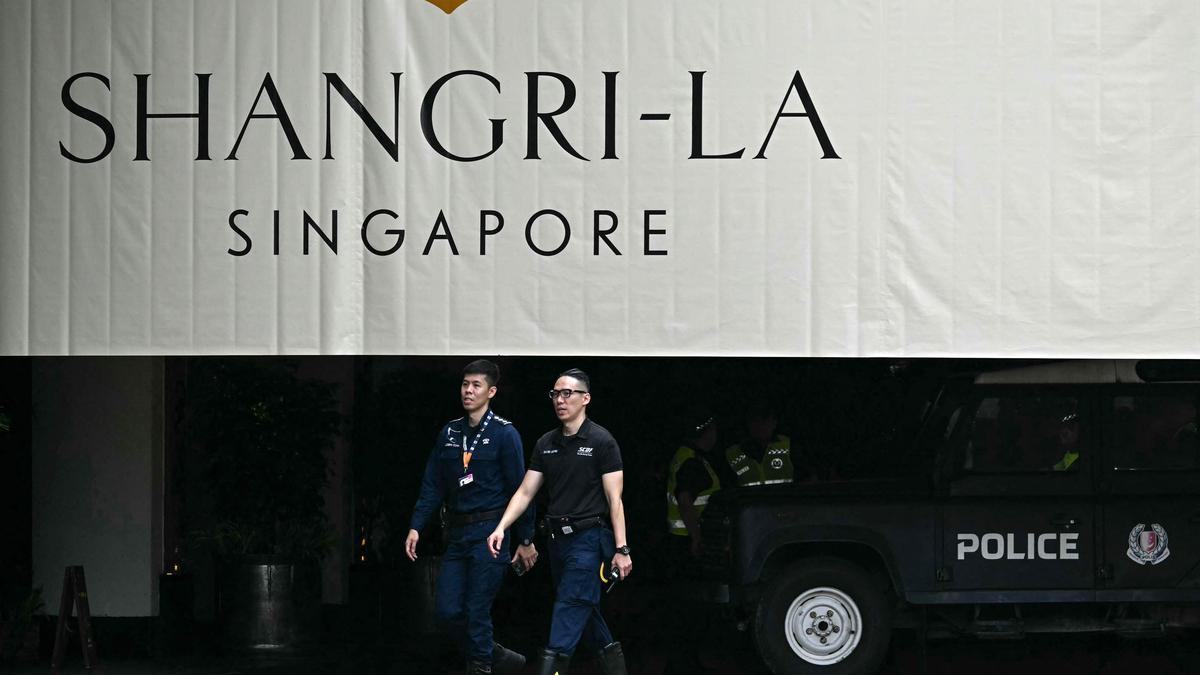
Beijing's decision to withhold Defence Minister Dong Jun from the 2026 Shangri-La Dialogue and instead deploy an academic delegation led by Major General Meng Xiangqing of the National Defense University signals a structural shift in how China manages regional security tensions. By replacing top-tier executive representation with defense scholars, the People’s Liberation Army (PLA) is implementing an asymmetric diplomatic framework. This strategy minimizes direct operational accountability while maximizing doctrinal influence. To understand this tactical realignment, it is necessary to examine the structural mechanics of state-level interactions, the logic of strategic insulation, and the calculated divergence between American and Chinese military diplomacy.
The Structural Mechanics of Institutional Representation
The choice of personnel sent to an international forum dictates the functional parameters of the interaction. When a state sends its defense minister, the communication mechanism is operational, executive, and binding. When a state sends military scholars, the mechanism shifts to intellectual, non-binding exposition.
The 2026 delegation is comprised of figures from three distinct institutional pillars:
- The PLA National Defense University (NDU): The core center for senior officer professional military education, responsible for formulating strategic theory.
- The Academy of Military Sciences (AMS): The premier research entity that develops military doctrine, warfighting concepts, and defense policy frameworks.
- The PLA Navy (PLAN) Academic Cohort: Specialized maritime scholars focused on legal and operational arguments regarding the South China Sea and Taiwan Strait.
The functional outcome of this composition is the decoupling of policy exposition from state accountability. By utilizing Major General Meng and his peers, Beijing can present its regional security initiatives without subjecting its military leadership to the friction of binding, face-to-face negotiations with counterparts like US Defense Secretary Pete Hegseth.
The Strategic Cost Function of Ministerial Absence
The decision for Minister Dong Jun to skip the summit for a second consecutive year can be modeled through a cost-benefit calculation based on risk mitigation and asymmetric diplomatic leverage.
1. Minimizing Friction and Asymmetric Accusations
A defense minister operating at a multilateral forum is exposed to public questioning regarding live operational theater issues, such as maritime encounters in the Second Thomas Shoal or airspace incursions near Taiwan. An academic delegation possesses an institutional shield; they can respond to specific operational critiques by retreating to grand strategy principles, citing the Global Security Initiative (GSI) rather than defending individual tactical encounters.
2. Operational Asymmetry in Bilateral Accountability
With US Defense Secretary Pete Hegseth scheduled to speak, a ministerial-level meeting would create a structural expectation of reciprocity or de-escalation protocols. By sending scholars, Beijing alters the diplomatic payoff matrix. Hegseth cannot extract operational concessions or establish concrete crisis-communication hotlines with a university professor or a naval researcher. This creates an institutional bottleneck that freezes functional military-to-military integration while maintaining an overture of dialogue.
3. Preservation of Strategic Timeline Leverage
Following the recent Trump-Xi summit, where state media emphasized "constructive strategic stability," Beijing's priority is to preserve domestic industrial and technological capitalization while avoiding premature operational friction. Sending scholars allows China to project a status quo of "openness and inclusiveness" without binding its fleet operations or strategic rocket forces to international oversight.
The Ideological Versus Operational Blueprint
The deployment of defense scholars serves an analytical function: the propagation of the Global Security Initiative as an alternative security architecture for the Asia-Pacific. This operational blueprint relies on two distinct messaging layers.
                  [ Beijing's Diplomatic Layer ]
                                 │
          ┌──────────────────────┴──────────────────────┐
          ▼                                             ▼
[ Core Normative Narrative ]                  [ Structural Objective ]
 - Indivisible Security                        - Delegitimize U.S. Alliances
 - Anti-Unilateral Arbitrage                   - Displace Minilateralism (AUKUS)
The core normative narrative is built around the concept of "indivisible security," an idea that rejects external alliance systems like AUKUS or the Quad, framing them as forms of unilateral arbitrage that destabilize regional systems. The structural objective of the academic delegation is to socialise these concepts among middle-power nations in attendance, such as ASEAN members, arguing that regional stability is best maintained via consensus-based frameworks rather than integrated deterrence networks led by the United States.
While the US delegation relies on operational metrics—such as the frequency of joint exercises, radar integration, and shared anti-submarine patrols—the Chinese scholar delegation operates on doctrinal positioning. They seek to shift the burden of regional escalation onto Western alliance systems by presenting Chinese naval expansion as a defensive necessity driven by external containment strategies.
Strategic Realignment and Institutional Limits
The limitation of using academic diplomacy is the rapid depreciation of trust among states experiencing direct physical friction with China's armed forces. Academic assertions of "mutual trust and consensus" conflict directly with the empirical reality of gray-zone operations in maritime corridors. For states like the Philippines or Vietnam, the deployment of scholars rather than decision-makers signals that Beijing views the Shangri-La Dialogue as a theater for narrative management rather than a venue for resolving conflicting structural claims.
Furthermore, this institutional insulation confirms that China prefers its internal venues, such as the Xiangshan Forum, for high-level military-to-military engagement where it can control the agenda and format. The choice to down-spec the Shangri-La delegation highlights a calculated assessment that the forum's structural environment favors Western security models, making it a venue for narrative containment rather than binding diplomacy.
Regional defense planners must evaluate China’s participation not by the rhetoric of its academic emissaries, but by the structural divergence between its academic diplomacy and its operational deployment schedules. The presence of scholars in Singapore guarantees that dialogue continues, but it simultaneously ensures that the structural friction points driving Indo-Pacific competition remain unaddressed. The immediate strategic response for allied networks is to maintain open academic channels while recognizing that genuine operational stabilization will require direct engagement with the Central Military Commission, bypassing the scholarly vanguard entirely.