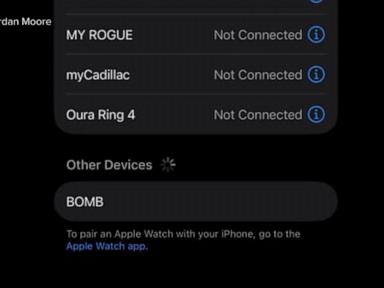
Commercial aviation operates on an asymmetric risk model where the cost of a false positive is measured in tens of thousands of dollars, while the cost of a false negative is catastrophic. When United Airlines Flight 236 en route from Newark to Palma de Mallorca executed a 180-degree turnaround over the Atlantic Ocean, the catalyst was not a mechanical failure or a physical breach, but a data packet: a local Bluetooth broadcast containing the four-letter string "BOMB."
This incident exposes a critical vulnerability in modern aviation security protocols. The system is designed around physical checkpoints, leaving a structural blind spot for localized digital signals that can mimic threat vectors and force an operational shutdown.
The Tri-Stage Threat Escalation Matrix
Aviation security operates under a rigid, multi-layered framework designed to handle threats systematically. When a local signal disrupts a flight, it triggers three distinct operational phases.
Phase 1: Local Discovery and Verification Failure
The initial breakdown occurs at the cabin level. A passenger or crew member detects a high-risk Service Set Identifier (SSID) or Bluetooth network name. Because consumer electronics broadcast locally using omnidirectional radio frequencies, pinpointing the specific physical coordinates of a single active node within a pressurized aluminum tube is mathematically complex without dedicated signal-triangulation hardware.
The flight crew is forced to rely on manual compliance. On Flight 236, the cabin crew issued repeated directives for all passengers to deactivate Bluetooth broadcasting. This intervention introduces two immediate failure points:
- The Compliance Gap: Non-technical or sleeping passengers fail to comply, leaving multiple active devices online.
- The Anonymity Loophole: The architecture of Bluetooth pairing protocols allows a device to remain discoverable and broadcast an custom name without requiring active data transmission or revealing its owner.
Phase 2: Centralized Decision Mechanics
Once local mitigation fails and multiple devices remain active, the decision-making authority shifts from the cockpit to the airline’s centralized operations center—in this case, United’s headquarters in Chicago. This transition follows a strict cost-benefit function.
The decision to turn back a Boeing 767 carrying 190 passengers and 12 crew members approximately three hours into an eight-hour transatlantic flight incurs massive financial penalties, including fuel burn, crewing limits, and passenger compensation. However, the corporate risk calculation is dictated by legal liability and regulatory directives. When a threat vector cannot be definitively isolated or disproved in mid-air, corporate protocols mandate a return to the nearest viable hub.
Phase 3: Ground-Level Containment and Sweeping Protocols
Upon landing back at Newark Liberty International Airport, the aircraft enters a high-security containment protocol. The systemic response is non-negotiable:
- Isolation: The aircraft is taxied to a remote deplaning area to protect core airport infrastructure.
- Evacuation: All 202 individuals are removed via mobile airstairs to eliminate potential human shields or casualties.
- Physical Deconstruction: Port Authority police, the TSA, and Customs and Border Protection conduct a systematic sweep of the passenger cabin, avionics bays, and cargo holds.
- Identity Re-Verification: Every passenger undergoes secondary screening to re-establish the integrity of the flight manifest.
The Economics of a Digital False Positive
The operational math of a transatlantic diversion reveals why airlines are aggressive with safety protocols, yet highly vulnerable to digital disruption. The financial penalty of Flight 236's U-turn can be quantified across four primary cost centers.
Total Diversion Cost = Jet Fuel Burn + Crew Duty Exceedances + Airport Handling Fees + Passenger Compensation
Jet fuel represents the largest immediate loss. A Boeing 767-300ER burns roughly 1,600 gallons of fuel per hour. Forcing a 4.5-hour round-trip back to the origin point wastes over 7,000 gallons of aviation fuel before the actual journey even resumes.
The second limitation is crew duty time. Federal Aviation Administration (FAA) regulations enforce strict flight time limitations and rest requirements. A 4.5-hour mid-air diversion completely exhausts the legal operational window of the initial 12-person crew. The airline must source, clear, and deploy an entirely new replacement crew, causing a compounding 9.5-hour delay to the final arrival time in Spain.
The Vulnerability of local Wireless Protocols in Secure Spaces
The root cause of this operational vulnerability lies in the fundamental design of consumer wireless protocols. Bluetooth and Wi-Fi Direct were engineered for frictionless connectivity, not for operating within high-security, high-density environments.
+------------------------------------+
|       Open Broadcast Layer         | -> No authentication required to broadcast custom string
+------------------------------------+
|       Receiver Identification      | -> Any device within 30-100 feet caches and displays name
+------------------------------------+
|   Security Framework Disconnect   | -> TSA checks physical items; cannot audit active software state
+------------------------------------+
A dynamic network name is entirely unvetted. A user can alter a device's broadcast name to any alphanumeric string instantly. Because standard commercial aircraft lack localized signal-intelligence tools to map internal radio frequencies to specific seat coordinates, a malicious or negligent actor can exploit this architectural gap to create a phantom threat vector.
The security apparatus faces a fundamental mismatch: the TSA screens physical items at the perimeter, but cannot control the software state or broadcasting behavior of a device once it passes the gate. When a 16-year-old passenger's wearable fitness tracker broadcasts a high-risk word, the system cannot distinguish between a digital joke and an active threat without triggering a full ground evacuation.
Airlines must establish rigid operational boundaries for local wireless infrastructure. The current protocol—relying on verbal commands for passenger compliance—is a systemic failure point. Until aircraft are retrofitted with localized spectrum analyzers capable of instantly mapping and isolating active RF signals to specific cabin rows, the industry remains structurally vulnerable to anyone with a smartphone and a basic understanding of network settings. The strategic imperative for carriers is clear: transition from manual passenger policing to automated signal isolation, or continue to absorb the massive financial liabilities of digital false positives.