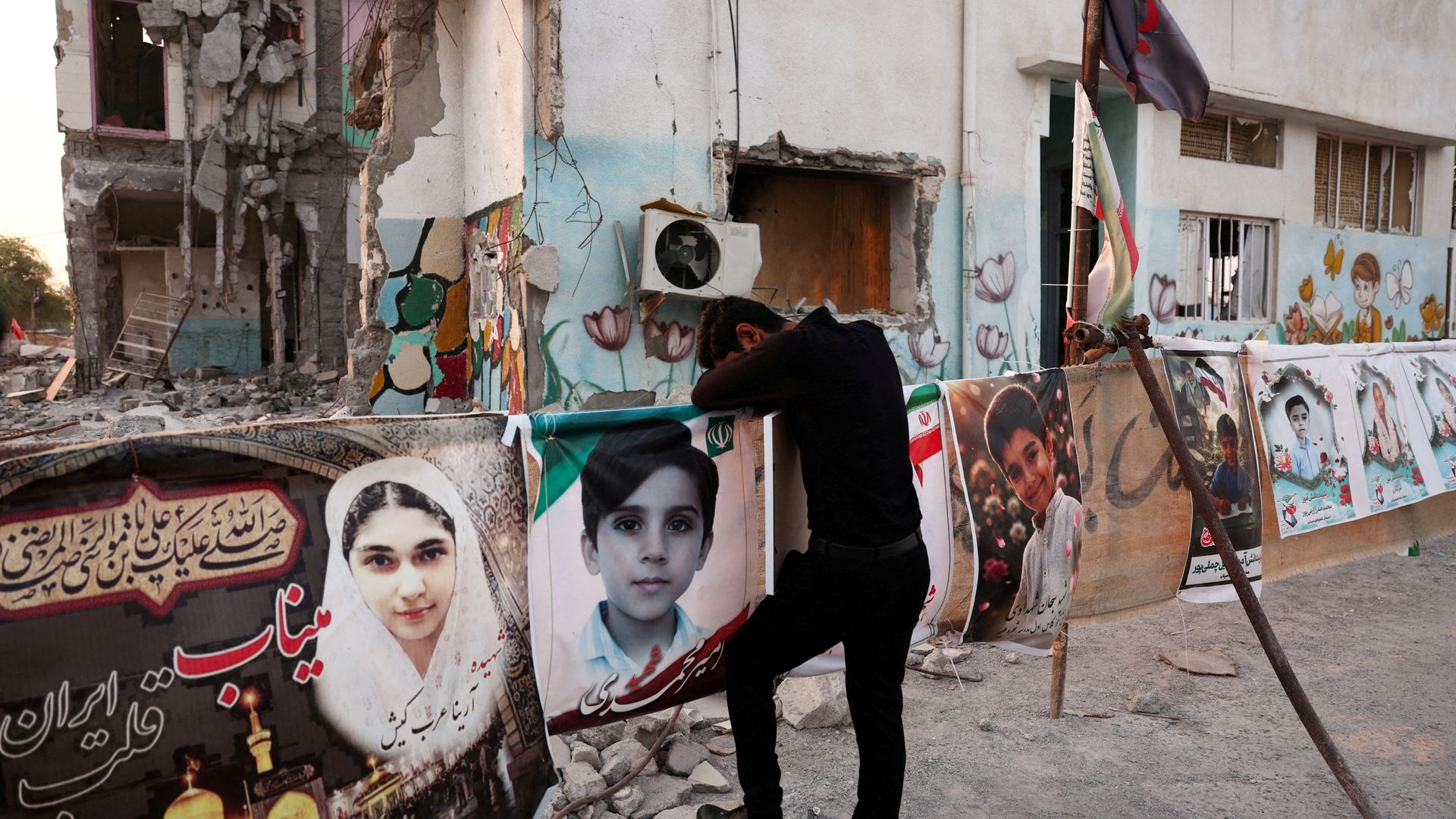
Independent human rights investigators mandated by the United Nations released a stark legal assessment stating there are reasonable grounds to conclude that United States military operations committed war crimes during a high-profile strike on an elementary school in Minab, Iran. The findings, published following extensive field analysis, satellite imagery verification, and witness testimony collections, pierce through the diplomatic shields typically deployed during modern high-technology military campaigns. They draw a hard line between tactical necessity and violations of international humanitarian law.
The incident in question occurred during joint air operations executed by the United States and Israel. On the morning of February 28, a volley of precision-guided munitions struck the Shajareh Tayyebeh school complex in the southern Iranian city. Because Saturday functions as a standard school and workday in Iran, the facility was fully occupied. The resulting structural collapse killed scores of children and civilian teachers, turning an ordinary morning classroom session into a historic mass casualty site.
For months following the explosion, institutional accountability drifted through a maze of bureaucratic denials and internal investigations. United States Central Command initially offered broad assurances that all operations adhered strictly to the law of armed conflict, though military officials later acknowledged that an internal inquiry had been opened specifically into the Minab strike. Yet, external investigators emphasize that official defense mechanisms routinely fail to reconcile the gap between declared intent and actual collateral wreckage on the ground.
The UN-backed fact-finding mission, chaired by jurist Sara Hossain, scrutinized the mechanics of the attack. According to their published dossier, the evidence gathered points directly to an indiscriminate strike vector. Investigators evaluated weapon signatures, missile trajectory metrics, and the geographical isolation of the targeted school building from legitimate military infrastructure. Their conclusion asserts that the United States military directed munitions at a protected civilian object while acting with reckless disregard for the substantial risk of civilian loss of life.
This legal determination places immense pressure on long-standing assumptions regarding algorithmic targeting and automated reconnaissance systems. Modern defense networks increasingly rely on automated data-processing pipelines to accelerate target validation. When intelligence architecture prioritizes speed over exhaustive manual verification, the margin for catastrophic error expands exponentially. Critics and human rights advocates have repeatedly warned that integrating advanced artificial intelligence models into military target-tagging chains creates an opaque layer of accountability avoidance. When a machine-suggested target results in a civilian catastrophe, tracing the chain of culpability from the software developer to the combatant commander becomes an institutional labyrinth.
Furthermore, the geopolitical fallout of the UN report extends far beyond a single legal condemnation. The investigation document did not isolate American conduct in a vacuum; it ran parallel to severe indictments of the Iranian government's domestic crackdown on civil protests, characterizing the state's internal violence as systemic crimes against humanity. This dual-track finding highlights a grim reality for civilian populations caught in the crosshairs of authoritarian repression abroad and high-technology intervention from outside powers. Citizens find themselves crushed between the internal machinery of state terror and the collateral fallout of foreign air campaigns.
Diplomatic engagement with the findings has broken down along predictable ideological fault lines. Representatives for Washington dismissed the UN conclusions as politically motivated while maintaining that ongoing internal reviews remain the appropriate mechanism for handling operational errors. Meanwhile, Iranian authorities have leveraged the international report to amplify diplomatic condemnation, even as domestic human rights violations committed by Tehran continue to draw global censure.
The core issue underlying the Minab school strike is not merely a question of operational mishap. It represents a fundamental stress test for the architecture of international justice. When global superpowers operate outside the compulsory jurisdiction of international tribunals, formal declarations of war crimes by United Nations bodies function primarily as historical records rather than immediate enforcement mechanisms. They establish an undeniable paper trail of accountability that lingers long after active hostilities subside, preserving the factual narrative of civilian suffering against the persistent friction of state denial.
As legal scholars and military analysts dissect the data from the February 28 operation, the institutional memory of the conflict hardens. The debate is no longer about whether the strike occurred—satellite data, local recovery efforts, and internal military admissions long ago settled that reality. The central question is whether modern military establishments possess the structural capacity to police their own technological execution, or if civilian protection will continue to be treated as an acceptable margin of error in high-stakes geopolitical confrontations. The UN report answers that question with a chilling legal threshold, leaving the international community to decide whether any mechanism exists to enforce it