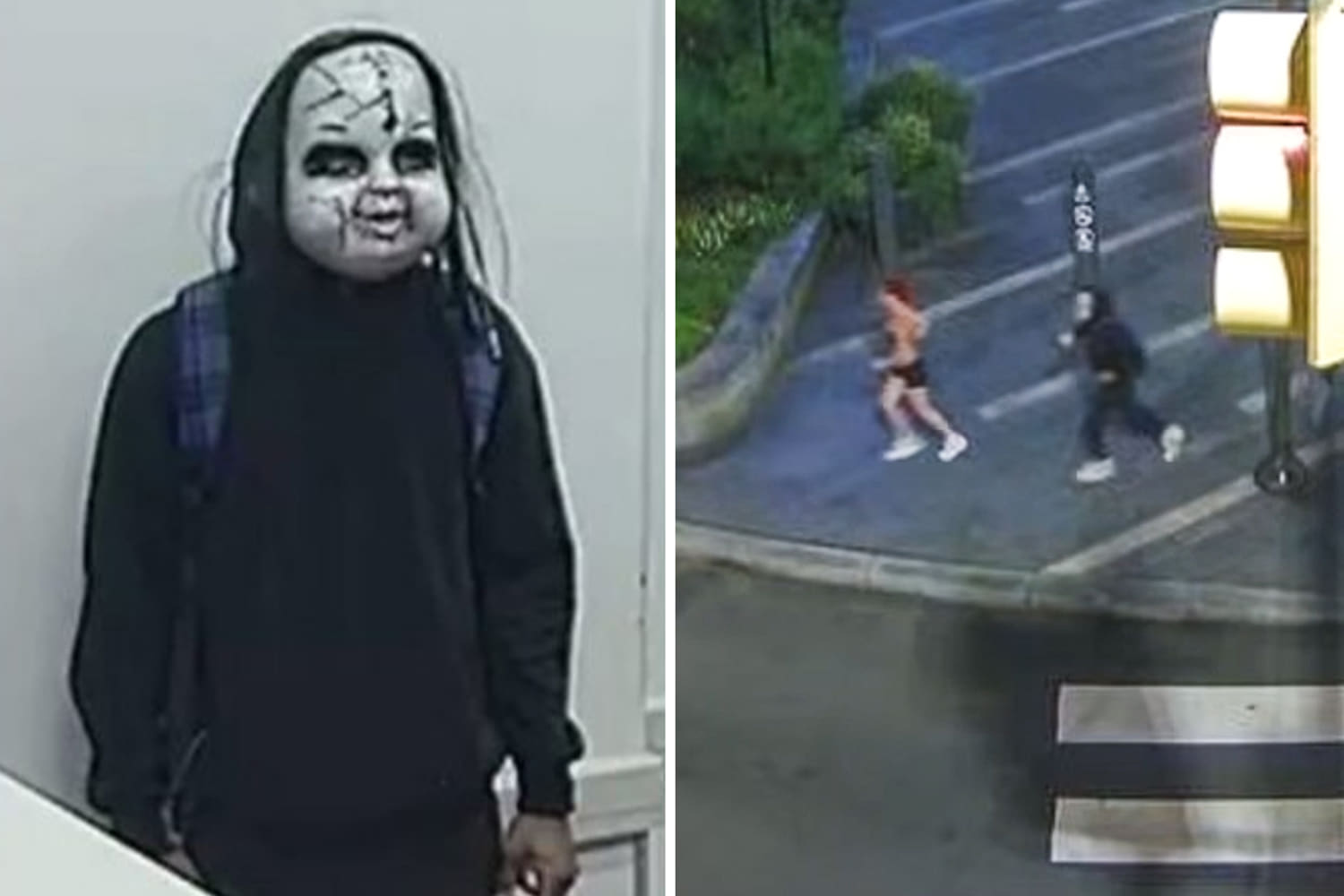
Public safety disruptions involving masked perpetrators create an immediate operational crisis for municipal law enforcement. When an individual executes a localized threat wearing a recognizable novelty mask, such as the Chucky-style caricature reported by Philadelphia police, the incident transcends a standard misdemeanor response. It activates a complex threat vector governed by media amplification, visual identification hurdles, and rapid deterrence mechanics.
Security frameworks must evaluate these events not as isolated anomalies, but as calculated disruptions that exploit the friction points of modern policing. By deconstructing the mechanics behind suspect identification, mask-induced anonymity, and public reporting loops, investigators can transition from reactive apprehension to proactive containment.
The Operational Mechanics of Mask-Induced Anonymity
Facial concealment alters the baseline economics of criminal identification. Biometric surveillance systems and eyewitness identification models rely heavily on facial geometry, micro-expressions, and distinct bone structure. A full-head vinyl or plastic mask disrupts these vectors by introducing three distinct failure points into the investigative pipeline.
First, standard facial recognition software fails when core facial landmarks are occluded. Automated systems depend on spatial relationships between the eyes, nose, and jawline. A novelty mask neutralizes these algorithmic data points entirely, forcing law enforcement to rely on secondary gait analysis, posture tracking, and apparel matching.
Second, psychological masking reduces bystander retention accuracy. Witnesses under acute stress prioritize threat categorization over detail retrieval. When a terrifying or culturally recognizable visual stimulus like a horror movie mask is introduced, the witness's cognitive load spikes. This narrows attentional focus onto the weapon or the mask itself, degrading the quality of subsequent suspect descriptions provided to dispatchers.
Third, mass-produced consumer goods complicate supply chain tracing. Unlike custom apparel or distinct tattoos, mass-market novelty masks are distributed across thousands of retail outlets and e-commerce platforms. Without a point-of-sale receipt, unique purchase identifier, or forensic touch DNA left inside the interior lining, tracing the physical item back to a specific buyer remains statistically improbable.
The Information Cascade and Public Reporting Efficiency
Apprehending an anonymous suspect in an urban environment depends heavily on the velocity and accuracy of public tip lines. The Philadelphia police department's dissemination of surveillance imagery initiates an information cascade, but the efficiency of this cascade relies on structural incentives within the community.
[Surveillance Release] -> [Cognitive Load Spike in Public] -> [Signal-to-Noise Ratio Degradation] -> [Targeted Tip Filtration]
When grainy security camera stills are published, police departments face a dual-edged information problem. The raw volume of incoming tips often overwhelms investigative bandwidth. Most citizen reports consist of false positives driven by pareidolia—the human tendency to perceive familiar patterns in ambiguous stimuli.
To optimize this feedback loop, investigative teams must filter incoming data through a strict tiered matrix:
- Geospatial Proximity: Prioritizing tips originating within a two-mile radius of the initial incident vector, accounting for pedestrian transit limits over a short timeframe.
- Behavioral Anomalies: Discarding casual sightings of individuals wearing masks during non-incident hours, and focusing exclusively on reports of sudden behavioral shifts, frantic disposal of clothing, or unexplained absences from routine locations.
- Material Corroboration: Filtering for reports that link the mask to specific secondary variables, such as a matching vehicle, unique footwear, or distinctive hand tattoos not covered by the costume.
Resource Allocation During High-Visibility Manhunts
When an ongoing manhunt captures public attention, police leadership faces a severe resource allocation dilemma. High-visibility incidents generate intense political and media pressure, which often distorts normal tactical prioritization.
Standard operational budgets allocate manpower based on historical crime data and statistical risk assessments. A high-profile public threat forces a diversion of detectives from long-term organized crime or property crime units into immediate tactical saturation patrols. This creates an opportunity cost across the broader municipal safety infrastructure.
To manage this distortion, agencies must apply a strict triage model:
- Containment vs. Search: Shifting from active grid searches to targeted surveillance of known associates, recent residences, and transit hubs once the immediate initial containment window closes.
- Digital Footprint Extraction: Mandating the immediate extraction of open-source intelligence, traffic camera feeds, and private commercial CCTV along the suspect's suspected egress routes before automated data overwrite cycles occur.
- Inter-Agency Friction Reduction: Establishing unified command protocols to prevent jurisdictional overlap between transit police, municipal patrols, and federal task forces if the suspect crosses municipal boundaries.
Systemic Vulnerabilities in Urban Surveillance Architecture
The pursuit of the Philadelphia mask suspect highlights systemic vulnerabilities in municipal surveillance networks. Many urban business districts rely on legacy analog security cameras or high-compression digital systems that degrade image quality at distances greater than fifteen feet.
When an individual utilizes a full-head mask, the lack of high-definition resolution compounds the failure of automated analytics. Low-light performance, motion blur, and frame rate limitations transform a potential identification asset into an ambiguous silhouette.
Upgrading urban surveillance requires a transition toward edge-computing cameras capable of real-time multi-modal tracking. Systems that analyze movement signatures, height-to-weight ratios, and clothing texture independently of facial features provide a resilient fallback when physical concealment is deployed.
Establish a comprehensive perimeter audit across all municipal transit hubs, prioritizing the immediate deployment of high-frame-rate optical sensors at choke points where suspects must remove or adjust concealing garments to blend back into normal commuter flows.