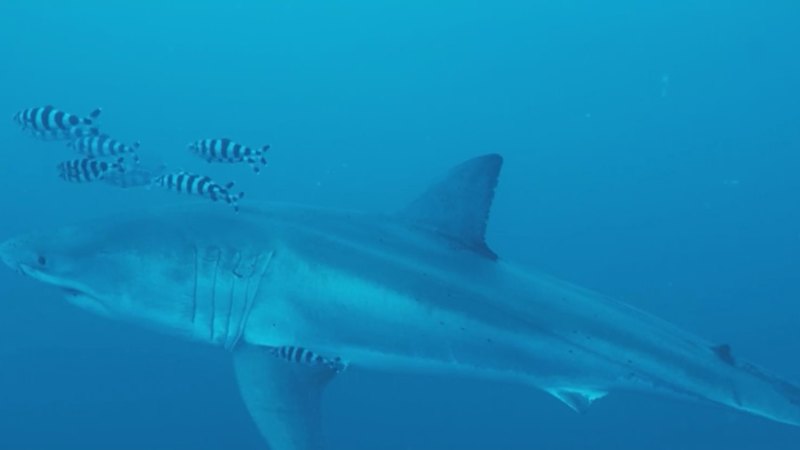
The Mediterranean population of the great white shark (Carcharodon carcharias) exists as a critically endangered, genetically isolated sub-population whose distribution and behavioral dynamics remain almost entirely opaque to modern marine science. This data vacuum changed fundamentally when technical divers from Ghost Diving, operating under the auspices of the Healthy Seas Foundation, captured verified underwater video footage of an adult great white shark at a depth of 40 meters in the Strait of Sicily. This encounter represents the first documented underwater visual record of a living adult specimen in its natural Mediterranean habitat.
Historically, data collection regarding Mediterranean great whites has relied on landing metrics from commercial fishing bycatch, shore-based stranding reports, or fleeting opportunistic surface sightings. These methods present significant selection biases, primarily documenting dead or highly stressed specimens in shallow coastal zones. The June 2026 footage offers a baseline for analyzing apex predator interactions within industrialized maritime corridors. Understanding the mechanics of this encounter requires mapping the specific ecological variables that brought a high-trophic predator into direct contact with an active marine conservation operation.
The Trophic Attractor Mechanical Framework
The physical intersection of the shark and the diving team occurred around a historical shipwreck resting at a maximum depth of 52 meters. Shipwrecks act as artificial reefs, structurally modifying the flat, soft-sediment bathymetry typical of the region into high-surface-area habitats. This structural complexity initiates a classic bottom-up trophic cascade:
- Micro-habitat Colonization: Benthic invertebrates and bio-fouling organisms colonize the exposed hull surfaces.
- Planktivore and Mesopredator Aggregation: Small teleost fish utilize the physical recesses for predator avoidance and localized feeding, drawing larger pelagic piscivores.
- Apex Convergence: High-trophic predators patrol the perimeter of these ecological hotspots to optimize hunting efficiency.
This baseline aggregation model was profoundly amplified by a critical anthropogenic variable: the presence of industrial ghost fishing gear. A large, abandoned commercial fishing net was entangled across the superstructure of the wreck, acting as an unmonitored, continuous mortality trap for marine life.
The mechanism driving the shark's presence can be expressed through a sensory attraction timeline. The ghost net had trapped numerous marine organisms, including sea turtles and large pelagic fish. As these organisms expired and decomposed, they generated an intense chemical and acoustic signal.
[Decaying Biomass in Ghost Net]
               │
               ▼
[Olfactory Diffusion Pipeline (Amino Acids & Fatty Acids)]
               │
               ▼
[Long-Range Chemotaxis Tracking by Carcharodon carcharias]
               │
               ▼
[Short-Range Low-Frequency Acoustic and Bioelectric Localization]
Sharks possess highly specialized olfactory bulbs capable of detecting dissolved chemical compounds at concentrations lower than one part per billion. The current dynamics within the Strait of Sicily established a continuous downstream plume of decomposition products, specifically amino acids and volatile fatty acids. The great white shark tracked this chemical gradient upcurrent—a behavioral process known as chemotaxis.
As the shark closed the distance to the wreck, short-range sensory modalities became dominant. The struggling and thrashing of newly entangled organisms generated low-frequency acoustic vibrations (hydroacoustic signals in the 10 to 100 Hz range) detectable via the shark's inner ear and lateral line system. Finally, at close proximity, the ampullae of Lorenzini allowed the predator to sense the minute bioelectric fields of organisms near the net, overriding the need for direct visual targeting. The shark was not casually passing through the zone; it was actively utilizing a highly concentrated, human-engineered foraging node.
Population Isolation and the Sicilian Bottleneck
The geographic location of this sighting holds severe biological weight. The Strait of Sicily operates as a narrow bathymetric bottleneck connecting the Western and Eastern Mediterranean basins. It features a complex network of shallow banks, deep trenches, and strong upwelling currents that drive primary productivity. This makes the region a critical migratory corridor and foraging ground for pelagic cetaceans, tunas, and sea turtles—the primary caloric targets for adult great whites.
The presence of an adult great white accompanied by roughly a dozen striped pilot fish (Naucrates ductor) confirms regular, long-term pelagic hunting behavior within this offshore zone. Pilot fish establish mutualistic relationships with large apex predators, utilizing the shark's bow wake to conserve swimming energy while feeding on ectoparasites and scraps from the shark’s hunts. The healthy condition of the observed shark indicates that despite severe environmental pressures, the offshore pelagic food web of the central Mediterranean retains enough structural integrity to support apex metabolic demands.
Genetic sampling and historical tracking indicate that the Mediterranean great white population is distinct from the nearby Atlantic populations. The Gibraltarian influx of Atlantic sharks is remarkably low, meaning the Mediterranean population relies almost entirely on internal reproductive success. The Strait of Sicily is hypothesized to be a key mating and potentially a nursery ground for the species. Documenting an adult specimen actively foraging in this narrow corridor validates the hypothesis that the channel is a vital geographical hub for the survival of the entire regional lineage.
Anthropogenic Synergy and Conservation Trade-Offs
The core paradox of the encounter lies in the fact that the platform enabling the scientific breakthrough—a technical diving expedition focused on ghost net removal—is also the primary threat to the species being documented. Industrial fishing pressure in the Strait of Sicily is among the highest in the Mediterranean, creating a severe operational bottleneck for marine conservation.
The threat matrix facing the Mediterranean great white population consists of three distinct vectors:
- Ghost Fishing Materiality: Abandoned nylon monofilament and trawl nets retain their structural integrity for decades. They create a perpetual killing loop, trapping target and non-target species alike. For great whites, these nets present a dual threat: they deplete the local prey base (sharks starve or move on) and pose a direct entanglement hazard. While an adult great white possess enough kinetic mass to break through light monofilament, heavy industrial trawl nets can immobilize an adult shark, leading to tonic immobility and drowning via ram-ventilation failure.
- Commercial Bycatch and Cryptic Mortality: Industrial longline, gillnet, and purse-seine fisheries operating legally within the region frequently hook or entangle sharks. Because the Mediterranean population is critically endangered, any single adult mortality represents a significant percentage drop in local reproductive potential. Much of this mortality is cryptic, going unrecorded in official port logs due to regulatory gaps or fear of legal penalties.
- Bioaccumulation of Toxins: As top-tier predators with life spans stretching over several decades, great whites sit at the apex of bioaccumulation pathways. Heavy metals, particularly methylmercury and organochlorine pollutants prevalent in the industrialized Mediterranean basin, biomagnify as they move up the trophic ladder from plankton to mesopredators, ultimately concentrating in the liver and muscle tissues of adult sharks, compromising long-term fertility and immune function.
Methodological Evolution via Collaborative Fieldwork
The operational framework deployed during this mission offers a blueprint for future non-invasive elasmobranch research in high-risk, deep-water environments. The collaboration fused technical diving execution from Ghost Diving, historical and documentation mapping from the Society for Documentation of Submerged Sites (SDSS), and academic oversight from the Sicily Marine Centre of the Stazione Zoologica Anton Dohrn.
┌────────────────────────────────────────┐
│      Technical Diving Operations       │
│ (Deep Wreck Penetration / Gas Mixes)   │
└───────────────────┬────────────────────┘
                    │
                    ▼
┌────────────────────────────────────────┐
│     Multimodal Data Collection         │
│  - 4K Close-Range Videogrammetry       │
│  - Spatial/Bathymetric Mapping         │
│  - Hydrographic Contextual Recording   │
│  - Environmental DNA (eDNA) Sampling   │
└───────────────────┬────────────────────┘
                    │
                    ▼
┌────────────────────────────────────────┐
│       Scientific Analysis Pipeline     │
│  - Morphological Sizing/Identification │
│  - Genetic Presence Verification       │
│  - Habitat Validation Models           │
└────────────────────────────────────────┘
The data collection strategy extended far beyond the viral video asset. The research team implemented a multi-tiered validation protocol:
Visual Identification and Morphometrics
The high-definition footage allowed researchers to conduct precise morphometric analysis. By comparing the shark's physical dimensions against known reference structures on the shipwreck's superstructure at a depth of 40 meters, biologists can estimate the total length and maturity stage of the animal with a low margin of error. The presence of specific scarring patterns provides a unique phenotypic fingerprint, allowing for future identification via photographic matching databases if the shark is sighted or captured elsewhere.
Environmental DNA (eDNA) Integration
Coinciding with the physical recovery of the nets, the team collected localized water samples to isolate environmental DNA. Marine organisms continuously shed cellular material into the water column through mucus, skin, and waste products. By filtering these water samples and amplifying the extracted DNA via quantitative Polymerase Chain Reaction (qPCR) assays, researchers can confirm the genetic signature of Carcharodon carcharias even after the individual has swam outside visual range. This spatial validation proves that eDNA can act as an effective early-warning or tracking system in deep offshore waters where traditional visual surveys are cost-prohibitive.
The operational reality of technical diving on deep wrecks (40 to 52 meters) severely limits bottom time due to nitrogen absorption and decompression obligations. The use of specialized gas mixtures (trimix) and closed-circuit rebreathers minimizes acoustic pollution—bubble noise—which otherwise deters pelagic wildlife. This silent operational profile was likely a key factor that allowed the shark to approach the divers calmly, rather than triggering an immediate avoidance response.
Strategic Operational Recommendations for Mediterranean Marine Management
The verification of an adult great white shark utilizing the Strait of Sicily as an active foraging hub demands a shift from passive observation to targeted regulatory intervention. Relying on opportunistic encounters to drive conservation policy is an inefficient allocation of scientific and regulatory capital.
The immediate administrative play requires the designation of targeted offshore Marine Protected Areas (MPAs) centered around verified deep-water biodiversity nodes. Current Mediterranean MPAs are heavily biased toward coastal, shallow-water ecosystems that are easier to monitor but fail to protect pelagic, highly migratory species. The boundaries of these new offshore reserves must be drawn using predictive habitat modeling that factors in bathymetric anomalies, upwelling zones, and historical bycatch data. Within these zones, commercial bottom trawling and longlining must be completely restricted.
Furthermore, a mandatory, tech-enabled ghost gear mitigation framework must be institutionalized across all Mediterranean fishing fleets. Commercial nets should be equipped with low-cost, passive RFID tags or acoustic transponders at the time of manufacture. If a net becomes snagged and must be cut loose, vessel operators should be legally required to log the precise GPS coordinates via a standardized maritime reporting portal within 24 hours. This data stream would allow specialized conservation diving groups to execute targeted, high-efficiency recovery operations before the lost gear transforms into a long-term trophic sink that attracts and kills endangered megafauna.
The Strait of Sicily sighting is a stark reminder that the baseline ecological infrastructure of the Mediterranean still holds the capacity to support top-tier apex predators. However, their continued survival depends entirely on transforming unmanaged, hazardous anthropogenic sites like untracked shipwrecks into clean, strictly regulated sanctuaries.