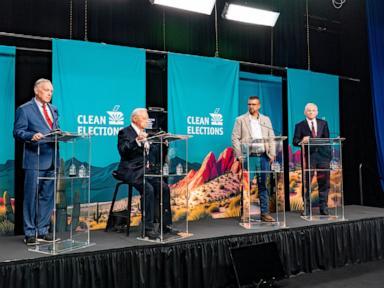
Winning a statewide election in a hyper-segregated political environment requires optimizing for two conflicting variables: maximizing core-partisan turnout during the primary phase while minimizing suburban independent defection during the general phase. The upcoming 2026 Arizona gubernatorial race presents a textbook failure of standard political modeling. Republican primary contenders are framing their candidacies around subjective notions of electability, yet their strategic platforms ignore the structural mathematical realities required to unseat incumbent Democratic Governor Katie Hobbs.
Unseating an incumbent governor in a state that voted R+5.5 in the 2024 presidential election but currently features a "Lean D" gubernatorial rating requires understanding the precise regional margin dynamics, economic pressure points, and structural voter bottlenecks unique to Arizona.
The Core Divergence in Competitiveness Models
The primary contest between the two leading Republican candidates, U.S. Representatives Andy Biggs and David Schweikert, exposes a fundamental strategic split in how to build a winning electoral coalition. Each candidate operates under a distinct, non-overlapping thesis of competitive advantage.
The Turnout Maximization Thesis (The Biggs Model)
The electoral model championed by Andy Biggs relies on maximizing voter turnout within the highly conservative, high-propensity base. This approach assumes that general election victory is achieved by driving deep base motivation, particularly among voters aligned with the populist wing of the party. The model is built upon three operational pillars:
- Nationalized Endorsement Value: Capitalizing on a direct endorsement from Donald Trump to establish low-cost name recognition and secure institutional support among primary voters.
- Legislative Policy Anchoring: Leveraging a historical record from the Arizona Legislature, including the restriction of abortion access and the expansion of school choice, to establish ideological credibility.
- Institutional Alignment: Relying on support from influential state networks, such as Turning Point USA, to lower the field operations cost function through pre-existing activist structures.
The operational bottleneck of the Biggs model lies in its general election scalability. By anchoring his platform to a nationalized, populist brand, Biggs faces a steep independent discount rate. In statewide general elections, Maricopa County independents penalize candidates who carry high nationalized ideological weight.
The Suburban Efficiency Thesis (The Schweikert Model)
David Schweikert's competitive thesis shifts the focus from deep base optimization to marginal suburban recovery. Representing Arizona's 1st Congressional District—a highly competitive, affluent suburban seat with a Cook Partisan Voting Index (PVI) of R+1—Schweikert has repeatedly survived high-spending Democratic challenges. His strategy relies on two distinct mechanisms:
- The Fiscal Salience Mechanism: Shifting the campaign narrative away from cultural issues and toward government finances, national debt, and cost-of-living metrics to attract high-earning suburban moderates.
- The Incumbency Insulation Factor: Utilizing an eight-term congressional voting record focused on budget metrics to signal technocratic competence, which dilutes the standard partisan attacks deployed by the opposition.
The strategic risk in the Schweikert model is primary phase viability. Polling data from mid-2026 demonstrates the severity of this vulnerability. In a May 2026 Stealth Analytics poll of likely Republican primary voters, Biggs commanded 55% support compared to Schweikert's 9%, with 34% undecided. Schweikert's focus on suburban moderates creates an ideological deficit in a closed primary ecosystem dominated by high-propensity conservative voters.
The Mathematical Realities of the Arizona Electorate
The standard media narrative focuses on debate performance and rhetorical presentation. A structural analysis, however, reveals that the path to victory is governed by strict mathematical constraints across Arizona's county-level voter distributions.
The Maricopa County Margin Threshold
Maricopa County contains approximately 60% of the statewide vote share. It acts as the ultimate clearinghouse for any statewide campaign. Historical data from the 2022 gubernatorial race, where Katie Hobbs defeated Kari Lake by a razor-thin 0.7 percentage points (50.3% to 49.6%), establishes a clear margin threshold:
$$M_{republican} = (V_{rural} \times \Delta R_{rural}) - (V_{pima} \times \Delta D_{pima})$$
For a Republican candidate to win statewide, the net positive vote margin generated across the 13 rural counties must completely offset the net negative vote margin generated in Pima County (Tucson). If that offset is achieved, Maricopa County becomes the decisive factor.
A Republican nominee cannot win the governor's mansion without securing at least 50.5% of the Maricopa County vote. Achieving this margin is impossible through base turnout alone; it requires winning self-identified independent voters in suburban sub-markets like Scottsdale, Gilbert, and Chandler by a minimum three-point margin.
The Independent Voter Bottleneck
Arizona's voter registration is split almost evenly into three columns: registered Republicans, registered Democrats, and Independent/Unaffiliated voters.
| Voter Bloc | Primary Behavior | General Election Behavior |
|---|---|---|
| Registered Republicans | High turnout; heavily influenced by populist endorsements and tax-cutting platforms. | Highly sticky; minimal defection risk regardless of nominee. |
| Registered Democrats | Monolithic support for incumbent Katie Hobbs; low primary spending required. | Consolidated; highly responsive to reproductive rights and anti-populist messaging. |
| Independent/Unaffiliated | Excluded from closed party primaries; zero input on nominee selection. | Volatile; highly sensitive to affordability metrics and candidates' perceived stability. |
Because independent voters are locked out of the primary process, the candidate who optimizes their platform for the July primary face an immediate structural penalty in August. The primary requires rhetorical and policy positions that alienate the exact independent demographic needed to achieve the Maricopa County margin threshold in November.
Economic Friction Points and Platform Feasibility
Both major Republican contenders have focused their economic critiques on Arizona's affordability struggles, yet their proposed policy remedies face severe legislative and macroeconomic constraints.
The Income Tax Elimination Friction
Andy Biggs has proposed a structural overhaul targeting the complete elimination of Arizona's state income tax, arguing that the revenue deficit can be offset by aggressively reducing state-level program fraud.
This proposal overlooks the structural mechanics of the Arizona state budget. Following the implementation of the 2.5% flat tax under former Governor Doug Ducey, individual income tax collections constitute roughly 35% of the state's General Fund revenues. Eliminating this revenue stream creates a multi-billion-dollar structural deficit that cannot be filled by anti-fraud measures alone.
Implementing this policy would require either a massive expansion of the transaction privilege tax (sales tax)—which introduces a regressive tax burden that penalizes low-to-middle-income consumers—or severe spending reductions in K-12 education and Medicaid enrollment.
The Data Center Subsidy Trade-Off
The candidates have aligned on a three-year moratorium on state tax incentives for new data centers, a position also held by Governor Hobbs. While politically popular due to rising concerns over resource consumption, this policy presents an underlying economic trade-off.
Data centers are capital-intensive operations that yield low direct employment infrastructure post-construction, yet they contribute significantly to local municipal property tax bases. A blanket moratorium curtails the state's technology infrastructure expansion, creating an economic bottleneck for secondary service providers and cloud-computing dependent industries considering relocation to the Phoenix metropolitan area.
The Healthcare Subsidy Fiscal Cliff
A key policy disagreement emerged regarding expired healthcare subsidies under the Affordable Care Act (ACA). The candidates' responses highlight the classic tension between fiscal conservatism and public program dependence in a swing state.
Schweikert's position—that the continuous subsidization of the domestic economy is fundamentally unsustainable—aligns with long-term macroeconomic stability models but introduces immediate political vulnerability. Terminating healthcare subsidies or reducing state Medicaid allocations directly impacts rural healthcare systems. Rural hospitals in Arizona operate on thin capital cushions; scaling back subsidized insurance pools increases uncompensated care costs, creating a high risk of rural facility closures.
Conversely, Biggs' proposal to utilize Health Savings Accounts (HSAs) funded by direct federal allocations shifts the administrative burden to the individual. While this mechanism promotes consumer-driven price discovery in healthcare services, it fails to address the underlying market failure: individuals with chronic conditions or low incomes cannot generate sufficient savings to cover high-deductible catastrophic insurance plans without structural premium support.
The Asymmetric Advantage of the Incumbent
Any strategy designed to unseat Governor Katie Hobbs must account for the structural advantages accumulated by an incumbent executive operating in a divided government framework.
The Veto Strategy as a Branding Shield
During her tenure, Hobbs has issued nearly 400 vetoes against bills passed by the Republican-led legislature. While Republican candidates frame this as hyper-partisan obstruction, the institutional mechanism functions as a highly effective general election branding shield.
By blocking conservative legislative packages on immigration, election administration, and cultural issues, Hobbs has insulated herself from downstream political liabilities. Every veto allows the incumbent to signal to suburban Maricopa independents that she functions as a structural check against ideological overreach. This positions her as a moderate defender of stability, forcing the eventual Republican nominee to run an offensive campaign against a status-quo bias.
The General Election War Chest
The ultimate operational challenge for the Republican field is financial asymmetry. Because Hobbs faces an uncompetitive Democratic primary, her campaign apparatus has focused exclusively on general election capital accumulation.
By early 2026, Hobbs had raised over $4 million, outraising the active Republican field combined and maintaining a five-to-one cash-on-hand advantage over her nearest competitor. The Republican primary on July 21, 2026, acts as a capital depletion mechanism. Whether Biggs or Schweikert emerges as the nominee, they will exit the primary with depleted financial reserves and a bruised brand, having spent months running a "race to the right."
Hobbs, meanwhile, retains a fully intact war chest ready to immediately deploy saturation media campaigns targeting the nominee's primary-phase rhetorical commitments the day after the primary concludes.
The Strategic Playbook for Unseating Hobbs
To overcome these structural hurdles, the winning Republican general election strategy cannot rely on standard conservative talking points. It must execute a precise, three-part operational pivot immediately following the July primary.
First, the campaign must transition its economic narrative from tax elimination to regulatory predictability. Instead of promising unfeasible income tax cuts that scare moderate voters concerned with education funding, the nominee must focus on supply-side housing reforms. Overcoming Arizona's affordability crisis requires preempting local municipal zoning bottlenecks to accelerate single-family and multi-family housing starts, directly addressing the underlying driver of regional inflation.
Second, the nominee must de-nationalize the race. Running on a nationalized populist brand plays directly into the Hobbs campaign's hands. The nominee must systematically refocus voter attention on localized infrastructure, specifically long-term water security management and the stabilization of the electrical grid against industrial data center strain.
Finally, the campaign must deploy a targeted suburban split-ticket strategy. The goal should not be convincing registered Democrats to cross over, but rather convincing suburban independents who vote for federal Democratic candidates to split their ballot for a state executive focused on technocratic balance. This requires explicit commitment to maintaining institutional stability, preserving existing healthcare safety nets for vulnerable populations, and positioning the governorship not as an ideological weapon, but as an economic management tool.
For a deeper dive into how competitive dynamics shape swing-state debates, you can watch this analysis of the Arizona Republican primary debate. This recording provides immediate context on how the candidates attempt to balance base appeal with general election viability in real time.


