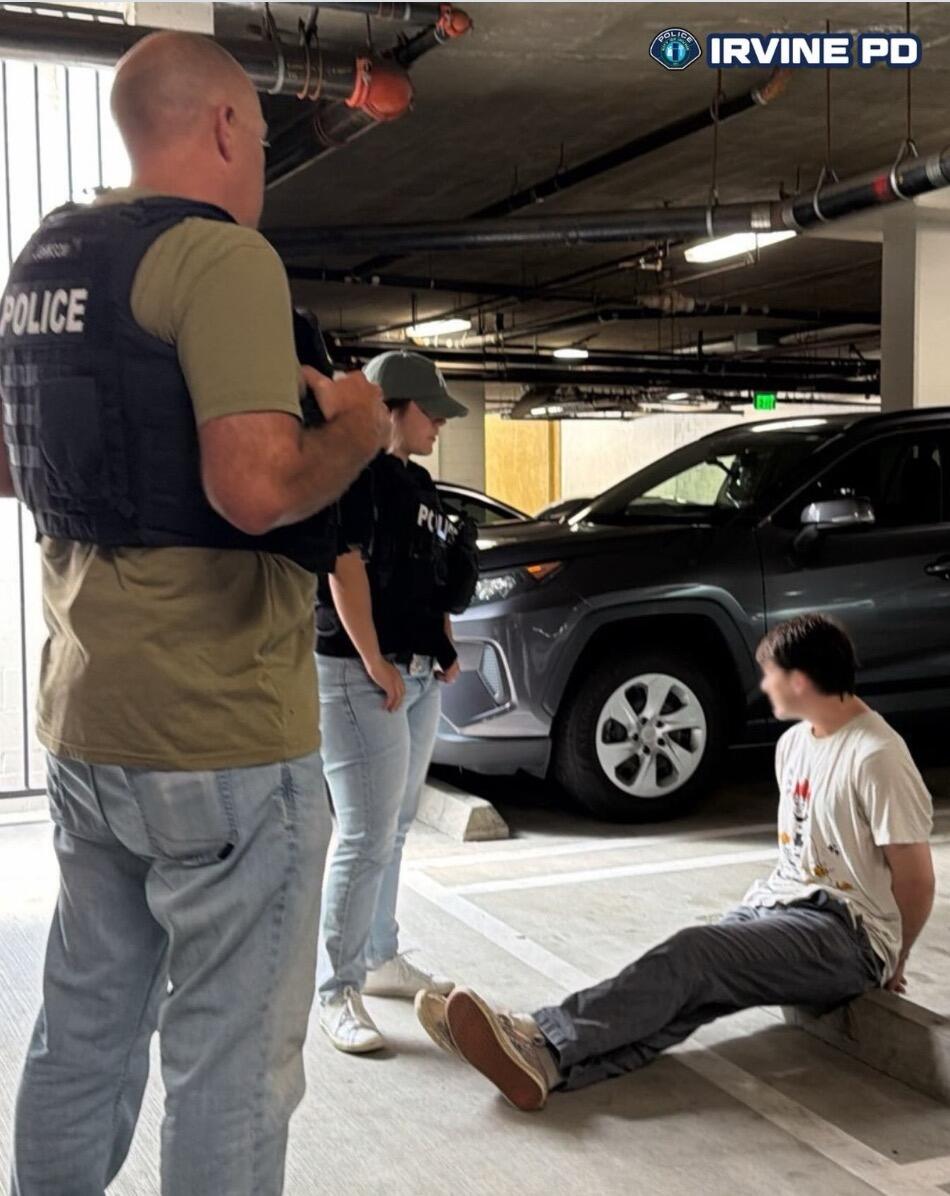
Urban property destruction follows distinct behavioral patterns. When an individual targeted multiple electric vehicles in Irvine, California, spray-painting political slurs across exterior body panels, the subsequent apprehension exposed the operational mechanics of modern law enforcement investigations. Public reporting framed the resolution as a fortunate break centered around a routine takeout food order. A rigorous examination of the case reveals a predictable intersection of digital footprint management, physical surveillance infrastructure, and suspect behavioral leakage.
Property targeting decisions are rarely random. Teslas present specific operational vectors for politically or ideologically motivated vandals due to their distinct brand association, ubiquitous presence in affluent suburban environments, and specialized exterior material composition. The aluminum and glass construction requires specific chemical interventions to deface permanently, making the act both performative and deliberate. Understanding how police agencies transition from unstructured vandalism reports to a custodial arrest requires deconstructing the investigative pipeline into three distinct operational phases: physical evidence correlation, digital trail reconstruction, and behavioral interception.
The Physical Evidence Vector and Jurisdictional Consolidation
The primary challenge in serial property destruction cases is fragmentation. Localized police departments frequently receive isolated reports across different neighborhoods or reporting districts, creating data silos. When multiple Teslas are defaced with identical terminology across a municipality, the first systemic requirement is incident aggregation.
Investigators must establish a spatial-temporal matrix. By plotting the coordinates of each reported defacement, analysts can map the radius of activity, establish probable transit corridors, and estimate the suspect's deployment window. In the Irvine incidents, the concentration of targeted vehicles in specific commercial and residential zones allowed law enforcement to shift from reactive report-taking to proactive surveillance deployment.
Physical evidence recovered from the scenes typically includes spray paint residue, aerosol container particulates, and potential DNA or latent fingerprint deposits. However, chemical agents used in vandalism rarely yield immediate forensic matches unless the suspect has a prior criminal record cataloged in national databases like CODIS. Consequently, reliance on physical forensics alone creates an operational bottleneck. The breakthrough in these investigations almost invariably stems from environmental intelligence gathering, specifically closed-circuit television and private security camera integration.
Modern suburban infrastructure is saturated with private optical sensors. Ring doorbells, commercial parking lot surveillance systems, and automated license plate readers create a continuous digital perimeter. When evaluating how law enforcement isolates a suspect vehicle or individual, the process relies on reverse-route tracing.
[Vandalism Incident Location]
       │
       ▼ (Reverse Route Tracing)
[Private Surveillance / Ring Cameras]
       │
       ▼ (Vehicle / Foot Traffic Isolation)
[Commercial Point-of-Sale / Transaction Data]
       │
       ▼ (Suspect Identification & Arrest)
- Identify the exact timestamp of the vandalism event.
- Query all available optical devices within a quarter-mile radius for outward-bound transit vectors.
- Track the suspect backward to a point of origin or forward to a point of transaction.
This methodology bypasses the limitations of eyewitness testimony, which is notoriously unreliable under nocturnal conditions. The reliance on digital sensor networks transforms an invisible act into a chronological sequence of movement.
Digital Footprints and Transactional Leakage
The narrative surrounding the Irvine arrest highlights a takeout food order as the catalyst for the suspect's identification. While framed colloquially as a stroke of luck, a transactional footprint is a predictable node in modern investigative workflows.
When an individual operates within a specific geographic zone over an extended timeline, their basic physiological and logistical requirements necessitate interaction with commercial systems. Food delivery applications, point-of-sale terminal logs, credit card authorizations, and cellular tower handshakes form an inescapable matrix of digital exhaust.
The mechanism works through convergence. An investigator isolates a suspect on surveillance footage committing a crime at timestamp T. By analyzing the preceding and succeeding temporal windows, the analyst searches for correlating electronic transactions near the physical location. If a suspect stops to interact with a commercial establishment, purchase supplies, or collect an order immediately before or after an incident, that transaction bridges the gap between anonymity and identity.
Digital transactions carry metadata that static video feeds lack:
- Exact timestamp down to the second.
- Verified financial identity or account handle.
- Specific itemized preferences or delivery addresses.
- IP or device identifiers associated with mobile ordering platforms.
When a suspect utilizes a commercial service during the operational execution of a crime, they effectively provide law enforcement with a signed affidavit of their presence. The takeout order was not a random coincidence; it was an inevitable point of friction where a physical actor intersected with a digital ledger.
Behavioral Leakage and Operational Fatigue
Perpetrators of serial property crimes frequently suffer from operational fatigue. The initial execution of a vandalism campaign is marked by heightened caution, but as frequency increases, risk assessment degrades. The offender begins to normalize the environment, shortening their preparatory phase and increasing predictability.
Behavioral leakage occurs when the suspect's routine habits override their criminal security measures. In cases involving ideological or grievance-based vandalism, the psychological compulsion to complete the act often supersedes tactical awareness. The offender returns to familiar commercial zones, utilizes recurring routes, or interacts with local businesses in a predictable pattern.
Police agencies leverage this predictability by deploying predictive patrolling strategies. Once a geographic cluster is identified, plainclothes units or automated monitoring systems concentrate on high-probability intervention zones. The suspect's internal cost-benefit analysis—weighing the psychological satisfaction of the act against the risk of apprehension—becomes severely skewed because they underestimate the speed at which modern municipal data can be aggregated.
The transition from a string of unsolved property crimes to a definitive apprehension relies on eliminating variables. By fusing spatial data from damaged vehicles, optical tracking from private security infrastructure, and transactional data from local commerce, law enforcement reduces a broad demographic unknown to a specific individual.
Deploy institutional auditing protocols across all municipal police districts to ensure real-time aggregation of disparate property crime reports within a twenty-four-hour window. Mandate the immediate integration of commercial and residential security camera registries to eliminate manual canvassing delays during active serial property destruction investigations.