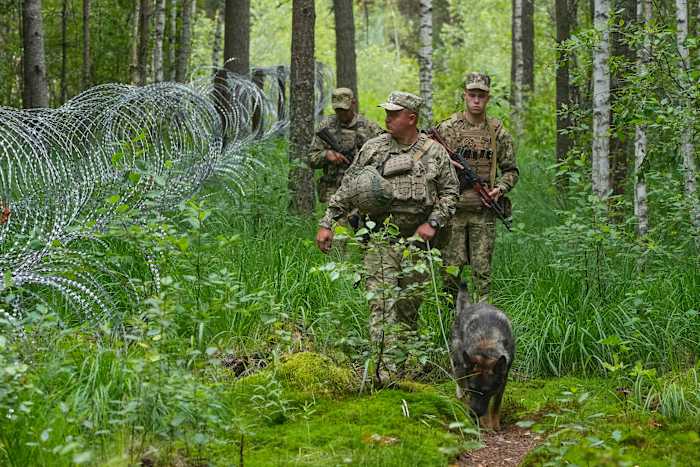
The modern state border functions less as a line on a map and more as a continuous economic and military filter. When a nation elects to heavily fortify a secondary frontier years after an active invasion vector has shifted elsewhere, the decision defies simple tactical reactions. It reveals a structural recalibration of national resource allocation, deterrence theory, and risk management.
Defense architectures along contested zones are driven by three distinct systemic pressures: opportunity cost minimization, resource reallocation efficiency, and political signaling value. Observers frequently misinterpret these fortifications as purely reactive measures to immediate troop movements. Instead, they operate as long-term capital investments designed to alter the strategic calculus of potential aggressors by institutionalizing friction. In other developments, read about: Inside China's Renewed Tibet Assimilation Drive and the Erasure of an Ancient Identity.
The Economic and Strategic Mechanics of Static Defense
Static military architecture incurs high upfront capital expenditures alongside ongoing maintenance liabilities. In the context of the northern Ukrainian frontier bordering Belarus, the physical barrier deployment serves an explicit economic and operational function. By converting geography into an asymmetric obstacle course of minefields, anti-tank ditches, and reinforced concrete bunkers, a defender achieves force multiplication.
A smaller standing force can successfully deny maneuver space to a significantly larger mechanized army. This dynamic changes the cost function for an invading power. Instead of calculating the velocity of an advance based purely on troop ratios, an attacker must factor in prohibitive engineering delays, sustained asset attrition, and predictable choke points. The Washington Post has provided coverage on this fascinating topic in extensive detail.
The deployment relies on layered depth rather than a single impenetrable perimeter. Depth absorbs momentum. When an adversary encounters successive rings of prepared defenses, their logistical supply lines stretch while their operational tempo collapses. The defender deliberately trades territory for time, utilizing the engineered landscape to fix enemy units in low-value terrain while preserving mobile reserves for targeted counter-maneuvers.
The Friction of Alternative Vectors
Geographic continuity creates permanent vulnerabilities. A hostile power does not need to cross an international boundary directly; it can leverage a compliant or occupied neighbor to stage forces. The northern border vector remains a permanent variable in military planning because geography cannot be relocated.
Treating a secondary border as dormant is a structural error in strategic analysis. Military planners evaluate lines of communication based on worst-case capacity rather than current diplomatic posture. Belarus offers an operational staging ground that compresses the distance to critical logistical hubs, including the capital region. Leaving this vector unfortified would force the defender to maintain a disproportionate mobile reserve close to the north, effectively pinning down divisions that are desperately needed on primary eastern axes.
Fortification solves this dilemma through automation and structural deterrence. Concrete does not require rotation, sleep, or constant tactical briefings. By hardening the terrain, the state lowers the required human garrison density while maintaining an equivalent baseline of security.
The Operational Limits of Physical Barriers
Static engineering solutions possess inherent vulnerabilities that demand precise risk assessment. Physical barriers do not win wars independently; they channel adversary movements into predictable kill zones. If those kill zones lack sufficient artillery coverage, air defense integration, or responsive command structures, the fortification degenerates into an expensive, bypassed speed bump.
Another limitation involves technological obsolescence. Modern reconnaissance and precision strike complexes reduce the survivability of fixed positions unless they are deeply buried and reinforced against vertical kinetic impact. The integration of uncrewed aerial systems means that any static position can be continuously monitored, targeted, and systematically dismantled by loitering munitions or artillery correction unless paired with robust electronic warfare shielding and active air defense nets.
Furthermore, capital trapped in concrete cannot be deployed elsewhere. The opportunity cost of pouring millions of tons of aggregate and steel into a northern frontier is the simultaneous reduction of resources available for counter-offensive capabilities, advanced drone manufacturing, or aerospace defense systems. Strategic leaders must constantly audit this balance, ensuring that defensive hardening does not metastasize into institutional paralysis.
The Strategic Horizon
The ongoing fortification of the northern frontier establishes a permanent structural reality. Borders adjacent to hostile or proxy-controlled territories will remain permanently militarized zones characterized by deep engineering, continuous surveillance, and institutionalized distrust.
Future state survival in contested regions depends on the mastery of hybrid defensive architecture. The optimal posture merges heavy engineering with decentralized, highly mobile tactical units capable of exploiting the friction that static barriers impose on the enemy. State planners must abandon the assumption of temporary conflict and treat border hardening as enduring critical infrastructure, budgeting for perpetual maintenance, technological upgrades, and generational garrison rotations.