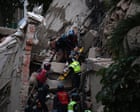
The catastrophic failure of residential and commercial infrastructure across Caracas following the June 24, 2026, seismic event represents a predictable convergence of tectonic mechanics and structural deficit. Seismic doublets—episodes where two major earthquakes of comparable magnitude occur within a brief temporal window—inflict a compounding stress profile on built environments that standard civil engineering codes rarely anticipate. When a magnitude ($M_w$) 7.2 foreshock is followed a mere 39 seconds later by a magnitude ($M_w$) 7.5 mainshock along the San Sebastián fault system, the destructive efficiency of the energy release does not simply add up; it multiplies.
The structural survival of a high-rise building under seismic load depends on its capacity to dissipate kinetic energy through elastic deformation and managed material yielding. The first shock compromises this capacity. By stripping structures of their structural ductility during the initial 7.2 shock, the subsequent 7.5 mainshock encounters weakened, brittle geometries incapable of resisting lateral acceleration. Understanding the scale of the destruction in Caracas requires dissecting three independent but intersecting systems: the seismological doublet mechanics, the structural pathology of the city's building stock, and the immediate systemic failure of municipal infrastructure.
Seismological Doublet Mechanics and Energy Amplification
The earthquakes of June 24 occurred along the complex plate boundary zone between the Caribbean and South American plates, a region dominated by right-lateral strike-slip faulting. The first event ($M_w$ 7.2) nucleated at 18:04 local time at a depth of roughly 22 kilometers in Yaracuy, near Morón. Before the ground motion from this initial rupture could fully attenuate, the second, more powerful rupture ($M_w$ 7.5) initiated at a shallower depth of 10 kilometers, roughly 16 kilometers to the southwest.
To quantify the sheer forces applied to the Caracas basin, one must look at the logarithmic nature of the moment magnitude scale. An increase of 0.3 magnitude units equates to an approximate doubling of seismic energy release. The $M_w$ 7.5 mainshock released nearly three times the energy of the $M_w$ 7.2 foreshock.
The physics of this doublet can be broken down into three phases of structural degradation:
- Phase 1: Initial Peak Ground Acceleration (PGA): The $M_w$ 7.2 foreshock generated high-frequency shear waves (S-waves) that propagated through the Caracas valley, causing immediate non-structural damage and micro-fracturing in reinforced concrete joints.
- Phase 2: The Hysteresis Deficit: As buildings sway, they undergo hysteresis loops—cycles of deformation that absorb and dissipate energy. The first quake pushed many high-rise structures past their elastic limits, leaving them with permanent displacement, cracked columns, and compromised rebar adhesion.
- Phase 3: The 7.5 Mainshock Overload: Arriving 39 seconds later, the larger mainshock struck a highly vulnerable building stock. Because the natural resonant frequency of the damaged buildings had shifted due to structural degradation, many structures entered a state of destructive resonance with the long-period seismic waves characteristic of the shallower 7.5 rupture.
The geographical features of Caracas exacerbated this energy transfer. The city sits inside an alluvial basin filled with unconsolidated sediment. This geological profile triggers seismic site amplification. When deep-seated seismic waves transition from high-velocity bedrock into soft sedimentary layers, their velocity drops, forcing their amplitude to increase sharply. This basin effect traps and amplifies the seismic energy, exposing high-rises to sustained, violent ground oscillation far exceeding the baseline measurements recorded at the rocky epicentral zone.
The Structural Pathology of the Collapse Zones
The distribution of structural failures across Caracas reveals a clear correlation with architectural typology and construction vintage. The worst-affected districts—Altamira, Los Palos Grandes, and Baruta—contain a high concentration of mid-to-high-rise residential concrete frames built between 1950 and 1980. The widespread collapse of structures, including a 22-story tower in Altamira, stems from a well-documented engineering vulnerability: the soft-story defect.
A soft-story building features a ground floor with significantly less stiffness or lateral resistance than the floors above it, usually to accommodate open parking spaces, lobbies, or commercial storefronts. Under intense lateral seismic loads, the stiffness discontinuity focuses the shear deformation almost exclusively on the ground-floor columns. If these columns lack sufficient transverse reinforcement, they undergo brittle shear failure, causing the upper floors to pancake flat onto the foundation.
[Upper Floors: High Stiffness / Rigid Shear Walls]
      ||                  ||                  ||
======================================================  <-- Stress Concentrates Here
[Ground Floor: Soft-Story / Open Frame / Weak Columns]
      ||                  ||                  ||
------------------------------------------------------
                   [Foundation]
This structural vulnerability is further compounded by concrete degradation and outdated design criteria:
- Inadequate Ductility and Detailing: Structures designed prior to modern seismic codes often lack close stirrup spacing within beam-column joints. Without tight, continuous steel ties, concrete columns spall and burst outward under high axial loads.
- Material Fatigue: Decades of exposure to tropical humidity, combined with inconsistent maintenance cycles linked to national economic volatility, have driven widespread carbonation in the concrete. This chemical process neutralizes the alkaline environment protecting internal rebar, causing it to rust, expand, and crack the surrounding concrete from within.
- Unreinforced Masonry Infill: Many concrete frame structures in Caracas rely on hollow clay tile walls for internal partitions. While not designed to bear structural loads, these rigid walls alter the building's dynamic response during a quake. Their sudden failure early in the shaking creates unexpected torsional stresses, twisting the building until the core columns give way.
Systemic Failure Cascades in Urban Infrastructure
Evaluating a seismic disaster requires looking past individual building collapses to examine the broader operational failures across interconnected infrastructure networks. The Caracas doublet instantly triggered a series of logistical bottlenecks that paralyzed emergency response efforts.
The primary systemic bottleneck is the shutdown of the Simón Bolívar International Airport in Maiquetía due to severe runway fracturing and terminal damage. In a large-scale natural disaster, an international airport serves as the logistical hub for inbound search-and-rescue teams, specialized heavy-lifting equipment, and field medical units. Closing this artery isolates the capital, forcing incoming international relief to route through distant secondary airfields or vulnerable overland highways.
Simultaneously, municipal authorities ordered an immediate shutdown of the city's natural gas distribution pipelines. This step is a standard, necessary protocol to prevent large-scale post-earthquake fires, yet it strips the urban core of power and cooking fuel, increasing the operational burden on emergency shelters.
The suspension of the Caracas Metro further worsened the crisis. With underground transit offline and surface streets blocked by fallen electric poles and concrete debris, the physical mobility of rescue personnel was completely compromised.
The United States Geological Survey PAGER (Prompt Assessment of Global Earthquakes for Response) system models a high-fatality scenario for the $M_w$ 7.5 event, placing the highest probability curve between 10,000 and 100,000 deaths. This projection is shaped less by the raw magnitude of the quakes and more by the specific timing of the disaster. Because June 24 is a national holiday in Venezuela commemorating the Battle of Carabobo, commercial centers were empty, but high-density residential high-rises were fully occupied. The structural failure of a single 20-story residential tower can instantly trap hundreds of individuals, overtaxing local urban search-and-rescue teams within the first hour.
Immediate Tactical Resource Reallocation
The immediate tactical priority for emergency management must pivot away from decentralized reconnaissance and toward the deployment of acoustic and thermal search tools at known high-density collapse sites in Altamira and Chacao. Given the total disruption of standard cellular networks across the capital, emergency services must establish localized mesh networks and sat-com hubs at designated staging points to coordinate heavy machinery logistics.
Managing the incoming influx of international aid requires setting up an alternative logistics node at a secure port facility or a secondary airfield outside the immediate damage zone, using military corridors to transport heavy shoring equipment over the coastal mountain range. Engineering teams must immediately prioritize checking the structural integrity of the remaining overpasses and tunnels connecting La Guaira to Caracas, as any failure along these routes will completely cut off the capital's supply lines.