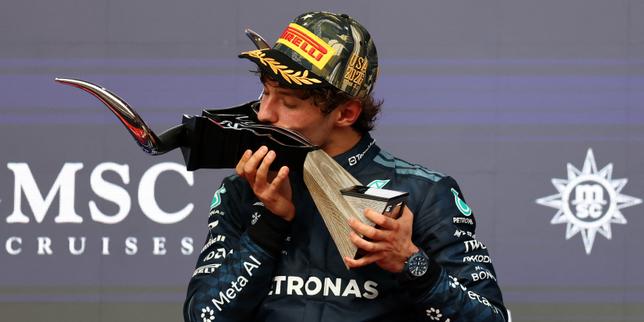
Winning the United States Grand Prix in Austin does more than add twenty-five points to a driver’s ledger; it fundamentally alters the mathematical probability distribution of a Formula 1 World Championship. Kimi Antonelli’s victory at the Circuit of the Americas (COTA) represents a decisive shift in late-season title dynamics, transforming a theoretical pursuit into an operational stranglehold. Standard race recaps treat a Grand Prix victory as an isolated athletic achievement, missing the underlying systemic mechanics: track-specific aerodynamic validation, points-buffer compounding, and the psychological attrition imposed on rival pit walls during the final flyaway leg of the calendar.
To understand why an Austin victory carries disproportionate weight in a title fight, one must examine the structural demands of the venue itself. COTA is not a specialized outlier like Monaco or Monza; it is a high-speed diagnostic laboratory. A car that dominates across Austin’s three distinct sectors possesses a balanced performance envelope capable of winning on almost every remaining circuit on the calendar.
The Three Pillars of COTA Dominance
A victory at the Circuit of the Americas requires solving three competing engineering constraints simultaneously. When a driver like Antonelli converts pace into a win here, it signals that the team has resolved the fundamental trade-offs of ground-effect aerodynamics.
High-Speed Lateral Load Management (Sector 1)
The opening sequence from Turn 3 through Turn 6 mimics Silverstone’s Maggotts-Becketts complex. Cars sustain lateral forces exceeding 4G while changing direction at speeds above 250 km/h. Success here depends entirely on platform stability. If the floor stalls or porpoises under high-frequency direction changes, the driver loses front-end bite, inducing understeer that bleeds tenths across four consecutive apexes. Antonelli’s ability to carry minimum corner speed through this sequence demonstrates superior ride-height control—meaning the suspension kinematics keep the underfloor Venturi tunnels sealed without bottoming out on Austin’s notoriously bumpy asphalt.Traction-Limited Braking Zones (Sector 2)
The back straight into Turn 12 is the primary overtaking zone, preceded by the hairpin at Turn 11. This section exposes longitudinal inefficiency. A car must shed over 230 km/h in roughly 110 meters while remaining stable over braking-zone undulations, then deploy electrical energy smoothly on exit without overwhelming the rear thermal envelope. Dominance here indicates optimal brake-by-wire calibration and differential locking maps that prevent rear-axle instability during trail-braking.Multi-Apex Thermal Equilibrium (Sector 3)
Turns 16, 17, and 18 form a prolonged, triple-apex right-hander that subjects the front-left tire to sustained mechanical and thermal stress. Unlike single-corner tracks where surface temperatures spike and recover, this complex cooks the tire carcass from the inside out. Maintaining pace through Sector 3 without triggering thermal degradation proves that the chassis generates downforce organically through aerodynamic efficiency rather than relying on mechanical grip, which inevitably chews through Pirelli’s rubber compounds.
The Championship Math and Asymmetric Pressure
In late-season Formula 1, points do not carry linear value; they carry exponential strategic utility. Each race completed reduces the denominator of available points remaining, compressing the recovery window for trailing competitors.
Consider the mechanics of a points lead entering the final stretch of the season. When Antonelli secures maximum points in Austin, he forces his direct title rivals into a high-variance strategic posture. A trailing driver can no longer afford conservative risk management; they must optimize for maximum point extraction every weekend, which narrows their operational margin for error.
- The Podium Floor Effect: Once a leader establishes a buffer exceeding a single race win (25 points), they gain the luxury of defensive optimization. They no longer need to contest marginal, high-risk wheel-to-wheel battles in Turn 1. Finishing second or third behind a rival still preserves the structural integrity of the championship lead, whereas a DNF (Did Not Finish) for the trailing driver effectively terminates their mathematical viability.
- Power Unit and Gearbox Allocation Leverage: Leading the standings late in the year dictates component strategy. If a rival is forced to take a five-place grid penalty for an internal combustion engine (ICE) change to chase peak power, the leader can mirror or absorb that variance without surrendering track position in the standings. Conversely, if the leader already possesses healthy component mileage, they can run higher engine modes during qualifying without risking late-race reliability failures.
- Pit Wall Game Theory: A substantial points cushion shifts the burden of strategic innovation onto the chasing teams. Trailing pit walls must gamble on early undercuts, off-sequence tire compounds, or extended first stints hoping for a Safety Car intervention. The leading strategist simply covers the most mathematically probable threat, letting the chasing cars burn their tire life in dirty air.
Tire Degradation as the Primary Differentiator
Austin’s abrasive tarmac and high ambient track temperatures turn every Grand Prix into an exercise in thermal management. Raw one-lap qualifying pace frequently decouples from race-day execution at COTA because the energy put into the tires during Saturday’s low-fuel runs bears little resemblance to Sunday’s 110-kilogram fuel load reality.
Antonelli’s execution in Austin highlights a critical operational discipline: phase-one stint management. In modern Formula 1, pushing at 98 percent capacity during the first five laps of a stint creates a permanent thermal deficit. Once the surface temperature of the tire exceeds its optimal operating window, the rubber begins to grain or blister, permanently altering the chemical grip of the compound for the remainder of the stint.
By managing pace during the opening laps—sacrificing immediate gap-building to stabilize carcass temperatures—a driver preserves the structural integrity of the tire for the final third of the stint. This creates a massive pace delta right before the pit window opens. When rivals are forced to box early due to cliff-like drop-offs in rear traction, the driver with preserved tire life can extend their stint by three to five laps. This "overcut" capability provides two distinct advantages:
First, it grants clean air on a lighter fuel load, allowing the leader to post sector times faster than rivals who have just emerged on fresh, cold tires into midfield traffic. Second, it opens the strategic window to capitalize on virtual or full Safety Cars, which reduce pit-stop time loss from roughly twenty-one seconds to twelve seconds.
The Structural Limitations of Late-Season Momentum
While sports media frequently anthropomorphizes consecutive wins as unstoppable "momentum," rigorous analysis requires acknowledging the fragility of any championship lead in motorsport. Formula 1 remains an engineering-bound discipline where deterministic variables can be wiped out by stochastic events in milliseconds.
Three specific failure modes threaten any driver closing in on a world title:
- Lap-One Chaos and Geometric Bottlenecks: Austin’s steep uphill run into Turn 1 is notorious for creating a funnel effect where multiple racing lines converge at an acute angle. Regardless of a driver’s pace advantage, starting on the front row exposes them to first-corner collisions triggered by midfield braking errors. A single broken front wing or punctured rear tire at the start of a race erases an entire weekend of aerodynamic superiority.
- Track Limits and Regulatory Enforcement: COTA’s wide asphalt run-off areas invite drivers to exploit every millimeter of track width to carry exit speed. Modern race direction enforces strict four-wheels-off limits via automated timing loops and high-definition camera monitoring. Accumulating three strikes triggers a black-and-white warning flag; a fourth incurs an automatic five-second time penalty. In a tightly contested race, a five-second penalty drops a race winner off the podium entirely, turning a net points gain into a net loss.
- Environmental Volatility and Setup Windows: Ground-effect cars operate within razor-thin ride-height and wind-sensitivity windows. A sudden shift in wind direction—common across the exposed Texas plains—can stall the front wing in high-speed corners or induce snap oversteer under braking. A car that felt balanced in Friday practice can become unpredictable on Sunday afternoon if ambient temperatures drop by eight degrees Celsius, shifting the tires out of their narrow thermal working range.
Tactical Blueprint for Closing Out a Title Campaign
For Antonelli and his engineering team, the objective shifts immediately after leaving Austin. The goal is no longer proving outright speed; it is variance reduction. Winning a championship from the front requires transitioning from an aggressive optimization model to a defensive containment protocol.
To convert the Austin victory into the World Championship, the operational execution over the remaining rounds must follow a strict hierarchy of priorities:
- Qualifying for Clean Air Over Pole Position: Setup compromises should favor Sunday race pace and tire longevity over Saturday single-lap glory. Starting inside the top three is sufficient to stay out of midfield turbulence; sacrificing race-day ride height for an extra tenth in Q3 introduces unnecessary plank-wear disqualification risks and mid-race degradation.
- Conservative Kerb Usage: During practice and the early phases of the race, drivers must stay off high-frequency exit kerbs unless defending an immediate overtaking threat. Modern floor edges and underbody strakes are delicate carbon-fiber structures; minor structural damage from aggressive kerb strikes costs ten to fifteen points of downforce, which translates directly into three-tenths of a second per lap in lost race pace.
- Mirroring Rival Pit Windows: Once track position is secured, the leading pit wall must eliminate speculative strategy calls. Every pit stop should be triggered strictly as a mathematical response to the closest championship contender entering the pit lane, ensuring the leader never surrenders track position to an undercut or gets trapped behind slower cars running an offset strategy.
The United States Grand Prix did not hand Kimi Antonelli the World Championship trophy, nor did it eliminate the mechanical and regulatory hazards inherent to the sport. What it accomplished is far more concrete: it validated his machinery across every aerodynamic regime, compressed the mathematical runway available to his competitors, and placed the strategic burden of risk entirely on the chasing pack. From this point forward, the title is no longer won through heroics; it is secured through disciplined, low-variance execution.