Civil unrest rarely begins with ideological crusades. The path from institutional friction to urban confrontation follows a predictable trajectory governed by resource constraints, communication bottlenecks, and tactical overreactions. When localized grievances regarding infrastructure and service delivery go unaddressed, they create an accumulation of pressure that routine administrative channels are ill-equipped to absorb.
To deconstruct how localized grievances scale into systemic disruption, we must examine the mechanics of institutional failure, the dynamics of mobilization, and the feedback loops of state response. You might also find this similar story insightful: Why the Third Anniversary of October 7 Still Echoes Globally.
The Infrastructure Deficit Model
The origin point of widespread civil friction often traces back to micro-level failures in public asset management. Facilities that suffer from chronic underfunding exhibit clear degradation vectors: sanitation maintenance lapses, thermal regulation failures, and spatial overcrowding.
When institutions fail to maintain baseline operational standards, they communicate a silent message to their constituents regarding perceived institutional value. In educational settings, deteriorating infrastructure directly impedes daily operations. Students facing persistent structural decay experience a functional degradation of their learning environment. As highlighted in detailed articles by Associated Press, the implications are worth noting.
The transition from silent endurance to active defiance occurs when administrative bodies implement restrictive containment policies—such as restricting access to basic amenities or enforcing rigid behavioral controls—without addressing the root cause of the infrastructural failure. This creates an asymmetric cost burden on the user base, sparking immediate pushback.
The Mobilization Threshold and Network Effects
Once an administrative restriction provokes localized resistance, the mechanism of spread relies heavily on modern communication networks and shared identity markers.
- Grievance Identification: A localized policy or infrastructure failure impacts a distinct cohort simultaneously, establishing a shared identity of disadvantage.
- Horizontal Communication: Digital networks allow for the rapid lateral sharing of grievances, bypassing traditional vertical reporting channels that typically act as friction points or suppression valves.
- Tactical Standardization: Methods of disruption, such as facility blockades or synchronized walkouts, are standardized and replicated across multiple sites with minimal centralized coordination.
The speed of mobilization is directly proportional to the perceived inflexibility of the governing institution. If administrative responses rely on disciplinary threats rather than structural remediation, participants view the system as closed to feedback, lowering the psychological barrier to escalation.
The Escalation Feedback Loop
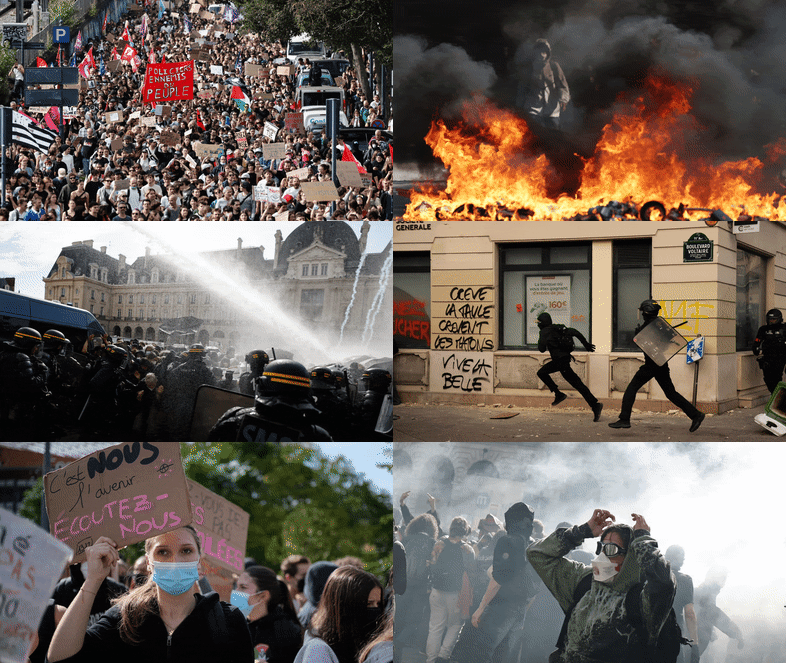
The introduction of state security forces into civil friction zones alters the operational dynamics, frequently accelerating the transition from peaceful demonstration to violent confrontation. This dynamic operates through a distinct escalation cycle:
- Initial Disruption: Participants utilize non-violent disruption—such as barricading entrances or halting standard operations—to force administrative visibility.
- Security Deployment: Authorities introduce crowd-control apparatuses to restore order and clear public thoroughfares.
- Tactical Friction: The deployment of chemical irritants, kinetic impact projectiles, or high-pressure water systems changes the risk calculation for participants.
- Radicalization of Demands: Physical confrontation shifts the primary focus of the protest from the original administrative grievance (e.g., infrastructure repair) to systemic opposition against state intervention and policing tactics.
When kinetic force is utilized against demographic cohorts operating within public institutions, the visual documentation of injuries or aggressive dispersal methods generates external sympathy. This draws secondary actors—broader labor groups, political factions, and unaffiliated citizens—into the operational theater. What began as an operational dispute over asset management transforms into a broader crisis of public legitimacy.
Strategic Forecast and Systemic Intervention
Mitigating the transition from localized stasis to widespread civil disorder requires abandoning reactive containment strategies in favor of predictive resource allocation. Traditional administrative playbooks that rely on dispersal orders and disciplinary sanctions fail because they treat systemic friction as a behavioral compliance issue rather than a structural deficit.
To break the escalation cycle, institutional operators must implement real-time feedback loops that decouple infrastructure maintenance from political cycles, ensuring that micro-level grievances are addressed before they reach the critical threshold of public mobilization.
This video provides an on-the-ground visual and analytical breakdown of how initial student grievances regarding classroom conditions rapidly escalated into widespread protests and clashes with security forces in urban centers.