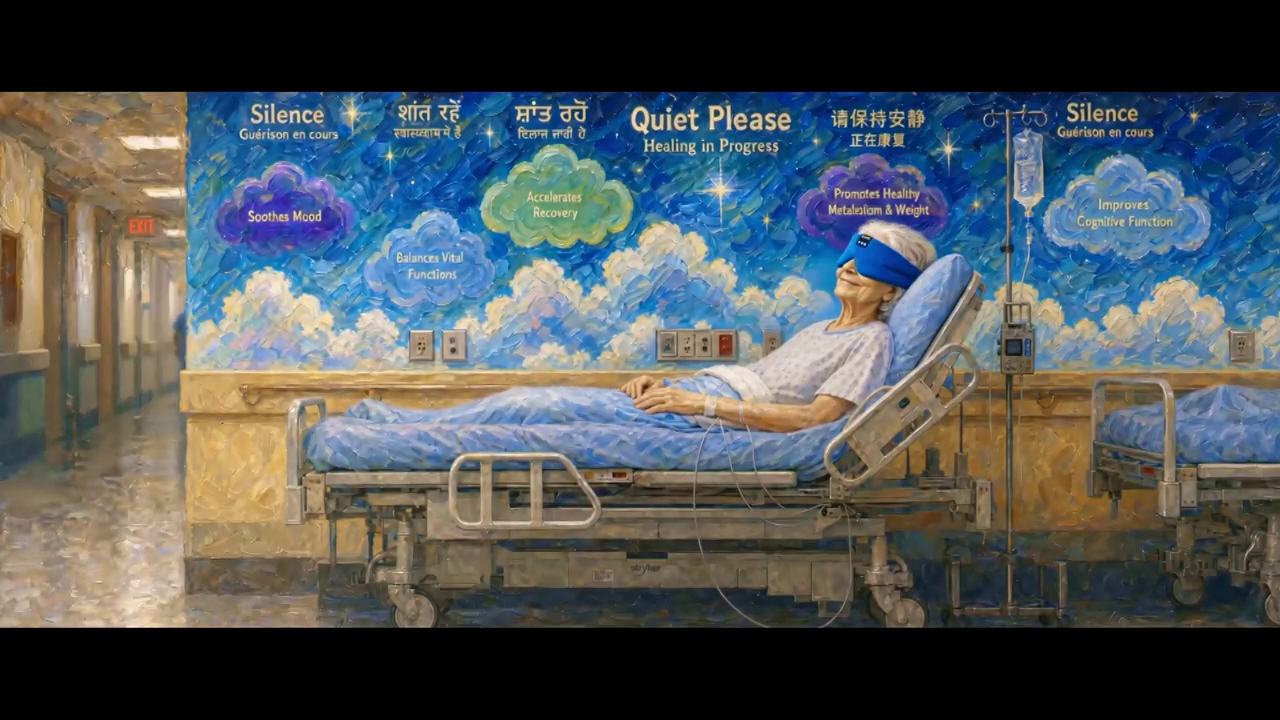
The utilization of emergency department hallways for inpatient care—commonly termed corridor medicine—is not an isolated operational anomaly; it is the visible manifestation of systemic hospital capacity insolvency. When British Columbia healthcare facilities issue eye masks and earplugs to patients admitted to hallways, the intervention is often framed as a comfort measure. In reality, this practice represents a low-cost, low-efficacy tactical buffer designed to mitigate the sensory consequences of a profound structural failure: the collapse of the hospital's internal supply chain for bed capacity.
To resolve the crisis of hallway medicine, healthcare leaders must look past surface-level symptoms and analyze the systemic throughput bottlenecks that force acute care into unmonitored, non-clinical spaces.
The Operational Mechanics of the Corridor Bottleneck
Hospital throughput operates on a strict queuing model governed by Little’s Law, which states that the long-term average number of patients in a stationary system is equal to the long-term average effective arrival rate multiplied by the average time a patient spends in the system. When the exit channels of a hospital become blocked, the entire system backs up into the entry point: the Emergency Department (ED).
[ED Admissions] ---> [Acute Care Inpatient Wards] ---> [Post-Acute / Community Care]
                           ^                                       |
                           |                                       v
                [CRITICAL BOTTLENECK]                    [ALC Bed Blockage]
                           |
              (Forces Hallway Overflow)
The progression toward corridor medicine follows a predictable three-stage cascade:
- Alternate Level of Care (ALC) Stagnation: The primary driver of ward blockages is the inability to discharge stabilized patients to post-acute destinations, such as long-term care facilities, rehabilitation centers, or home support services. These individuals are designated as ALC patients. They no longer require acute medical intervention but cannot be safely discharged to the community.
- Inpatient Bed Boarding: Because ALC patients occupy acute care beds, newly admitted patients from the ED cannot transition upstairs to the appropriate medical-surgical wards. The ED is forced to "board" these admitted patients.
- Decentralized Resource Dilution: As boarded patients fill the physical exam rooms of the ED, incoming ambulatory and ambulance patients still arrive. To maintain any degree of triage capability, the facility utilizes non-treatment zones—hallways, alcoves, and lounge areas—to hold the overflow.
The distribution of eye masks and earplugs is a direct acknowledgement of this failure. These tools attempt to artificially induce a micro-environment of rest within an area characterized by 24-hour ambient noise, high foot traffic, and continuous artificial lighting.
The Micro-Environmental Hazards of Non-Standard Care Spaces
Evaluating hallway medicine through a clinical risk framework reveals that the practice introduces significant latent errors into patient care. Standard inpatient rooms are engineered with fixed infrastructure designed to minimize adverse events. Hallways lack these structural controls, creating specific operational hazards.
Infection Control and Spatial Compromise
Standard acute care rooms dictate a specific volume of air exchange per hour and maintain physical barriers to limit droplet and airborne transmission. Hallway placement eliminates spatial isolation. Admitted patients in corridors are exposed to the viral and bacterial shedding of every individual walking through the department, including undiagnosed infectious patients entering through triage. The lack of dedicated hand hygiene sinks immediately adjacent to hallway stretchers reduces compliance with sanitization protocols, accelerating the risk of hospital-acquired infections.
Sensory Deprivation and Cognitive Degradation
The human circadian rhythm relies heavily on environmental cues, primarily the regulation of light and sound. The acoustic profile of a hospital hallway frequently exceeds 70 decibels due to alarms, staff communication, and rolling equipment—well above the World Health Organization's recommended limit of 35 decibels for patient rooms.
Continuous exposure to high-intensity fluorescent lighting and unpredictable acoustic spikes causes sleep fragmentation. In elderly or critically ill populations, this sensory chaos directly precipitates hospital-induced delirium. Delirium is not merely an inconvenience; it is a severe neurological complication associated with prolonged lengths of stay, increased cognitive decline, and higher mortality rates.
Distributing earplugs and eye masks attempts to create a barrier against these stimuli, but this assumes the patient possesses the cognitive and physical capacity to keep them in place. For patients with baseline dementia, altered mental status, or physical frailties, these external appliances offer no protection and can increase disorientation.
The Erosion of Diagnostic Privacy and Dignity
Physical layout directly influences clinical communication. In a corridor, private medical histories, diagnostic disclosures, and physical examinations occur within earshot and eyesight of passersby. This structural lack of privacy causes patients to withhold critical clinical information out of embarrassment, compromising the diagnostic accuracy of the treating team.
The Economic and Human Capital Toll
The financial costs of hallway medicine are frequently miscalculated because they are hidden within standard operational budgets. A precise accounting reveals that corridor care increases the overall cost function of healthcare delivery through several distinct mechanisms.
| Vector of Escalation | Operational Mechanism | Financial Impact |
|---|---|---|
| Nursing Inefficiency | Redundant movement, lack of integrated telemetry, manual charting workarounds. | Elevated labor cost per patient day. |
| Adverse Events | Increased falls, medication errors due to distraction, unmonitored clinical deterioration. | Extended length of stay, litigation costs, non-reimbursable treatments. |
| Staff Attrition | Moral injury from providing sub-standard care, chronic burnout, physical strain. | Escalated recruitment costs, reliance on high-cost agency nursing contracts. |
When nurses are forced to deliver care in a hallway, their workflow is fundamentally disrupted. They must travel longer distances to access medication dispensing units, clean supply rooms, and charting stations.
Furthermore, patient monitoring becomes decentralized. Instead of glancing at a centralized telemetry monitor or looking through a glass partition, nurses must physically navigate crowded corridors to check vital signs. This structural inefficiency reduces the time available for direct patient surveillance, increasing the probability that subtle signs of clinical deterioration will go unnoticed until a critical event occurs.
Structural Mitigation Strategies: Moving Beyond the Band-Aid
Resolving hallway medicine requires a transition away from symptom management toward structural capacity re-engineering. Hospital leadership cannot build their way out of the crisis simply by adding more physical beds; they must optimize the velocity of patient movement through the existing infrastructure.
1. Implementing Discharge-To-Assess (D2A) Models
The traditional discharge architecture requires all functional, cognitive, and social assessments to be completed before a patient leaves the acute care bed. This creates massive delays as patients wait for occupational therapy, physical therapy, and home care coordination.
The Discharge-to-Assess framework shifts these assessments to the patient’s home or a community-based setting.
- Step 1: Identify patients who are medically stable but require functional support optimization.
- Step 2: Discharge the patient immediately to their home environment with an integrated transition team (nurse, occupational therapist, and social worker).
- Step 3: Conduct the environmental and functional assessments within the home on day one of discharge, deploying targeted support services in real time.
This mechanism frees up acute care beds hours or days earlier, accelerating the decompression of the inpatient units and clearing the bottleneck that forces patients into the hallways.
2. Predictive Capacity Matching and Real-Time Demand Forecasting
Most hospitals operate on a reactive capacity model: they wait for the ED to fill up before calling in extra staff or attempting to expedite discharges. Modern operational strategy requires predictive modeling.
By analyzing historical triage data, seasonal viral patterns, ambulance arrival vectors, and scheduled elective surgeries, machine learning algorithms can predict ED admission volumes 48 to 72 hours in advance with high accuracy.
When the predictive model indicates that incoming demand will exceed inpatient capacity on a specific date, the hospital activates pre-emptively:
- Executing planned discharges 24 hours early.
- Opening temporary surge decompression spaces staffed by cross-trained personnel.
- Pausing non-urgent elective admissions that require post-operative inpatient beds.
3. Establishing Centralized Command Centers
Fragmented communication between departments slows down patient movement. A centralized hospital command center co-locates environmental services (cleaning), transport, bed management, and clinical leadership into a single room utilizing real-time data dashboards.
When an inpatient bed becomes empty, environmental services are dispatched via automated telemetry. The moment the room is sanitized, the ED bed coordinator is notified electronically, and the patient transport team is routed immediately. Reducing the time between bed vacancy and new patient arrival from three hours to 45 minutes across a 500-bed facility generates equivalent capacity to adding dozens of new physical beds, entirely without structural expansion.
4. Overhaul of Post-Acute Infrastructure Integration
The ultimate resolution of corridor medicine lies outside the hospital walls. Regional healthcare authorities must treat acute care hospitals and long-term care facilities as a single, deeply integrated ecosystem.
Governments must incentivize the expansion of specialized sub-acute and restorative care beds. These facilities operate at a lower cost-per-bed day than acute care hospitals and are specifically designed to transition ALC patients out of the acute care grid. Until the rate of community care capacity expansion matches or exceeds the rate of aging population growth, acute care hallways will continue to function as the safety net of an incomplete system.
The Strategic Path Forward
Hospital systems cannot afford to normalize substandard care through the institutionalization of amenities like eye masks and earplugs. These items are a metric of operational failure, signaling that a facility has compromised its core mission of safe, structured healing.
To permanently eliminate hallway medicine, regional healthcare executives must immediately reallocate capital away from superficial crisis management and toward the hard work of operational re-engineering. This demands the deployment of predictive analytics to forecast demand, the immediate implementation of Discharge-to-Assess protocols to reduce inpatient length of stay, and the aggressive expansion of community-based post-acute beds.
The elimination of corridor care is not a matter of comfort; it is a prerequisite for clinical safety and institutional survival. Hospital boards must hold leadership accountable not for how quietly patients wait in corridors, but for how rapidly those corridors are cleared.