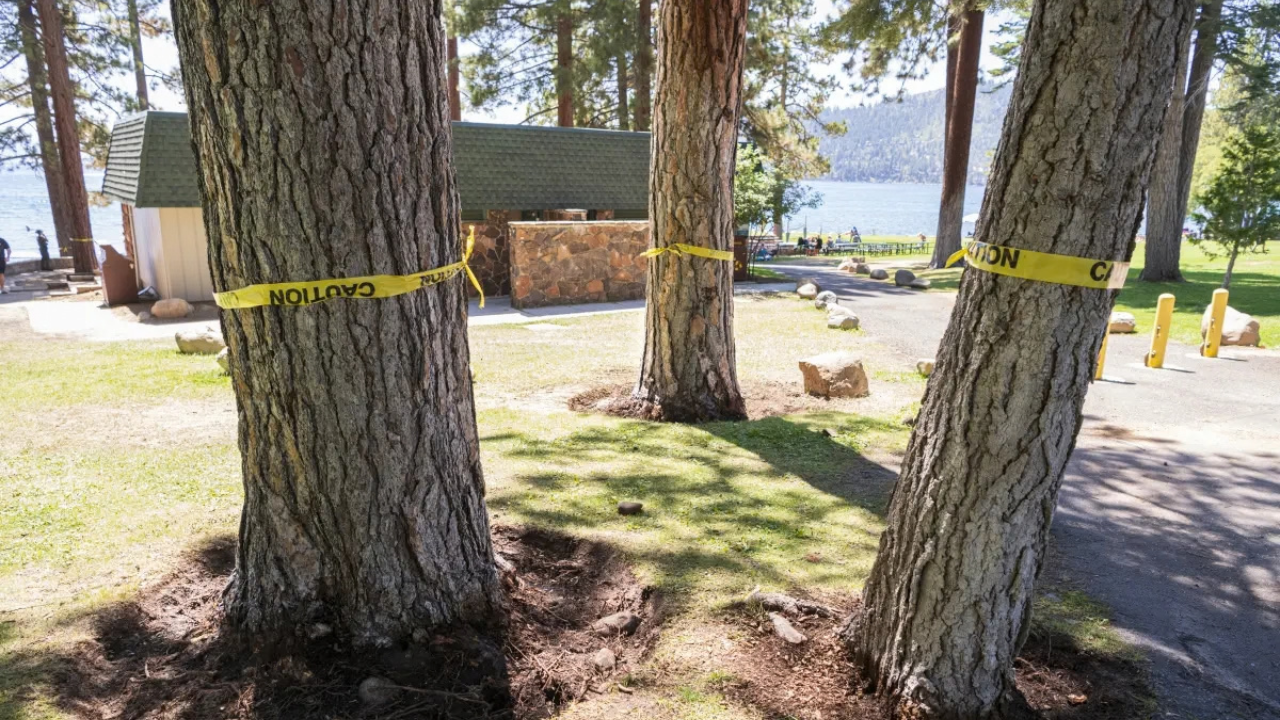
The systematic destruction of twenty-eight mature pine trees at Burnt Cedar Beach in Incline Village represents a distinct category of property degradation: asymmetric environmental vandalism executed for private locational rent capture. Between 2022 and 2026, an unknown perpetrator utilized localized systemic poisoning techniques—specifically drilling holes into trunks and treating root zones—to systematically eliminate centuries-old timber assets on public-access recreational land managed by the Incline Village General Improvement District (IVGID).
Analyzing this operational failure requires shifting the analytical framework from simple criminal mischief to a structured examination of asset valuation, vector mechanics, structural vulnerabilities in public land protection, and the economic incentives driving ecological crimes.
The Economic Motive Structure and Rent Capture
In high-value real estate markets surrounding alpine lake basins, visual access directly correlates with equity valuation. Waterfront and near-shore properties command steep premiums based on unobstructed sightlines. When public park infrastructure preserves dense arboreal buffers, private property owners who desire enhanced panoramic lake views face a structural barrier.
The economic calculus of environmental sabotage operates on a simple cost-benefit ratio:
- Cost Variables: The capital risk of criminal penalties, potential felony prosecution, and community-funded reward liability ($147,000).
- Benefit Variables: An immediate, permanent increase in adjacent property resale values driven by improved lake vistas, achieved by transforming a dense canopy into a degraded, cleared landscape.
Because the damaged timber is officially valued at more than $300,000—with individual century-old specimens classified by law enforcement as biologically irreplaceable—the financial upside for a private beneficiary whose property value stands to jump by hundreds of thousands of dollars creates a high-incentive corruption vector.
The Operational Mechanics of the Sabotage
The spatial and temporal distribution of the attacks reveals a calculated, recurring methodology rather than random acts of vandalism. The timeline documents distinct operational phases:
- Phase One (2022): Six initial trees targeted, serving as an initial test of detection thresholds and municipal response times.
- Phase Two (2024): An additional six trees targeted, establishing a persistent pattern of covert chemical deployment.
- Phase Three (2026): Accelerated escalation with sixteen additional trees targeted across multiple months (May, July, and August), totaling twenty-eight affected specimens.
The mechanical execution relies on vector precision: perpetrators bored holes directly into the vascular tissue of the trunks or applied concentrated chemical agents to the root perimeters. Pines transport water and nutrients via xylem vessels; introducing systemic herbicides or chemical disruptors directly into this
The Economics of Environmental Vandalism A Systems Analysis of Lake Tahoe Tree Poisoning
news, travel
Lake Tahoe represents an ecologically sensitive basin where vegetation serves a dual function as a natural filtration barrier and a real estate valuation mechanism. When twenty-eight mature trees suffer intentional poisoning across a concentrated timeframe, the incident transcends local vandalism. It exposes a systemic failure in perimeter asset protection, revealing an incentive structure where property owners or commercial entities capture asymmetric financial gains by eliminating natural view obstructions at a minimal, calculated penalty risk.
Evaluating this phenomenon requires dissecting the economic incentives, regulatory friction, and enforcement bottlenecks that govern urban forestry management within basin protection zones.
The Economic Motive Architecture
To understand why perpetrators risk criminal prosecution to kill mature Jeffrey pines and white firs, one must analyze the capitalization of lake views in mountain real estate markets. Unobstructed view corridors command a significant valuation premium over obscured parcels. A mature canopy positioned on public right-of-ways or shared easements frequently blocks panoramic perspectives, directly depressing property resale values or tourist visibility metrics for commercial hospitality structures.
When calculating the return on investment for environmental sabotage, perpetrators weigh the immediate appreciation of real estate equity against the expected value of penalties. The baseline enforcement mechanism relies on a financial reward structure, exemplified by a one hundred forty-seven thousand dollar pool funded by private and public stakeholders. However, a reward depends entirely on civilian informant testimony and successful criminal conviction—a high-friction investigative threshold.
If the probability of apprehension approaches zero due to covert execution methods, the expected cost of the crime collapses to marginal operational expenses, such as the chemical cost of systemic herbicides like glyphosate or triclopyr injected through discreet drill holes in the cambium layer. The rational actor model suggests that unauthorized arboricide persists precisely because the upside of permanent view creation outweighs the probabilistic deterrent of catch-and-penalize frameworks.
Methodological Vulnerabilities in Canopy Defense
Protecting dispersed biological assets across hundreds of square miles creates an inherent defensive asymmetry. Unlike static infrastructure protected by closed-circuit telemetry and perimeter fencing, living trees exist in open environments accessible to the public twenty-four hours a day.
Perpetrators exploit this vulnerability through standardized mechanical protocols:
- Borehole Penetration: Drilling narrow, downward-sloping channels into the vascular cambium layer using battery-operated augers during low-traffic nocturnal windows.
- High-Concentration Application: Instantly injecting concentrated systemic herbicides directly into the nutrient transport stream, bypassing soil-absorption detection vectors.
- Delayed Lethality Timing: Selecting application schedules that mimic natural drought stress or bark beetle infestation, thereby delaying diagnostic confirmation until the canopy fails months later.
This operational stealth prevents real-time interdiction. Foresters and municipal landscape managers typically identify poisoning only after chlorosis and needle drop render the damage irreversible. By the time diagnostic tissue assays confirm chemical agents, the perpetrator has fully realized the objective, whether it involves enhanced sunlight exposure for solar panels, expanded parking capacity, or permanent vista clearing.
Regulatory Friction and Jurisdictional Overlap
Mitigating unauthorized tree removal is complicated by a fragmented jurisdictional matrix. The Lake Tahoe basin involves a complex overlay of local municipal codes, state environmental protection divisions, and regional planning compacts like the Tahoe Regional Planning Agency.
This regulatory stratification generates three structural vulnerabilities:
- Enforcement Gaps: Jurisdictional boundaries create administrative hesitation regarding primary investigative responsibility, slowing response times during the critical evidence-collection window.
- Permit Asymmetry: The administrative burden and financial cost of legally pruning or removing a hazardous or view-obstructing tree through authorized channels can span months and incur strict mitigation fees. This friction incentivizes illicit circumvention.
- Diagnostic Lag: Proving criminal intent requires establishing that chemical introduction was deliberate rather than accidental drift or natural pathogen mortality, a standard of proof that strains municipal lab resources.
When legal compliance requires high transaction costs while unauthorized destruction yields immediate economic windfalls with low enforcement velocity, the regulatory framework actively incentivizes non-compliance.
Resource Allocation and Surveillance Optimization
Relying on retroactive cash rewards functions as a reactive policy instrument rather than a preventative control. To alter the cost-benefit calculus for potential offenders, resource allocation must shift from post-mortem investigation to real-time asset monitoring.
Municipalities and property associations must treat high-value canopy specimens as critical infrastructure. This requires deploying targeted, low-profile environmental sensors capable of detecting unauthorized mechanical vibrations near tree trunks, or utilizing multispectral drone flyovers to detect early-stage canopy water stress before visual symptoms manifest. Furthermore, reforming the permit architecture to streamline legitimate, monitored view-management requests would reduce the economic desperation that often drives property owners toward covert arboricide.
Until the probability of immediate detection matches the high financial stakes of real estate view enhancement, targeted environmental sabotage will remain a rational, low-risk strategy for actors seeking to capture localized value at the expense of collective natural capital.