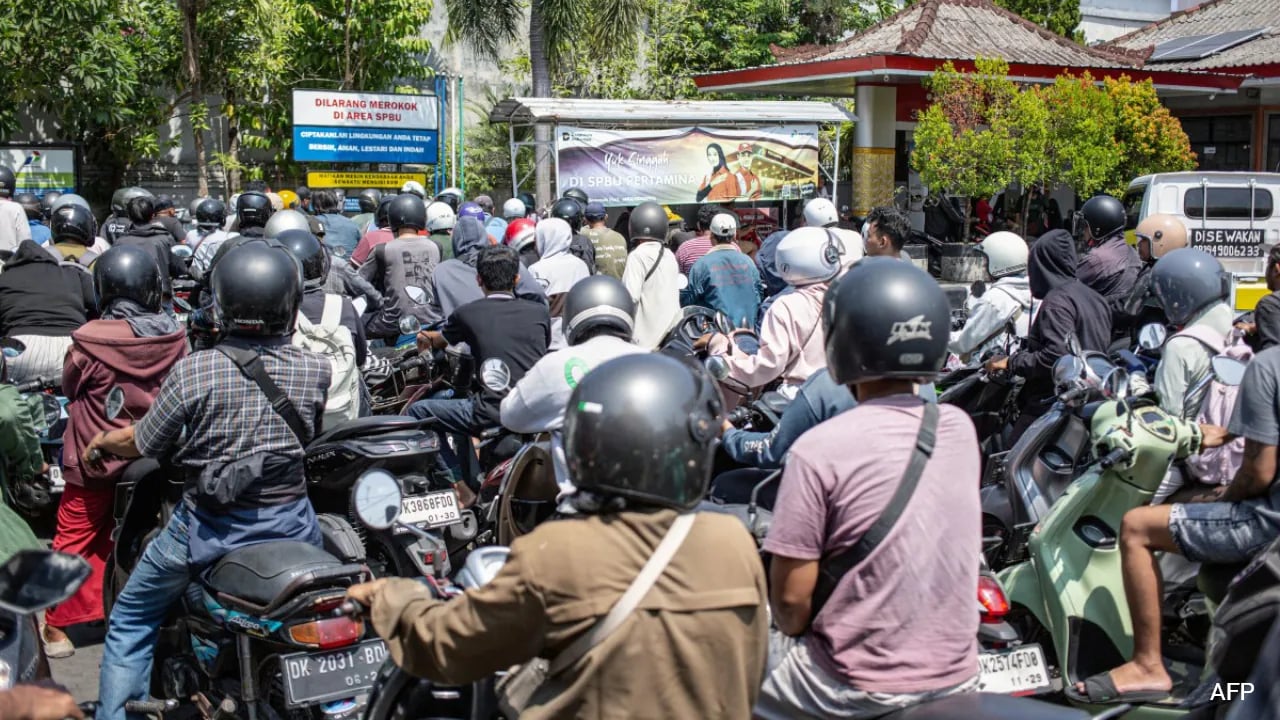
A retail fuel system does not collapse merely because a tanker drops an anchor or weather slows a vessel; it breaks when price distortions turn a narrow logistics delay into a self-reinforcing run on inventory. During the October 2026 fuel disruption in Bali, hundreds of protesters gathered in Denpasar while vehicle queues stretched over a kilometre at service stations across the island. Standard wire coverage treats that sequence as a straightforward chain of events: weather and shipping snags delayed fuel deliveries, motorists panicked and lined up, authorities introduced rationing and military support, and public anger spilled into street protests.
That narrative describes symptoms rather than structure. In an island economy that depends on seaborne fuel imports and state-administered pricing, physical logistics and price incentives interact continuously. A small drop in arrival cadence hits a market already primed for substitution, turning routine refilling into precautionary hoarding and exposing the operational limits of last-mile distribution.
The blueprint for understanding this episode rests on four analytical pillars: how a single-entry island supply chain amplifies small delays into station stockouts, how two-tier fuel pricing drives sudden demand migration toward subsidized grades, how precautionary buying and informal resale distort queue physics, and how administrative rationing trades short-term calm for operational friction.
Deconstructing the Competitor Narrative
Conventional reporting on the Bali shortage relies on four core claims:
- External and maritime friction: Anchor trouble on a tanker, rough weather, and broader shipping tensions slowed fuel deliveries into Bali.
- Aggregate versus local availability: Officials maintained that national or depot inventories remained sufficient and that the core problem was distribution rather than absolute scarcity.
- Demand surges and substitution: Motorists shifted toward subsidized Pertalite after price increases on higher-grade Pertamax products, while fear of running dry triggered panic buying.
- Emergency containment: Authorities rolled out odd-even license plate rules, volume caps per vehicle, night-time truck refueling limits, police escorts, and extended station hours alongside military assistance.
Taken together, those points read like a list of separate causes rather than an integrated system. Standard news summaries rarely ask why a temporary marine delay quickly produces kilometre-long queues in urban centers like Denpasar and South Kuta, nor why official assurances about depot stocks fail to calm motorists once pumps run dry. To move from journalism to operational diagnosis, each claim has to be mapped onto the mechanism that governs it.
Where public records do not publish exact hourly depot volumes, station-level tank readings, or total litres diverted into informal resale, exact figures must be treated as unknown rather than guessed. What is established is the structural logic connecting marine bottlenecks, relative price gaps, queue behavior, and administrative controls.
The Four Structural Pillars of the Disruption
Marine Buffer Compression and Last-Mile Bottlenecks
Island fuel supply chains operate with a different risk profile than mainland pipeline networks. Because Bali relies on shipped-in gasoline and diesel, inventory at any given moment sits across three echelons: incoming vessels, onshore storage depots, and retail service station tanks.
A delay at the marine unloading stage does not need to exhaust national reserves to cause local empty pumps. If tanker berthing or unloading slips due to anchor issues or adverse sea conditions, replenishment intervals lengthen while retail withdrawal continues. Once retail tank levels fall below a critical working threshold, two operational problems emerge:
- Pump cavitation and downtime: Tanks running near empty lose pressure consistency and require careful replenishment management, slowing throughput at the forecourt.
- Fleet dispatch congestion: When deliveries fall behind schedule, road tankers face compressed turnarounds, prompting measures such as escorting trucks and restricting commercial trucks to night-time refueling to keep retail bays open for public vehicles.
In queuing theory, a service system with variable arrival rates and high utilization behaves nonlinearly. Even a modest reduction in delivery frequency can push utilization close to capacity, causing waiting times to expand far faster than the percentage drop in supply.
Relative Pricing and Demand Migration
Supply bottlenecks rarely hit a static demand curve. In a market where unsubsidized fuel grades sit at higher prices than state-subsidized Pertalite, price adjustments on upper tiers alter consumer choice immediately. When non-subsidized Pertamax prices rise, cost-sensitive motorists and commercial operators have a direct financial incentive to trade down to cheaper Pertalite.
That substitution creates an asymmetric strain on fuel infrastructure. Storage tanks, delivery schedules, and forecourt nozzles are proportioned around historical grade mix and quota structures. A sudden shift in consumer preference concentrates pressure on the subsidized grade even if total fuel across all grades appears balanced on paper.
Consider a commuter or ride-hailing driver whose daily operating margin depends on fuel cost. Moving from a higher-priced grade to subsidized Pertalite preserves cash flow every single day. Once queues form at Pertalite pumps, the time cost of waiting competes with the money saved per litre—yet for low-margin transport workers, protecting unit fuel cost often outweighs time spent waiting.
Precautionary Hoarding and Informal Arbitrage
Once motorists observe empty pumps or multi-hour lines at neighboring stations, individual incentives shift from routine refueling to precautionary stockholding. In economics, this is a classic coordination failure: filling up early or topping off a nearly full tank is rational for an individual trying to avoid being stranded, yet when hundreds of drivers act on that same logic simultaneously, demand spikes artificially ahead of physical consumption.
That rush creates a secondary distortion: informal arbitrage. When regulated pump prices sit below clearing levels during a localized shortage, opportunistic resellers buy fuel at subsidized rates and offer small quantities—such as fuel sold in bottles online—at steep markups. Police action against unauthorized resale underscores how price caps paired with physical scarcity invite middlemen to capture the spread between official pump prices and desperate willingness to pay.
Rationing Mechanics and Administrative Friction
To arrest queue growth and stretch remaining stocks, authorities turned to administrative allocation: restricting Pertalite purchases by odd or even plate digits on corresponding dates, capping purchase volumes at three litres for motorcycles and twenty litres for cars, expanding operating hours at dozens of stations, and deploying security personnel to manage order.
Rationing alters the rationing mechanism from price or first-come patience to calendar eligibility and quantity caps. That shift solves two immediate problems while introducing new operational trade-offs:
- Demand smoothing on peak days: Odd-even rules split eligible buyers across days, reducing simultaneous pressure on pumps during the initial rationing window.
- Tank-top-up distortion: A small cap—such as three litres for a motorcycle—prevents large single-visit hoarding, but frequent small top-ups can increase total customer visits per litre dispensed if riders return as soon as their eligible day opens.
- Enforcement load: Checking plate digits, enforcing volume limits, and keeping queues out of live traffic lanes require sustained human oversight at every participating station.
What Standard Coverage Misses About Cause and Effect
The first hidden connection lies between visibility and panic. Social media clips of kilometre-long lines and exhausted drivers waiting overnight or through midday heat act as real-time demand signals. Even drivers who still have half a tank enter the queue after seeing viral footage, turning a localized pocket of low inventory into an island-wide surge.
The second connection involves time-of-day productivity loss. When commuters, delivery riders, and small-business operators spend hours in line—sometimes starting early in the morning and still waiting in the afternoon—the economic cost extends beyond fuel expenditure. Missed shifts, delayed deliveries, and near-misses on airport transfers disrupt service reliability across Bali's tourism and local service economy.
The third connection concerns credibility gaps during a shortage. Official statements that depots hold adequate fuel are technically plausible if onshore or regional reserves exist, yet they ring hollow to a motorist staring at a "fuel not available" sign after waiting for hours. Without transparent, station-level replenishment updates, drivers discount macro assurances and rely on physical line-jumping or early arrival to secure supply.
Operational Implications for Stakeholders
For Residents, Commuters, and Gig Workers
- Treat tank level as a buffer, not a gauge: Refill well above a quarter-tank threshold during normal periods so routine marine or road delays do not force an emergency queue.
- Match trips to eligibility and hours: When odd-even plate rules or volume caps are active, plan journeys around eligible dates and check extended-hour station lists rather than visiting the nearest congested urban forecourt.
- Avoid unverified roadside or online resale: Buying fuel from informal sellers at inflated prices carries safety hazards, quality risks, and legal exposure when authorities crack down on unauthorized resale.
For Travelers and Tourism Operators
- Build time buffers around transit: If traveling to or from the airport or moving between regions during a fuel crunch, add extra transit time for slower traffic around congested stations and potential ride delays.
- Coordinate fleet and transfer schedules early: Tour operators, hotels, and car-rental agencies should stagger vehicle dispatch times, track refueling windows, and avoid letting transfer vehicles run low between pickups.
For Energy Distributors and Local Authorities
- Publish live station-level status: Pairing macro stock statements with frequent updates on which stations have active supply and scheduled deliveries reduces speculative queuing.
- Protect commercial and essential mobility: Separating priority commercial refueling—such as logistics trucks operating at night—from peak commuter rushes helps maintain goods movement while stations clear backlogs.
- Calibrate cap sizes to tank economics: Volume limits should curb bulk hoarding without forcing so many micro-refills that forecourt transaction overhead slows overall throughput.
Limits of These Measures and Strategic Play
No administrative rule or logistics adjustment eliminates every risk in an island fuel system. Odd-even restrictions can frustrate workers whose schedules do not align with eligible dates, strict volume caps can increase repeat visits, and heightened security presence addresses crowd control rather than adding marine unloading capacity. Furthermore, price gaps between subsidized and non-subsidized grades will keep creating substitution pressure whenever upper-tier prices rise or supply tightens.
The decisive strategic play for fuel distributors and regional planners is to couple marine contingency buffers with real-time demand transparency. Instead of relying on reassurance after queues form, operators should maintain dedicated marine unloading slack for weather and vessel delays, model grade-substitution spikes whenever unsubsidized prices adjust, and publish clear replenishment schedules by station so motorists do not have to guess whether a one-kilometre line leads to an empty pump.