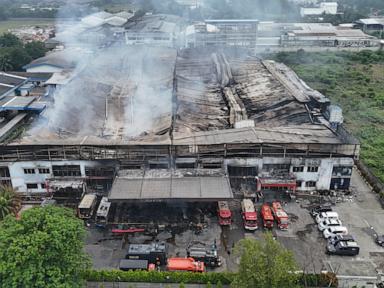
Industrial fires in low-margin manufacturing facilities rarely result from a single catastrophic failure. When a blaze erupts inside a candy production plant and leaves 34 workers unaccounted for, the immediate operational reality shifts from fire suppression to high-stakes search and rescue under extreme structural and thermal constraints. Standard news coverage treats these events as sudden tragedies driven by bad luck. In reality, mass-casualty factory fires follow a predictable thermodynamic, architectural, and regulatory chain reaction.
Understanding why 34 personnel become trapped during a single shift requires mapping the exact mechanics of confectionery plant operations. Candy manufacturing combines volatile particulate matter, high-heat cooking vessels, flammable packaging polymers, and dense manual labor. When these variables intersect inside facilities built with inadequate egress architecture, the time between initial ignition and total compartment flashover drops below three minutes. You might also find this connected coverage interesting: Marcia Ann Gillespie Rebuilt Black Women's Media From the Ashes of Tokenism.
The Thermodynamics of Confectionery Production
Confectionery plants operate as high-energy thermal environments. Unlike heavy metallurgy or chemical refining, food processing rarely carries the public perception of extreme fire hazard. This perception gap creates fatal blind spots in facility design and daily floor management.
Three distinct fuel loads coexist on a standard candy production floor: As highlighted in detailed reports by The Washington Post, the effects are notable.
- Combustible Dust Clouds: Sugar, cornstarch, and flour are foundational inputs. In bulk form, granulated sugar burns slowly. When pulverized during grinding, coating, or pneumatic transfer, fine sugar particles suspend in the air. If this aerosolized dust reaches a specific concentration within an enclosed space and encounters an ignition source—such as an overheated bearing, static discharge, or electrical arc—it triggers a rapid deflagration. The initial pressure wave dislodges settled dust from overhead rafters and ductwork, causing secondary explosions that propagate through the entire structure within seconds.
- High-Temperature Cooking Media: Boiling sugar syrups requires sustained temperatures between 110°C and 165°C depending on the target crystallization stage. Facilities rely on gas-fired burners, pressurized steam lines, or thermal oil heaters to maintain these loads. If a thermal oil line ruptures or pressurized gas leaks near an open flame, the resulting pool fire generates radiant heat intense enough to ignite adjacent materials without direct flame contact.
- Hydrocarbon Packaging Inventories: Finished confectionery products require high-speed wrapping in polypropylene, polyethylene, and waxed paper. High-throughput facilities store massive rolls of plastic film and corrugated cardboard directly adjacent to the packaging lines to minimize material handling time. Once ignited, these polymers melt into flowing liquid fires, releasing dense, toxic plumes of carbon monoxide, hydrogen cyanide, and acrolein.
The interaction between these three elements dictates the speed of the disaster. A localized mechanical failure ignites packaging film, which produces radiant heat sufficient to rupture cooking lines or aerosolize settled starch dust. Within 120 seconds, breathable air inside the production hall is replaced by superheated, oxygen-depleted toxic smoke.
The Architecture of Egress Failure
When 34 workers cannot exit a burning facility, the failure lies in egress engineering and floor-plan congestion rather than slow human reaction times. Industrial safety codes globally—including Indonesia's national building standards (SNI) and international benchmarks like NFPA 101—establish strict mathematical ratios for exit width, travel distance, and occupant load.
In rapid-growth manufacturing sectors, operational realities routinely degrade these safety margins through four mechanisms:
- Exit Obstruction and Security Locks: Facility managers frequently lock secondary fire doors from the outside or block them with pallets of raw ingredients to prevent inventory shrinkage and unauthorized breaks. During a fire, workers instinctively retreat toward the main entrance they use daily. If smoke obscures that primary corridor, the remaining personnel hit dead ends at locked emergency exits.
- Compartmentalization Breakdown: Properly engineered factories use fire-rated walls and self-closing fire doors to isolate high-heat cooking zones from labor-intensive manual packing rooms. In retrofitted or older plants, these barriers are often compromised by unsealed conveyor belt pass-throughs, open ventilation ducts, and utility penetrations. Smoke and heat bypass walls entirely, filling packing rooms before workers on the floor realize a fire has started in the kitchen sector.
- Maze-Like Production Layouts: To maximize square-footage yield, machinery, cooling tunnels, and sorting tables are packed tightly together. This creates narrow, winding aisles. Under zero-visibility smoke conditions—where light transmission drops to less than half a meter—workers lose spatial orientation. Even employees with years of tenure cannot navigate a 90-degree turn around a conveyor line when blinded by acrid smoke and suffering from acute hypoxia.
- Window Security Grilles: Ground-floor and second-story windows in industrial zones are routinely fitted with welded steel bars to deter theft. While effective against external intrusion, these grilles convert standard windows into lethal cages during an internal fire, preventing workers from self-evacuating and blocking firefighters from inserting ladders or hose lines from the exterior.
Search and Rescue Mechanics Under Structural Compromise
When rescue teams arrive at a fully involved industrial fire with dozens of missing personnel, they face an acute tactical dilemma: aggressive interior search versus defensive exterior containment.
Every minute spent suppressing the fire from the outside reduces the survival probability of trapped workers. Conversely, sending rescue squads into a burning steel-and-concrete shell risks catastrophic loss of responders. Industrial warehouses typically utilize unprotected structural steel trusses to support wide-span roofs. Steel loses approximately 50 percent of its load-bearing strength at 550°C. A hydrocarbon-fueled factory fire easily exceeds 800°C within ten minutes.
Rescue commanders must execute a rigid operational sequence under extreme time pressure:
- Thermal and Structural Assessment: Before breaching the perimeter, incident commanders evaluate roof deflection, wall bowing, and smoke color. Thick, pressurized black smoke pulsing from eaves indicates ventilation-limited combustion—a precursor to backdraft explosions if doors are forced open improperly.
- Establishing Vent-Enter-Isolate-Search (VEIS) Sectors: Rather than walking blindly from the main entrance, specialized teams breach exterior walls or windows directly adjacent to high-occupancy zones, such as manual packaging lines, break rooms, and washrooms. They isolate the room from the main corridor to prevent smoke inflow, search the perimeter, and extract victims immediately.
- Thermal Imaging and Acoustic Sweeps: Standard flashlights fail completely in dense polymer smoke. Rescuers rely on thermal imaging cameras (TICs) to detect human heat signatures against cooler floor slabs. However, if the ambient temperature inside the building approaches human body temperature (37°C) or higher, TIC contrast degrades, forcing teams to conduct physical wall-and-floor sweeps on hands and knees where the lowest thermal layer resides.
- Heavy Debris Extrication: Once primary flame knockdown occurs, partial roof collapses often trap victims beneath twisted sheet metal, fallen HVAC ducts, and collapsed shelving. Transitioning from fire suppression to Urban Search and Rescue (USAR) requires hydraulic spreaders, concrete saws, and crane support to lift structural steel without triggering secondary collapses over void spaces where survivors might be sheltered.
The Regulatory Enforcement Deficit in Emerging Manufacturing Hubs
Indonesia represents one of Southeast Asia's largest manufacturing economies, driven by domestic consumption and export-oriented food processing. While the nation maintains formal occupational health and safety statutes—specifically Law No. 1 of 1970 on Occupational Safety and subsequent Ministry of Manpower regulations—a wide gap persists between statutory requirements and factory-floor enforcement.
This enforcement deficit stems from three structural realities:
First, municipal fire inspectorates and labor ministries operate with severe manpower shortages relative to the total number of registered small- and medium-sized enterprises (SMEs). Inspectors must cover thousands of facilities per district, leading to predictable, scheduled audits rather than unannounced operational inspections. Facility operators temporarily clear aisles and unlock doors during scheduled visits, reverting to congested configurations the following week.
Second, the informal subcontracting of labor obscures true headcounts. When a fire occurs, management frequently struggles to provide rescue commanders with an accurate manifest of personnel inside the building. Daily casual laborers, third-party packaging contractors, and shift-change overlaps create uncertainty regarding whether 34 people are trapped inside or whether some fled the scene without checking in at assembly points. This ambiguity forces rescuers to continue high-risk interior searches long after survivable conditions have expired.
Third, capital allocation in low-margin food manufacturing prioritizes production throughput over passive fire protection. Installing automated dry-chemical suppression systems over cooking vats, explosion-venting panels on dust collectors, and addressable smoke-detection networks requires significant upfront capital expenditure (CapEx) that yields zero direct increase in unit output. Without strict enforcement penalties or insurer mandates, operators defer these investments indefinitely.
Limitations of Reactive Emergency Response
Public scrutiny following mass-casualty factory fires inevitably focuses on the speed and equipment of municipal fire brigades. This focus misdiagnoses the root cause. Even the best-equipped, fastest-responding fire department in the world cannot overcome the physics of an unprotected industrial flashover.
If a fire starts at minute zero, automatic detection fails, and workers do not evacuate immediately, fatal atmospheric conditions develop by minute four. A municipal fire engine requires an average of two minutes for dispatch processing, four to eight minutes for transit through urban or industrial traffic, and another three minutes to establish water supply and deploy attack lines. By the time water hits the fire at minute twelve, the outcome for anyone trapped inside the primary burn zone is already determined.
Water supply infrastructure in peri-urban industrial zones compounds this limitation. Municipal hydrants frequently lack adequate static pressure or flow volume (measured in liters per minute) to sustain multiple master streams required for a large-footprint warehouse blaze. Tanker shuttles must be established, creating intermittent water delivery that allows fires to regain intensity between drops.
Strategic Mandates for Industrial Risk Mitigation
Preventing mass-casualty events in confectionery and light-manufacturing facilities requires shifting capital and regulatory pressure upstream—away from post-ignition rescue and toward pre-ignition engineering controls. Supply chain buyers, insurers, and industrial operators must enforce four non-negotiable operational standards:
- Mandatory Physical Egress Audits: Digital compliance checklists are useless. Third-party auditors and corporate buyers must conduct unannounced, physical walkthroughs verifying that every emergency exit opens outward with a single push-bar motion, zero external locks or chains exist on the premises, and window grilles feature interior quick-release mechanisms.
- Dust and Vapor Source Capture: Facilities handling powdered sugar, starch, or flour must install grounded, explosion-vented dust collection systems directly at milling and coating points. Housekeeping protocols must mandate HEPA-filtered industrial vacuums rather than compressed air blow-downs, which aerosolize settled dust into explosive clouds.
- Fire-Rated Process Isolation: High-heat cooking operations must be physically separated from manual packing and raw material storage by two-hour fire-rated masonry walls. Conveyor openings passing through these walls must be equipped with fusible-link fire shutters that drop automatically upon thermal detection.
- Real-Time Personnel Accountability Systems: Replace paper sign-in sheets with ruggedized RFID badge gates or biometric turnstiles integrated with exterior muster-point readers. During an evacuation, incident commanders must receive an automated, real-time digital manifest showing exact headcounts by zone within 60 seconds of alarm activation.
Until industrial operators treat fire protection engineering as a core prerequisite for plant operation rather than an optional regulatory overhead, rapid-onset thermal events will continue to turn routine production shifts into mass-casualty recovery operations.



