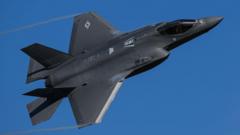
The United States Central Command (CENTCOM) deployment of targeted kinetic strikes against Iranian Revolutionary Guard Corps (IRGC) naval and missile assets in southern Iran is not a breakdown of diplomacy, but the calculated execution of a coercive bargaining framework. On May 25, 2026, US warplanes struck surface-to-surface missile launch sites and fast-attack craft attempting to emplace naval mines near the Strait of Hormuz, specifically targeting infrastructure across Bandar Abbas, Sirik, and Jask. While standard media analysis frames this as an escalatory contradiction to the fragile April 7 ceasefire, an operational assessment reveals it as an enforcement mechanism designed to alter Iran’s cost function during active negotiations in Doha.
Understanding this military intervention requires stripping away the political rhetoric of "self-defense" and analyzing the specific tactical bottlenecks, asymmetric calculations, and strategic variables driving the Washington-Tehran conflict.
The Strategic Triad of the Doha Negotiations
The current hostilities, initiated by the US-led Operation Epic Fury earlier this year, have evolved into a high-stakes diplomatic standoff. The strikes occurred precisely as Iranian Lead Negotiator Mohammad Bagher Ghalibaf and Foreign Minister Abbas Araghchi engaged in mediation efforts with Qatari officials. To understand why the US applied kinetic pressure during a diplomatic window, one must analyze the three core pillars underpinning the proposed 60-day ceasefire extension:
- The Maritime Reopening Schedule: The primary economic objective for the US and its allies is restoring unhindered traffic through the Strait of Hormuz. Normal transit volume of 125 to 140 vessels daily has collapsed to a mere 32 vessels, heavily bottlenecking global energy supply chains. The framework under negotiation demands a 60-day phased recovery: a 30-day window for Iran to halt hostilities, followed by a 30-day mine-clearing operation conducted by Iranian forces without charging transit fees.
- The Nuclear Stockpile Mandate: The Trump administration has introduced a non-negotiable structural constraint regarding Iran's highly enriched uranium stockpile. The US position dictates two binary pathways: the immediate physical transfer of the material to the United States or its verified, witness-backed destruction in situ under the supervision of the International Atomic Energy Agency (IAEA) or an equivalent body.
- Asset Liquidity Disbursal: Iran’s primary incentive for compliance is the conditional release of frozen foreign exchange reserves. The presence of Iran’s Central Bank governor in Doha confirms that access to capital is the core variable balancing Tehran's economic calculus against its geopolitical posturing.
The Cost Function of Asymmetric Interdiction
By attempting to lay naval mines during an active ceasefire, Iran sought to alter the baseline of the negotiations, demonstrating its capability to permanently choke off 20 percent of global oil and gas transit if its demands regarding asset liquidation were unmet. The US kinetic response was engineered to systematically dismantle this leverage by targeting the specific operational mechanisms of Iranian asymmetric warfare.
Naval Mine-Laying Infrastructure
The destruction of two IRGC boats near the Strait of Hormuz directly targets Iran’s primary anti-access/area-denial (A2/AD) mechanism. Naval mines represent an incredibly low-cost, high-impact method of asymmetric deterrence. By eliminating the fast-attack craft before the mines could be deployed, CENTCOM neutralized the threat at the lowest point of its cost-to-neutralize curve. Once a mine is in the water, the cost, time, and risk required to sweep and clear the waterway scale exponentially; by striking the vessels during the emplacement phase, the US maintained maritime access while minimizing post-conflict remediation costs.
Mobile and Fixed Missile Launch Sites
The targeting of land-based missile sites in Bandar Abbas, Sirik, and Jask serves a dual tactical purpose. First, it degrades Iran's shore-to-ship missile capability, which acts as the protective umbrella for their mine-laying operations. Second, it establishes a credible threat of vertical escalation. When an Iranian surface-to-air missile system in Bandar Abbas engaged US warplanes, the immediate kinetic destruction of that system demonstrated a clear technological and operational superiority, signaling to Tehran that its air defense network cannot safeguard its offensive coastal assets.
The Drone Intercept and Technological Asymmetry
Hours prior to the US airstrikes, Iranian state media claimed the successful intercept of a "hostile" stealth reconnaissance drone over the Persian Gulf via a newly unveiled indigenous air defense system. This event highlights a critical technical friction point in the conflict: the battle for local sensor supremacy.
In a highly confined maritime theater like the Strait of Hormuz, real-time intelligence, surveillance, and reconnaissance (ISR) determine tactical outcomes. The US relies heavily on low-observable uncrewed aerial vehicles (UAVs) to map IRGC troop movements, locate mobile missile launchers, and track mine-laying vessels. Iran’s deployment of a new domestic air defense asset to deny this airspace is an attempt to create an information vacuum.
However, the subsequent precision strikes by CENTCOM demonstrate that even if Iran achieved a localized, temporary disruption of low-observable ISR, the broader US command-and-control network retained sufficient targeting data from alternative orbital or standoff sensors to execute highly precise, concurrent strikes across multiple geographic coordinates.
Geopolitical Friction Points and Structural Limits
The tactical theater in the Persian Gulf does not exist in isolation. It is structurally linked to wider regional dynamics that limit or accelerate the options available to both state actors.
+------------------------------------+       +------------------------------------+
|       US Kinetic Escalation        |       |    Israeli Northern Offensive      |
|  (Targeting IRGC Southern Assets)  |       |   (Targeting Hizbollah Targets)    |
+-----------------+------------------+       +-----------------+------------------+
                  |                                            |
                  v                                            v
+---------------------------------------------------------------------------------+
|                                 IRANIAN STATE                                   |
|                          STRATEGIC RESOURCE CRUNCH                              |
|   (Simultaneous pressure on domestic infrastructure and external proxy networks)  |
+---------------------------------------------------------------------------------+
The first structural variable is the synchronization of pressure on Iran's proxy network. Concurrently with the US strikes in southern Iran, Israeli Prime Minister Benjamin Netanyahu ordered an intensification of kinetic operations against Hizbollah in Lebanon, hitting over 70 targets within a 24-hour window. This simultaneous execution forces Iran into a strategic dilemma. It must allocate dwindling command-and-control resources and financial capital to reinforce its primary external deterrent (Hizbollah) while defending its domestic sovereign territory from direct US air operations.
The second limitation lies within the diplomatic architecture itself. While certain regional actors have attempted to leverage the US-Iran peace talks to advance broader multi-lateral accords, regional diplomatic sources confirm that these files remain structurally decoupled. The US-Iran framework is strictly limited to the security architecture of the Strait of Hormuz and nuclear counter-proliferation. Treating these negotiations as a distinct, isolated transaction prevents the talks from becoming bogged down by the intractable political complexities of broader Levant dynamics.
Operational Forecast and Strategic Playbook
The deployment of kinetic force during a ceasefire is a text-book application of "brinkmanship within bounds." The US administration is signaling that it will not tolerate the modification of the status quo on the water while negotiations are pending.
The immediate economic impact of this calculated escalation was a 7 percent drop in global oil prices, signaling that energy markets interpreted the swift, precise neutralization of the mine-laying threat as a net positive for the long-term stability of the waterway, rather than a harbinger of total war. The market realizes what the strategic frameworks confirm: neither Washington nor Tehran desires a total collapse of the April 7 truce.
For the US, the next logical operational play is to maintain a high-readiness posture over the Strait of Hormuz while refusing to alter the core text of the Doha document. By demonstrating that the cost of violating the ceasefire terms is immediate infrastructure destruction, the US forces Iran into a binary choice: proceed with the 60-day phased reopening and uranium surrender, or face a systemic, piece-by-piece degradation of its coastal military architecture. Tehran's negotiators will likely prolong the specific language review for several days to save face domestically, but the structural reality remains that without the release of frozen funds, Iran’s economic friction point will inevitably compel its signature on the document.