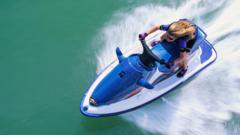
The proliferation of personal watercraft (PWC)—commonly known as jet skis—in coastal and municipal waterways has exposed a critical vulnerability in maritime law enforcement: the systemic failure of passive optical surveillance to deter high-risk operating behavior. Recent field reports indicating that PWC operators are deliberately removing identification plates to evade camera-based tracking systems, even while carrying minors, highlight a predictable breakdown in risk mitigation. When the probability of identification approaches zero, the perceived cost of non-compliance drops below the threshold of operator utility, resulting in reckless behavior.
Addressing this regulatory failure requires moving past superficial complaints about operator behavior. Instead, the problem must be analyzed through the mechanics of maritime enforcement, the economic incentives driving non-compliance, and the technical limitations of current tracking infrastructure.
The Tripartite Framework of Maritime Non-Compliance
To understand why PWC operators successfully evade oversight, the problem can be broken down into three interdependent variables.
+------------------------------------------------------------+
|            The Tripartite Evasion Framework                |
+------------------------------------------------------------+
|                                                            |
|  1. IDENTIFICATION ASYMMETRY                               |
|     High-speed watercraft vs. Static optical land systems  |
|                                                            |
|  2. THE ASYMMETRY OF JURISDICTION                          |
|     Fragmented oversight across land and water agencies    |
|                                                            |
|  3. THE ENFORCEMENT COST FUNCTION                          |
|     High resource requirements vs. Low probability of catch |
|                                                            |
+------------------------------------------------------------+
1. Identification Asymmetry
Unlike motor vehicles operating on linear, lane-constrained asphalt, a PWC operates in a fluid, three-dimensional environment with 360 degrees of freedom. Terrestrial automated license plate recognition (ALPR) systems rely on highly predictable vehicle trajectories, standardized plate placement, and retroreflective materials.
Maritime identification plates lack these standardized constraints. They are frequently mounted on curved fiberglass hulls, obscured by water spray, or entirely removed by the operator. Because passive shore-based cameras rely on unobstructed lines of sight, any alteration to the physical identifier completely breaks the data-capture chain.
2. The Asymmetry of Jurisdiction
Waterway management is rarely governed by a single authority. Responsibility is typically fractured across municipal police departments, port authorities, environmental agencies, and national coast guards.
This fragmentation creates an operational blind spot. A shore-based camera might record an infraction, but the data sits within a municipal database, while the assets capable of intercepting the vessel belong to a separate marine unit operating on a different radio frequency. The time delay between detecting an unplated PWC and deploying an intercept vessel allows the violator to exit the operational zone.
3. The Enforcement Cost Function
The resource expenditure required to intercept a non-compliant PWC is disproportionately high compared to the penalty structures currently in place.
Deploying a twin-engine marine patrol vessel involves significant fuel costs, maintenance overhead, and specialized personnel. Conversely, the fine for operating without a registration plate is often negligible—a minor cost of doing business for affluent hobbyists. When the cost of enforcement exceeds the economic or civil recovery value of the penalty, enforcement agencies face structural deficits, leading to under-patrolling and a reliance on passive, easily subverted camera systems.
The Mechanics of Optical Evasion
The deliberate removal of registration plates represents a calculated exploitation of physical and optical limitations inherent to modern surveillance infrastructure. Standard automated enforcement systems face distinct technical bottlenecks when applied to maritime environments.
- Specular Reflection and Wake Interference: Water surfaces act as dynamic mirrors, reflecting sunlight and creating high-contrast glare that blinds optical sensors. The white water generated by a PWC wake further degrades image contrast, making it mathematically difficult for computer-vision algorithms to isolate a vessel's hull, let alone read small, altered, or non-existent identification tags.
- Velocity and Angular Velocity Variables: Terrestrial speed cameras are calibrated for vehicles moving parallel to the sensor's lens or at fixed, predictable angles. A PWC traveling at 45 knots across a bay changes its angular velocity relative to a fixed shore camera rapidly. This variance causes motion blur and reduces the effective resolution of the captured frame, preventing accurate identification even if partial plates are visible.
- The Identification Deficit: When an operator removes a physical plate, they transition from a known entity to an anonymous data point. Traditional law enforcement relies on retrospective deterrence—mailing a citation based on a plate match. Without the plate, retrospective enforcement fails completely. Enforcement must then shift to real-time interception, which current marine deployments are poorly equipped to handle.
Risk Amplification via Dependent Passengers
The inclusion of children on unplated, speeding PWCs adds another layer of compounding risk. In a standard risk assessment, total risk is defined as the product of the probability of an event and its gravity ($R = P \times G$).
The removal of registration plates indicates an operator who intends to violate speed limits or enter restricted zones (such as swimming areas). This intention directly increases the probability ($P$) of a high-velocity impact or loss of control.
Introducing a minor into this scenario increases the gravity ($G$) of the outcome due to distinct physiological vulnerabilities:
+--------------------------------------------------------------+
|            Child Vulnerability Factor (CVF)                 |
+--------------------------------------------------------------+
|  Kinematic Mass Deficit                                      |
|  - Less muscle/bone mass to absorb high-velocity impacts      |
|                                                              |
|  Mechanical Ejection Vulnerability                           |
|  - Weak grip strength fails to resist centrifugal forces      |
|                                                              |
|  Thermal Degradation Risk                                    |
|  - Rapid core temperature drop accelerates drowning risk     |
+--------------------------------------------------------------+
Kinematic Mass Deficit
Minors possess lower bone density and less muscle mass than adults. In a sudden deceleration event—such as a PWC striking a wake or another vessel—the kinetic energy transferred to a child's body is more likely to cause catastrophic internal injuries or failure of the musculoskeletal system.
Mechanical Ejection Vulnerability
Unlike automobiles, PWCs offer no passive passenger restraints like seatbelts or airbags; safety relies entirely on active retention (holding on). A child lacks the upper-body grip strength required to counteract centrifugal forces during high-speed, sharp maneuvers, making ejection highly probable. Once in the water, the child faces immediate risk from the vessel's own intake/impeller system or trailing watercraft.
Thermal Degradation and Drowning Risk
The physiological response of a minor to sudden immersion in cold water involves a rapid drop in core body temperature, leading to involuntary gasping and hyperventilation. Even when wearing a personal flotation device (PFD), a minor's airway sits closer to the water's surface, making them highly vulnerable to drowning in rough conditions or wakes caused by fleeing vessels.
Upgrading the Enforcement Architecture
Resolving maritime evasion requires abandoning passive optical tracking in favor of an integrated, multi-layered regulatory architecture. Municipalities and marine authorities cannot rely on simple plate checks; they must deploy a combination of technological constraints and modernized operational tactics.
Radio-Frequency and Digital Fingerprinting
Physical plates should be supplemented or replaced by mandatory Radio-Frequency Identification (RFID) transponders embedded directly into the PWC hull during manufacturing.
Similar to electronic toll collection systems, shore-based or buoy-mounted RFID readers can ping passing watercraft, pulling registration data instantly regardless of hull orientation, speed, or optical obfuscation. Tampering with or shielding an embedded transponder would constitute a felony-grade obstruction offense, carrying penalties severe enough to alter the operator's cost-benefit calculation.
Automated Acoustic and Radar Triangulation
Instead of waiting for a visual confirmation, ports can deploy arrays of marine radar coupled with directional acoustic sensors.
PWCs produce a distinct high-frequency acoustic signature when operating under high throttle. When an acoustic array detects this signature paired with a radar target moving above local speed limits, it can automatically alert nearby patrol vessels and cross-reference the location with passive RFID logs. If a radar target exists without a corresponding RFID signal, the system flags the vessel as an immediate target for physical interception.
Shifting Penalties to Asset Forfeiture
The current monetary fine structure fails to deter high-net-worth violators. To create genuine deterrence, the legal framework must pivot from minor civil fines to immediate asset seizure.
Operating an unregistered or deliberately unplated watercraft should result in the impoundment of the vessel at the operator’s expense. Permanent forfeiture should apply for repeat offenses or when a minor is onboard during the violation. Removing the asset eliminates the vector for the dangerous behavior, establishing a powerful economic deterrent that outweighs the perceived thrill of evasion.
Strategic Operational Realignment
| Strategy component | Current State | Optimized Architecture |
|---|---|---|
| Primary Sensor | Fixed shore-based optical cameras | Multi-spectral arrays (Radar, RFID, Flir) |
| Enforcement Model | Retrospective (Mailed citations) | Real-time tactical interception |
| Legal Lever | Minor financial penalties | Asset seizure and registration revocation |
| Data Architecture | Siloed municipal databases | Unified cross-jurisdictional maritime registry |
The core limitation of this optimized model lies in its upfront capital expenditure. Installing radar, RFID buoys, and upgrading marine fleets requires significant public funding.
However, funding can be secured by restructuring registration fees for high-performance watercraft and directing revenue from asset forfeitures back into maritime enforcement budgets. Without transitioning to this active, integrated enforcement model, coastal municipalities will remain unable to control unplated watercraft, leaving public waterways vulnerable to high-speed, unaccountable operators.


