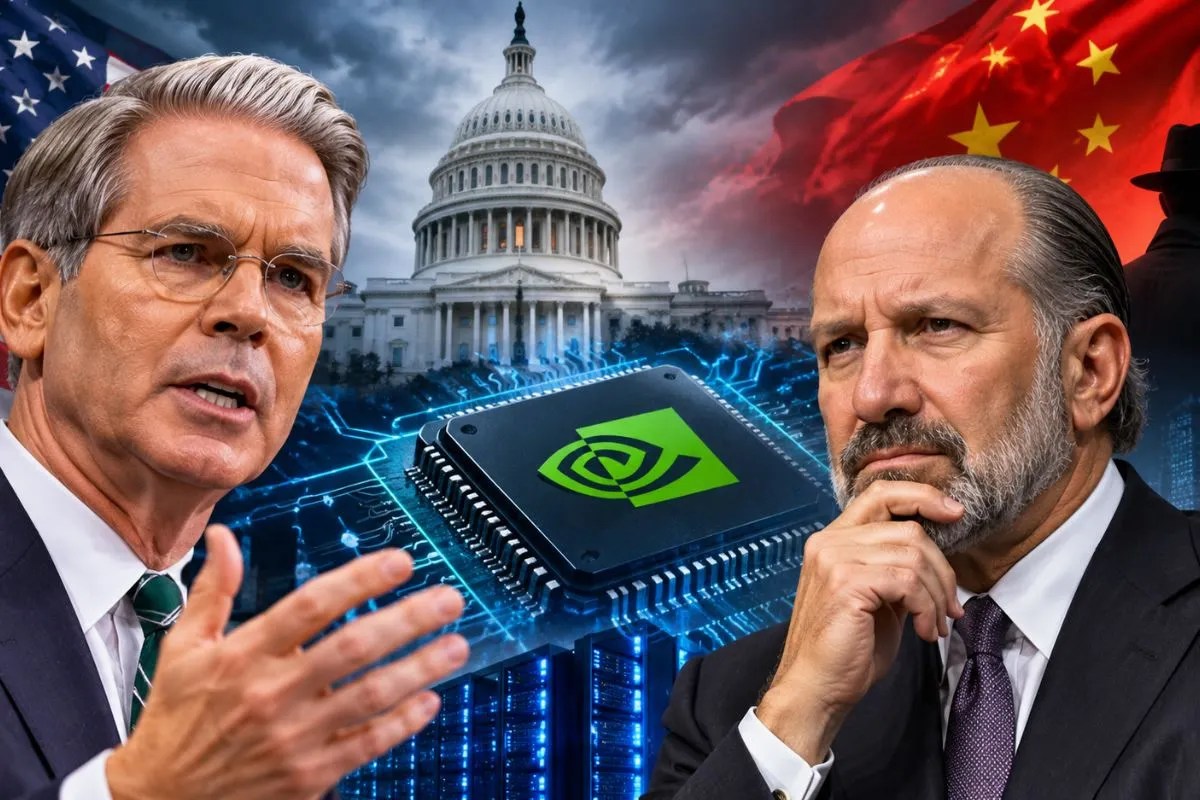
Regulatory oversight of advanced semiconductor exports operates on a fundamental tension between national security containment and commercial market preservation. When U.S. Commerce Secretary Howard Lutnick agreed to testify before a Senate panel regarding Nvidia export controls, the event exposed structural friction inside the Bureau of Industry and Security (BIS) licensing apparatus. Most reporting treats this hearing as routine political theater. In reality, it represents an audit of whether technical thresholds in the Export Administration Regulations (EAR) remain enforceable against rapid hardware iteration and third-party transshipment networks.
To understand the mechanics driving the Senate inquiry, analysts must separate political rhetoric from the operational bottlenecks governing high-performance compute transfers. The dispute centers on how the Department of Commerce defines, monitors, and restricts artificial intelligence accelerators destined for restricted jurisdictions, primarily China, while preventing collateral degradation of American semiconductor leadership.
The Structural Architecture of Semiconductor Export Controls
Export controls on advanced computing hardware rely on measurable physical and logical parameters rather than brand names. Under the framework established by the BIS, restrictions target integrated circuits capable of accelerating artificial intelligence training and inference at scale. The regulatory architecture rests on three primary variables:
- Total Processing Performance (TPP): A metric calculating the raw computational throughput of a chip, derived from bit-length multiplied by the number of operations per second. When a processor crosses the statutory TPP threshold, it triggers a presumption of denial for export to Country Group D:5 (arms-embargoed nations, including China) and specific allied destinations classified under Country Groups D:1 and D:4 to prevent diversion.
- Performance Density: Measured as TPP divided by the applicable die area in square millimeters. Regulators introduced this secondary constraint after hardware manufacturers bypassed initial interconnect bandwidth caps by designing downgraded variants that maintained high compute density. Performance density prevents firms from chaining thousands of slightly detuned chips together to achieve frontier-model training clusters.
- Interconnect Bandwidth and Memory Architecture: High-bandwidth memory (HBM) capacity and chip-to-chip communication speeds dictate whether individual processors can function as a unified supercomputer. Without rapid interconnect fabrics, distributed training across large clusters suffers severe latency penalties, degrading effective compute efficiency.
Nvidia sits at the center of this regulatory matrix because its graphics processing units (GPUs) and proprietary CUDA software ecosystem form the default infrastructure for frontier AI development. Whenever the Department of Commerce tightens TPP or performance density thresholds, Nvidia engineering teams respond by redesigning silicon—such as the transition from the A100 and H100 architectures to the modified A800, H800, and subsequently the H20—to sit precisely beneath the legal ceiling.
The Regulatory Arbitrage Loop
The Senate panel's scrutiny focuses on a recurring phenomenon in technology governance: regulatory arbitrage through rapid product modification. Every time BIS updates the Commerce Control List (CCL), a predictable sequence unfolds across the supply chain.
First, regulators establish static technical ceilings based on current-generation architecture. Second, semiconductor designers analyze the exact mathematical boundaries of those ceilings and strip out specific capabilities—such as reducing interconnect speeds or capping floating-point operations—to produce a compliant derivative SKU. Third, hyperscalers and enterprise buyers in restricted markets purchase these compliant chips in massive volumes, compensating for lower per-chip efficiency through horizontal scaling and software optimization.
This cycle creates an enforcement dilemma for Secretary Lutnick and the Department of Commerce:
- Over-calibration Risk: If BIS lowers performance thresholds aggressively enough to block modified chips like the H20, it risks cutting off legitimate commercial revenue streams that fund domestic research and development. Semiconductor fabrication and design require massive capital expenditures; starving U.S. fabless designers of global market share transfers capital directly to foreign competitors developing domestic alternatives.
- Under-calibration Risk: If BIS allows compliant derivatives to ship in high volumes, restricted entities acquire sufficient aggregate compute to train frontier models, neutralizing the strategic intent of the export control regime.
- Latency in Rulemaking: Administrative rulemaking under the Administrative Procedure Act requires interagency review, industry consultation, and technical validation. Hardware design cycles operate faster than bureaucratic adjustment cycles, leaving enforcement perpetually reactive.
The Transshipment and Diversion Problem
Beyond direct sales of compliant hardware, the Senate controversy encompasses the leakage of restricted, top-tier GPUs into prohibited territories. Once a high-performance server rack leaves a foundry in Taiwan, undergoes assembly in Southeast Asia, and ships to a data center operator in the Middle East or Europe, maintaining chain-of-custody verification becomes extraordinarily difficult.
Diversion networks exploit three systemic vulnerabilities in global hardware logistics:
- Shell Entity Layering: Front companies registered in jurisdictions without strict end-use monitoring purchase enterprise servers under the guise of regional cloud infrastructure expansion. These entities subsequently re-export the hardware or lease remote compute access via virtual private networks.
- Component-Level Disassembly: High-value GPUs are physically extracted from OEM server chassis, shipped as unmanifested freight or mislabeled electronic components, and reintegrated into custom racks inside restricted facilities.
- Cloud Compute Access (IaaS Loophole): Physical export controls govern the movement of tangible goods across borders, not electrons traveling over fiber-optic cables. Entities restricted from buying physical chips can rent equivalent compute capacity from offshore cloud providers operating unrestricted hardware, achieving identical training outcomes without violating traditional customs rules.
Addressing these vectors requires shifting BIS from a passive licensing agency to an active intelligence and enforcement body. However, the bureau's enforcement division has historically operated with a fraction of the personnel and forensic tooling required to audit global semiconductor supply chains at scale.
Competing Incentives Within the Department of Commerce
Secretary Lutnick’s testimony sits at the intersection of conflicting statutory mandates. The Department of Commerce is simultaneously tasked with promoting American economic competitiveness abroad and safeguarding national security through export administration. In the semiconductor sector, these two mandates directly collide.
From an industrial policy perspective, maintaining global ecosystem lock-in is critical. When developers worldwide build software on Nvidia’s CUDA platform, the United States retains structural leverage over the global AI stack. If aggressive export bans force foreign developers to migrate to alternative hardware ecosystems—such as Huawei’s Ascend series and its CANN software framework—U.S. firms lose permanent market share, and foreign competitors gain the economies of scale necessary to close the technological gap.
Conversely, national security hawks within Congress argue that frontier AI capabilities represent a decisive military and intelligence advantage. Under this doctrine, any transfer of advanced compute—even in downgraded forms—accelerates an adversary's ability to develop autonomous weapons systems, cyber capabilities, and dual-use biological or chemical modeling. For lawmakers holding this view, short-term corporate revenue is subordinate to maintaining an asymmetric compute advantage.
When Lutnick appears before the Senate panel, senators will press him to resolve this ambiguity by defining the exact threshold at which commercial engagement becomes a national security liability.
Operational Mechanics of the Senate Inquiry
Congressional oversight hearings on export controls serve distinct institutional functions beyond public questioning. The Senate panel uses sworn testimony to establish an evidentiary record that constrains executive branch discretion. Specifically, lawmakers focus on four operational areas:
- License Approval Rates and Backlog Metrics: Senators demand granular data on how many export license applications BIS approved, denied, or returned without action over the preceding quarters, particularly regarding shipments to Middle Eastern sovereign wealth funds and regional cloud operators.
- End-Use Verification Audits: The committee examines how many physical inspections BIS export control officers actually conducted in high-risk transshipment hubs compared to the total volume of licensed shipments.
- Interagency Alignment: Export control decisions require coordination between Commerce, Defense, State, and Energy. Friction often emerges when the Department of Defense pushes for stricter denials while Commerce favors conditional approvals tied to corporate security assurances.
- Definition of "National Security" Thresholds: Lawmakers interrogate whether current compute caps reflect modern algorithmic efficiency gains. Because software breakthroughs continuously reduce the compute required to achieve a given level of model intelligence, static hardware thresholds rapidly lose predictive power.
Limitations of Current Enforcement Models
Even if the Department of Commerce implements stricter rules following Senate pressure, structural limitations constrain what export controls can achieve in isolation.
First, unilateral controls degrade over time. While the United States controls critical intellectual property in electronic design automation (EDA) software and core chip architectures, semiconductor manufacturing relies on a distributed global supply chain involving lithography equipment from the Netherlands and specialty chemicals and wafers from Japan. Without synchronized multilateral enforcement, unilateral U.S. restrictions create incentives for foreign suppliers to design out American components to remain eligible for lucrative markets.
Second, algorithmic efficiency undermines hardware caps. Export controls assume a fixed relationship between raw FLOPs (floating-point operations) and model capability. Advances in mixture-of-experts (MoE) architectures, quantization, and synthetic data training allow developers to extract higher intelligence from fewer, less capable chips. Regulators cannot easily legislate mathematical efficiency.
Third, physical tracking faces severe scaling limits. Requiring hardware-level telemetry or cryptographic location verification on every exported GPU introduces firmware security risks, raises privacy objections from allied buyers, and invites hardware tampering by sophisticated adversaries.
Strategic Forecasts and Institutional Plays
The outcome of Secretary Lutnick’s testimony will not be a binary choice between total embargo and unrestricted trade. Instead, the hearing will accelerate the transition toward a tiered, conditional licensing regime that fundamentally alters how semiconductor companies and cloud providers operate globally.
- Transition to Verified End-User (VEU) Frameworks: Rather than reviewing individual chip shipments, Commerce will expand VEU authorizations for trusted hyperscalers. Under this model, pre-vetted data center operators receive bulk approval to import high-end hardware in exchange for strict physical security protocols, real-time telemetry reporting, and regular third-party audits.
- Formalization of Compute Caps by Jurisdiction: Expect BIS to enforce regional compute ceilings—capping the total aggregate FLOPs permitted within specific non-allied countries—to prevent any single third-party nation from becoming an unmonitored compute hub or transshipment proxy.
- Mandatory Know-Your-Customer (KYC) Rules for IaaS Providers: To close the cloud loophole, regulatory pressure will force U.S. infrastructure-as-a-service providers to verify the ultimate beneficial ownership of entities training large models on their clusters, effectively extending export control compliance into the cloud layer.
For semiconductor executives and institutional investors, the strategic imperative is clear: compliance can no longer be treated as a post-design legal review. Hardware roadmaps must now incorporate regulatory resilience directly into silicon architecture, diversifying supply chains and building verifiable chain-of-custody telemetry into enterprise server deployments before statutory mandates force disruptive mid-cycle redesigns.