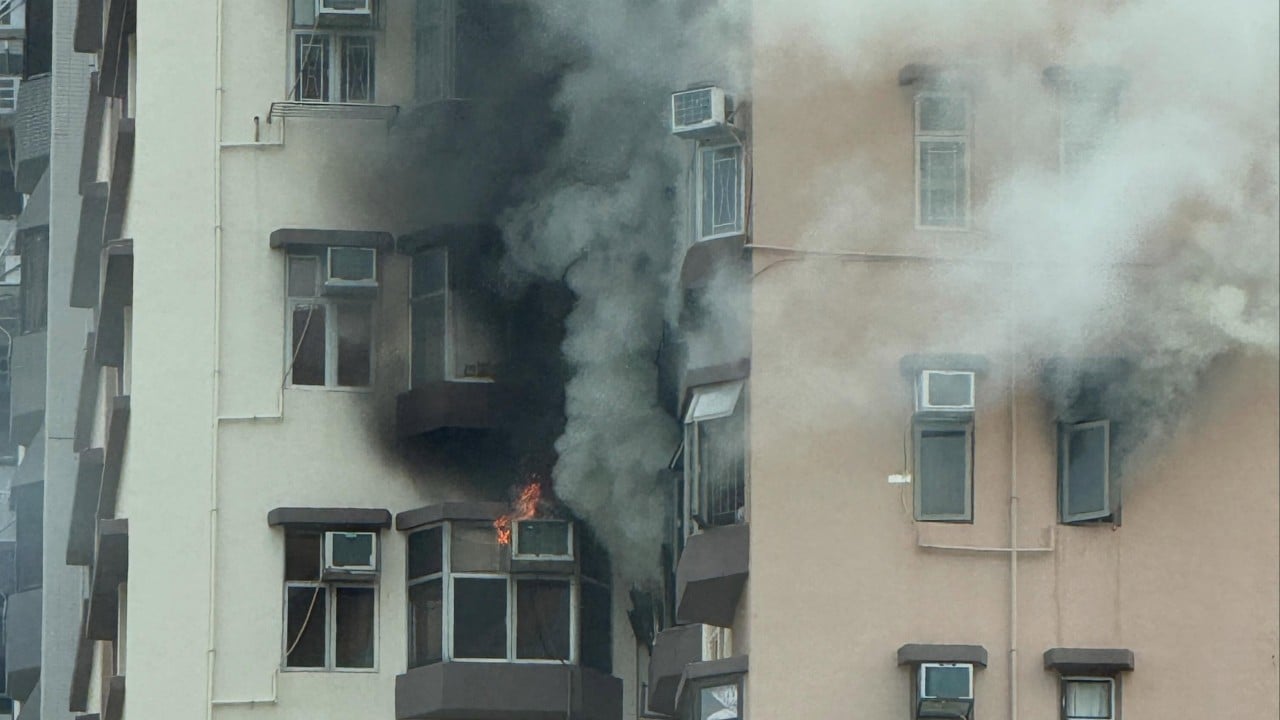
The morning of June 26 began like any other Friday in Ho Man Tin. It was mid-morning, just after ten o'clock, that transitional hour when a neighborhood breathes out. The early commuters had long since crammed into the MTR stations, leaving behind retirees, homemakers, and those who work the late shifts. In Valiant Court, a residential block typical of Hong Kong’s vertical density, televisions hummed through thin concrete walls. Kettles whistled.
Then came the smoke. For another perspective, check out: this related article.
It did not begin with a dramatic, cinematic roar. Fire in a high-rise usually starts as a quiet, insidious thing—a trickle of gray drifting past a windowpane, an acrid smell easily mistaken for burnt toast. But within minutes, the dry facts of a standard emergency report began to manifest in terrifying, physical reality. A fire had broken out in one of the residential units. Thick, oily smoke began choking the building’s corridors, transforming familiar hallways into blind, suffocating traps.
Consider what happens next when density meets disaster. Online footage captured by onlookers showed the fire rapidly engulfing the flat. In a city where square footage is a luxury, every inch of space is utilized. Air conditioners project outward from concrete facades, humming metronomes of urban life. As the heat inside the flat surged past the threshold of human endurance, a window-mounted air-conditioning unit caught fire and exploded. Related analysis regarding this has been shared by NPR.
The blast was a catalyst. The shattered glass and ruptured machinery rained down, while the erupting fireball licked upward, catching the exterior of the building and threatening the upper floors.
For the people trapped inside that specific unit, the world contracted into a desperate struggle for oxygen. Firefighters arrived swiftly, deploying a single hose line and a breathing apparatus team to cut through the blackness. They pulled four residents from the apartment—three women and one man. Among them was a woman in her 50s. She was found unconscious, her lungs filled with the toxic byproduct of synthetic materials catching fire.
Ambulances raced toward Kwong Wah Hospital, sirens cutting through the heavy June humidity. Paramedics worked in the back of the moving vehicles, performing the rhythmic, exhausting chest compressions that signal a life on the absolute precipice.
Outside Valiant Court, thirty residents stood on the pavement. Some were in slippers; others held pets or small canvas bags grabbed in panic. They looked upward at the blackened scar on their building, experiencing the sudden, jarring realization of how fragile the barrier is between an ordinary Friday and total displacement.
For three of the rescued residents, the story continues in a hospital ward, defined by the slow, painful process of recovery from smoke inhalation and shock. But for the woman in her 50s, the battle ended in the emergency room. She was certified dead shortly after arrival.
Police and fire investigators remain at the scene, sifting through the charred remnants to determine exactly what sparked the blaze. They will look at wiring, appliances, and human error. But the true weight of the event is already settled. A family is broken, an apartment is reduced to ash, and a neighborhood is left to contemplate the sudden stillness that follows a tragedy.