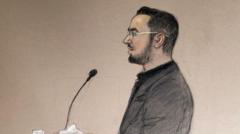
The physical attack on a dissident journalist in London is not an isolated breach of domestic security, but the execution phase of a highly optimized, cross-border corporate procurement model for violence. When Romanian nationals stood trial at London’s Woolwich Crown Court for the March 2024 stabbing of Iran International television presenter Pouria Zeraati, the prosecution exposed a structural evolution in how adversarial states project power abroad. Rather than deploying sovereign intelligence officers who carry high geopolitical risks and steep financial premiums, state actors now operate through an outsourced supply chain of transnational criminal networks.
This model relies on capital efficiency, plausible deniability, and the exploitation of open European borders to suppress free speech and independent journalism thousands of miles from the state’s geographic boundaries. Understanding this threat requires evaluating the operational mechanics, financial plumbing, and strategic cost functions that drive modern state-sponsored proxy operations.
The Economics of Outsourced Violence
The transition from indigenous intelligence operatives to transactional criminal proxies is dictated by a rigid risk-reward calculus. Historically, state-directed assassinations or assaults relied on deeply embedded agents or intelligence officers directly affiliated with state organs, such as Iran's Islamic Revolutionary Guard Corps (IRGC). This approach carried prohibitive costs, including the permanent loss of trained personnel upon capture, severe diplomatic retaliations, and direct attribution to the state.
The contemporary mechanism relies on a multi-tiered outsourcing hierarchy that effectively lowers the barrier to entry for transnational repression.
[State Intelligence / IRGC Agents]
               │
               ▼  (Disburses fiat currency / Crypto)
[Intermediaries / Dual Nationals]
               │
               ▼  (Contracts operational nodes)
[Transnational Organized Crime Entities]
               │
               ▼  (Deploys expendable labor)
[Local / Foreign Criminal Sub-contractors]
The Cost Function of Proxy Operations
The operational overhead of an outsourced strike team is fractions of the cost of maintaining a long-term, deep-cover intelligence cell.
- The Discardable Labor Pool: In the Zeraati case, the operational tier comprised low-level criminal actors motivated exclusively by immediate financial liquidations rather than ideological alignment. The prosecution revealed a known money trail where over £80,000 was routed through accounts tied to the operational cell via a London-based construction firm, ultimately linked back to a British-Iranian dual national handler.
- Asymmetric Risk Insulation: For the state sponsor, an unexpected asset compromise generates zero diplomatic exposure. If an operative is apprehended, the state can issue a flat institutional denial, confident that the paper trail is fractured by multiple shell layers and cash or cryptocurrency handoffs.
- Asset Liquidation and Exfiltration: The low cost of criminal labor allows the state to run multiple simultaneous reconnaissance operations with minimal capital constraints. If a cell fails or experiences interdiction, it is simply written off as a sunk operational cost.
Operational Mechanics: The Lifecycle of a Proxy Strike
A targeted state-sponsored attack through criminal proxies follows a highly regimented operational lifecycle. This structure mimics professional corporate project management, prioritizing extensive preparation to ensure a high probability of execution before the target can mobilize protective measures.
Phase 1: Target Identification and Classification
The state organ identifies high-impact media voices or political dissidents capable of altering domestic or international public opinion. For example, Tehran designated Iran International as a "terrorist organization" in 2022 following extensive coverage of domestic anti-regime protests. To formalize the target profile, institutional state apparatuses publish list-style visual directories. In November 2022, physical posters surfaced across Tehran displaying the faces of specific journalists, including Zeraati, explicitly subtitled "Wanted: dead or alive." This institutional signaling signals to external brokers that funding has been approved for these specific human targets.
Phase 2: Reconnaissance and Counter-Surveillance Resistance
The primary operational failure of criminal proxies frequently occurs during the protracted reconnaissance phase, as these actors rarely possess the sophisticated counter-surveillance training of professional state intelligence officers.
A full year prior to the March 2024 stabbing, British police interdicted one of the current defendants, George Stana, inside the communal garden of Zeraati’s Wimbledon residence. At the time of this preliminary compromise, Stana was equipped with latex gloves, scissors, and a surgical mask, while an accomplice carried a concealed sports bat. Despite this law enforcement contact, the proxy network demonstrated strategic resilience. When one operational node faced exposure, the network adapted, altering its timeline and shifting its digital communications to encrypted WhatsApp channels to coordinate vehicle manipulations, such as plotting to puncture the target's car tires to control his physical movements.
Phase 3: Synchronized Execution
The execution protocol requires precise physical synchronization to minimize the window for civilian intervention or law enforcement response. On the day of the attack, the cell deployed a three-man division of labor:
- The Restrainer: David Andrei physically neutralized Zeraati as he crossed the street from his residence, eliminating his mobility.
- The Striker: Nandito Badea delivered three precise knife wounds to the target's upper thigh. The choice of target area—the leg—carries deep operational intentionality. It inflicts severe trauma and structural damage while maintaining an ambiguous threshold between a lethal strike and an explicit, high-visibility warning to the broader journalist community.
- The Extrication Driver: Stana managed the immediate escape vector, operating a pre-staged Mazda getaway vehicle.
Phase 4: Tactical Escape and Financial Dissolution
Once the physical assault concludes, the cell’s primary objective shifts to rapid geographic displacement to outrun initial police alerts. The operators abandoned the primary getaway vehicle, discarded their blood-soaked apparel, and immediately transferred into a localized commercial taxi directed toward Heathrow Airport. Within hours of the assault, the entire team boarded an international flight to Geneva, Switzerland. This rapid border crossing exploits the latency in cross-jurisdictional law enforcement data-sharing networks, allowing the physical perpetrators to clear domestic airspace before forensic identification can trigger airport borders and customs locks.
Structural Deficiencies in Democratic Counter-Measures
Western security apparatuses face deep systemic vulnerabilities when defending against outsourced state terror. Domestic counter-terrorism frameworks are fundamentally designed to track ideological extremists or official foreign diplomats. They are poorly calibrated to intercept fluid, transient criminal actors moving across open borders on commercial flights for purely financial incentives.
The first structural limitation lies in Border Vulnerability and Freedom of Movement. The European Schengen zone and standard international transit routes allow low-profile EU nationals with clean international criminal records to enter and exit the United Kingdom with minimal friction. Because these individuals do not trigger flags on state-sponsored watchlists, they bypass deep automated screenings at points of entry.
The second bottleneck is Jurisdictional Attrition. When perpetrators successfully execute an exfiltration strategy to a continental European jurisdiction, the legal cost function for host-country law enforcement increases exponentially. Pursuing international arrests, managing complex extradition proceedings, and navigating foreign judicial environments requires months of institutional effort. The time elapsed between the March 2024 attack, the December 2024 extradition of Badea and Stana from Romania, and the eventual May 2026 trial illustrates how sovereign borders slow the velocity of democratic justice while proxy networks operate with high fluidity.
The final core limitation involves Network Adaptability and Parallel Nodes. Neutralizing a single proxy cell does not degrade the core operational capability of the sponsoring state. While Woolwich Crown Court tries the individuals responsible for the Wimbledon stabbing, parallel cells continue to operate independently.
Demonstrating this parallel track, British prosecutors concurrently brought separate charges against an entirely different operational cell for an April 2026 arson attempt targeting Iran International’s northwest London production studios. This separate group—comprising young local recruits facing trial in early 2027—proves that the foreign state entity does not rely on a singular supply chain. Instead, it runs multiple, concurrent procurement processes across different criminal subcultures to achieve its strategic ends.
Defensive Protocols for High-Risk Media Environments
To survive in an era of industrialized, state-sponsored proxy violence, media institutions and independent journalists cannot rely solely on reactive state law enforcement. They must deploy structured, proactive corporate defense protocols designed to break the lifecycle of a proxy strike at the reconnaissance phase.
Implement Dynamic Physical Disruption
Proxy cells rely heavily on predictable target routines to plan their execution windows. Media organizations must mandate variable scheduling, rotatably altered transit vectors, and randomized departure times for all public-facing personnel. By introducing constant behavioral variance, the cost and time required for a criminal cell to conduct successful reconnaissance increases to a restrictive degree.
Deploy Perimeter Technical Enclosures
Given that criminal proxies frequently attempt physical scouting of target residences, high-visibility individuals must integrate localized technical perimeters. This includes installing continuous, cloud-linked multi-angle license plate recognition (LPR) cameras and AI-driven perimeter tripwire alerts around private residences. This infrastructure ensures that figures like Stana are identified and flagged to corporate security teams the first time they enter a communal property boundary, rather than after multiple successful scouting missions.
Establish Hardened Media Safe Zones
When state threat levels spike—such as the explicit designation of a network as a target by a foreign regime—media entities must possess the operational agility to rapidly relocate entire physical broadcast operations. Moving personnel into fortified corporate business parks with restricted access control gates, or temporarily shifting key anchors to highly secure international jurisdictions (such as the United States), forces the adversarial state to recalibrate its entire intelligence apparatus, completely breaking their localized criminal supply chains.