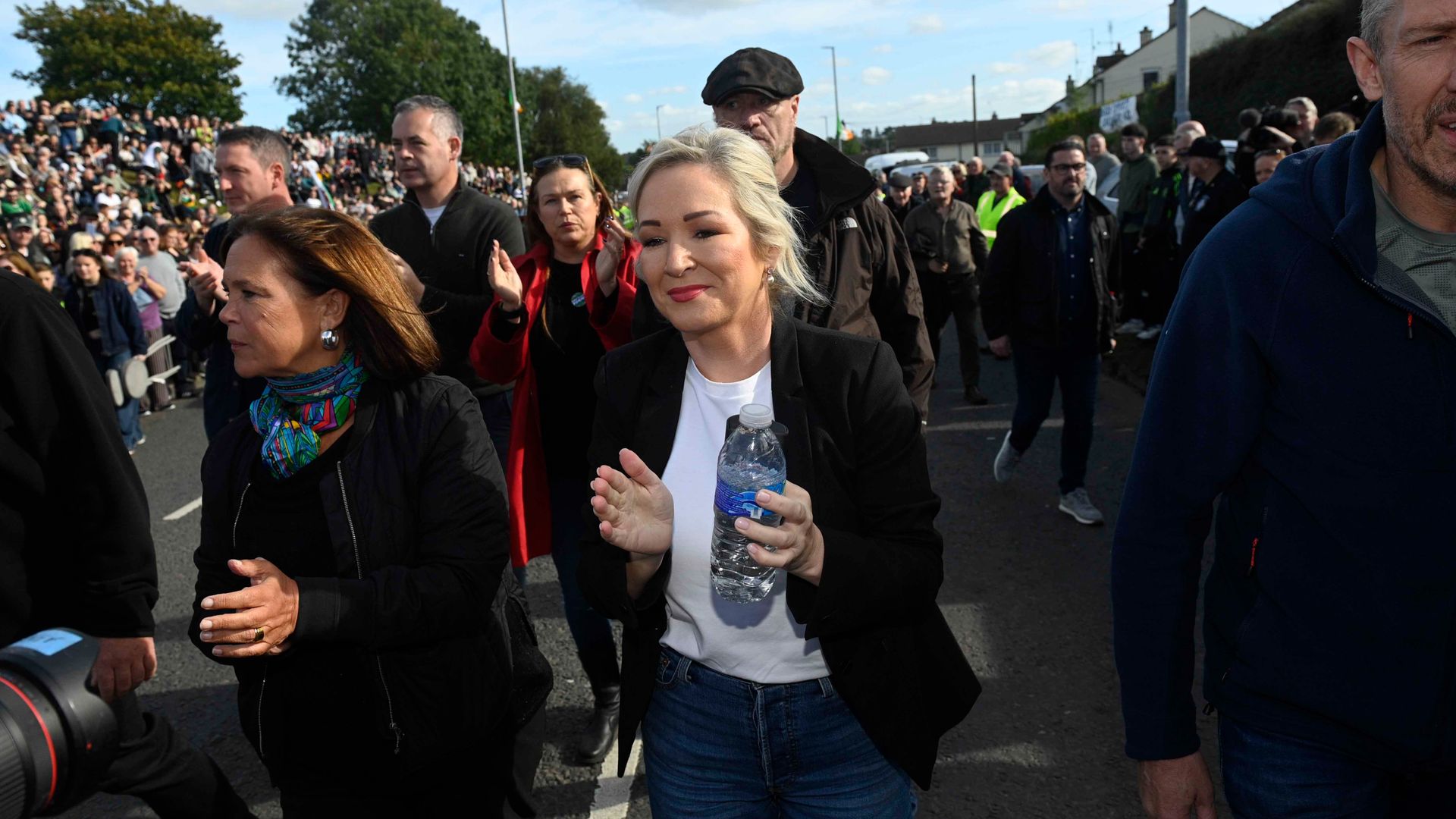
The convergence of political authority and street-level mobilization creates a distinct structural hazard in governance systems built on fragile power-sharing frameworks. When the head of an executive branch participates in an unauthorized demonstration against a legally sanctioned adjudication—such as the Police Service of Northern Ireland inviting Northern Ireland First Minister Michelle O'Neill for interview regarding the Garvaghy Road protests—the event exposes the inherent friction points between statutory authority and communal compliance.
This dynamic operates through predictable mechanisms of institutional friction, symbolic deterrence, and political calculus. Deconstructing the mechanics of the Drumcree parading dispute and the subsequent police investigative actions reveals how symbolic resistance functions as both a risk-mitigation strategy for political actors and a destabilizing force for administrative stability.
The Dual Incentive Structure of Executive Non-Compliance
Elected officials who participate in direct action against state-sanctioned determinations face a divergent cost-benefit matrix compared to standard civil actors.
The primary driver is constituency retention through signal amplification. In polarized environments, holding executive office introduces a principal-agent problem: the official must simultaneously administer the state apparatus and satisfy the foundational base that views that same apparatus with suspicion. Attending a localized blockade allows an executive leader to bridge the gap between institutional containment and base-level solidarity.
The secondary driver is pre-emptive narrative control. By co-locating with demonstrators prior to formal legal enforcement actions, political figures neutralize internal party challengers who might otherwise outflank them on ideological purity.
However, this strategy carries severe structural costs. When executive actors flout determinations rendered by statutory bodies like the Parades Commission, they weaken the very bureaucratic buffers designed to prevent zero-sum sectarian conflict. The cost function of this behavior is borne by institutional predictability: every instance of state-adjacent civil disobedience lowers the barrier for broader public non-compliance with the rule of law.
The Regulatory Failure Cascade
The escalation surrounding the Garvaghy Road and Drumcree route authorization highlights a sequential breakdown in institutional coordination.
The regulatory architecture relies on a cascade of sequential dependencies:
- Adjudication by an independent statutory commission based on historical precedent, public safety data, and community impact assessments.
- Judicial review cycles where aggrieved parties test the legality of the determination within appellate courts.
- Enforcement capacity by the policing service to guarantee the execution of the lawful ruling.
- Administrative backing from the executive branch to legitimize the enforcement mechanism.
When the executive branch actively disrupts step four, the entire sequence stalls. The policing service finds itself structurally isolated, tasked with enforcing a legal mandate against crowds endorsed, physically or rhetorically, by the leaders of the government itself. This creates an operational paralysis where maintaining public order requires disproportionate resource allocation, transforming a localized route dispute into a systemic governance crisis.
Legal Exposure and the Mechanics of Voluntary Cooperation
The decision by the Police Service of Northern Ireland to issue interview letters under the framework of investigating potential criminal offences at the September 27 demonstration establishes a strict procedural baseline.
In high-profile political investigations, the mechanism of voluntary attendance for interview serves two distinct purposes:
- Evidentiary collection without custodial escalation, minimizing the risk of secondary public disorder triggered by high-visibility arrests.
- Public accountability signaling, demonstrating that statutory oversight applies uniformly regardless of elected status.
For political leaders navigating these investigative letters, public cooperation statements serve as a tactical deflection. Agreeing to participate in an interview while maintaining rhetorical opposition to the underlying parade decision allows the individual to project compliance with the investigative process while doubling down on the political narrative that the initial adjudication was fundamentally unjust.
The Macroeconomic and Social Toll of Protracted Stand-Offs
Protracted parading disputes generate quantifiable externalities across social capital and administrative stability.
First, they impose heavy opportunity costs on public administration. The deployment profile required to police contested routes diverts personnel and fiscal resources from core public safety functions.
Second, they induce a freeze in cross-community legislative cooperation. As seen in the immediate political fallout—where joint executive engagements stall and legislative vetoes multiply—disputes over street-level symbolism translate instantly into institutional paralysis at Stormont. The legislative output drops as parties retreat to defensive silos, weaponizing procedural mechanisms to block unrelated policy files.
Strategic Forecast
The resolution of such disputes rarely occurs through judicial fiat alone. When appellate courts reserve judgment or confirm statutory determinations that face mass physical opposition, the legal victory remains purely theoretical if the enforcement cost exceeds systemic capacity.
The structural trajectory points toward a recurring cycle of cyclical mobilization unless the underlying statutory framework is redesigned to account for the velocity of localized grievance transmission. Until an administrative mechanism can decouple route access from zero-sum cultural dominance, executive actors will continue to calculate that the political utility of street-level solidarity outweighs the institutional friction of compliance.