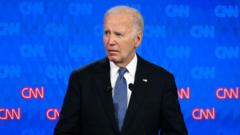
The divergence between public political messaging and private reality operates on a lag dictated by electoral utility. When former First Lady Dr. Jill Biden revealed to CBS News that she believed former President Joe Biden was experiencing an active stroke during the June 2024 presidential debate, the admission did not merely fill a historical footnote. It exposed the structural mechanics of crisis management within high-stakes political organizations. The revelation, timed precisely to the promotional cycle of her memoir View from the East Wing, offers a pristine case study in how information is suppressed, modulated, and eventually deployed as a strategic narrative corrective.
Analyzing this shift requires moving past partisan outrage to examine the raw calculus of institutional self-preservation, the mechanics of cognitive crisis response, and the inevitable depreciation of manufactured political narratives.
The Asymmetry Matrix: Public Performance vs. Private Evaluation
Political campaigns function as information-filtering mechanisms designed to minimize variance and project absolute stability. When an unexpected anomaly occurs—such as a candidate freezing, stumbling over syntax, or exhibiting acute cognitive fatigue—the organization faces an immediate optimization problem: balance immediate narrative defense against long-term credibility loss.
The transition in messaging from June 2024 to May 2026 illustrates this mathematical decay of a protective narrative:
The June 2024 Post-Debate Defense Strategy
- Public Output: "Joe, you did such a great job. You answered every question. You knew all the facts." (Dr. Jill Biden, immediate post-debate rally).
- Operational Objective: Prevent immediate organizational collapse, block down-ballot panic, and maintain structural control over the delegate apparatus.
- Mechanism: Hyperbolic validation. By overcompensating for a visible deficit, the campaign attempted to establish a baseline of normalcy, treating a systemic failure as a minor operational variance (e.g., "a cold" or "one bad night").
The May 2026 Retrospective Rectification
- Public Output: "As I watched it, I thought, 'Oh, my God, he's having a stroke.' And it scared me to death." (Dr. Jill Biden, CBS Sunday Morning interview).
- Operational Objective: Re-establish personal and institutional trustworthiness, capitalize on historical distance, and frame past deception as human fear rather than political calculation.
- Mechanism: Retroactive vulnerability injection. The actor shifts from an institutional defender to a protective, frightened spouse, trading past political utility for current moral authority.
This shift reveals that the cost of maintaining a demonstrably false narrative eventually outpaces the cost of admitting the truth. In 2024, the utility of the "great job" narrative was sky-high because the asset (the candidacy) was still active. In 2026, with the asset retired and subsequent events—including the former president’s later diagnosis of Stage 4 prostate cancer—recontextualizing his health profile, the utility of the old narrative drops to zero. The new narrative serves to humanize a past failure while driving engagement for a commercial memoir.
The Cognitive Crisis Function: Why the Stroke Framing is Deployed
The specific choice of words—framing the observation as a suspected acute medical event (a stroke) rather than a manifestation of progressive age-related decline—follows a precise logical framework designed to insulate the family and the administration from charges of long-term negligence.
http://googleusercontent.com/image_content/223
To understand why this distinction matters structurally, we must evaluate the two competing hypotheses regarding the former president's performance that evening:
- The Acute Event Hypothesis (The Stroke Framing): A sudden, unpredictable, and isolated physiological disruption. If the performance was driven by an acute event, the inner circle is absolved of blame for allowing him to take the stage. You cannot foresee a sudden medical emergency; therefore, keeping him in the race up to that point was a rational, defensible decision.
- The Chronic Decline Hypothesis (The Systemic Degradation Framing): A predictable, visible, and progressive loss of cognitive and physical stamina. If the performance was merely the visible tip of a long-standing trendline, the inner circle is exposed to accusations of institutional gaslighting, having actively hidden a known deficit from the electorate.
By explicitly stating she thought he was having a stroke, Dr. Jill Biden structurally forces the conversation into the Acute Event category. It reframes her immediate post-debate praise from a calculated political lie into a trauma response. Under this logic, telling him he "did a great job" was not an attempt to deceive the public, but rather an act of emotional stabilization directed at a spouse who had just survived a terrifying health scare.
The structural flaw in this defense is the timeline of subsequent actions. If an individual's closest advisor and spouse genuinely suspects a stroke on live television, standard medical protocol dictates immediate hospitalization and neurological evaluation, not an immediate transition to an afterparty rally to deliver scripted political applause. The structural bottleneck of political survival overrode the biological imperative of immediate medical intervention.
The Institutional Backlash and the Insult to the Electorate
The delayed admission has triggered what communication theorists call a narrative whiplash effect. When an institution spends months insisting that a clear physical reality is a hallucination or an exaggeration engineered by political opponents, they deplete their institutional trust reserves.
The reaction from former Obama administration aides and media figures highlights this bottleneck:
[Electorate Observes Deficit] ──> [Campaign Denies Deficit / Attacks Critics]
                                          │
                                          ▼
[Delayed Admission of Truth]  ──> [Complete Erasure of Campaign Credibility]
When insiders confirm that their internal assessment matched the public’s initial horror, it retroactively validates the electorate's instincts while exposing the campaign's aggressive counter-offensive as pure gaslighting. The strategy of pretending a catastrophic performance was "fine" or "good" creates a long-term liability. The short-term benefit of surviving a 24-hour news cycle is systematically wiped out by the long-term devaluation of the organization's voice.
Tactical Takeaway for High-Stakes Crisis Management
For strategic operators analyzing this event, the lesson is clear: The halflife of a political narrative is inversely proportional to its divergence from verifiable physical reality.
When managing an enterprise-level crisis where the core asset exhibits an undeniable deficit, the optimal play is immediate containment and structured transition, rather than hyper-validation and delayed rectification. Denying what the audience can see with their own eyes does not preserve authority; it merely compound the ultimate cost of the correction when the truth is inevitably leveraged for historical or commercial purposes. The final strategic play for any organization in a similar bottleneck is to execute an immediate pivot before the narrative market forces a chaotic, involuntary liquidation.