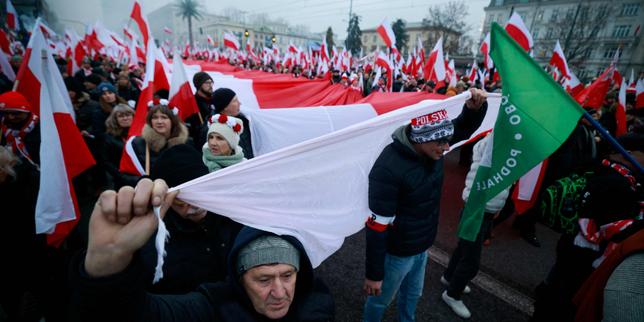
Mass political mobilization immediately following a violent domestic incident operates on a predictable feedback loop: an acute security shock lowers the threshold for public grievance, allowing organized nationalist movements to convert ambient fear into physical turnout before institutional actors can establish a counter-narrative. When thousands of nationalists marched in Poland four days after the Kraków attack, the event demonstrated how rapid street mobilization functions not merely as a memorial or spontaneous protest, but as a strategic lever to reframe national security discourse, test state crowd-control capacity, and consolidate political legitimacy.
To understand the mechanics of this mobilization, the incident in Kraków and the subsequent march must be separated from surface-level media framing and analyzed through structural political dynamics, crowd-mobilization economics, and institutional response latency.
The Structural Mechanics of Post-Incident Mobilization
Standard news coverage of post-attack demonstrations typically treats crowd size as a direct, linear measure of public anger. That assumption is flawed. Turnout four days after a violent event is the output of pre-existing organizational infrastructure interacting with a sudden spike in emotional salience. Without established logistics—bus networks, regional coordinators, encrypted messaging channels, and legal observers—an isolated attack in Kraków produces scattered vigils, not a synchronized national march.
The Four-Day Compression Window
The gap between the Kraków attack and the nationalist march represents a critical operational window in crisis politics. In the first 24 to 48 hours following a violent incident, information remains fragmented. Law enforcement restricts details to protect ongoing investigations, creating an information vacuum.
By day three, initial shock transitions into narrative competition. Political factions attempt to lock in causal explanations before official forensic or judicial conclusions are released. Staging a major demonstration on day four hits the exact inflection point where public attention remains at peak intensity, yet sufficient logistical lead time has elapsed to transport participants from secondary cities into major urban centers.
Threat Framing and Grievance Aggregation
Nationalist movements rely on a specific cognitive mechanism known as threat generalization. An isolated act of violence—regardless of whether official investigators classify it as ideological terrorism, criminal violence, or an individual psychological breakdown—is immediately integrated into a broader macro-narrative of national vulnerability.
This process operates through three distinct steps:
- Incident Abstraction: Stripping away localized or individual variables of the Kraków attack to present the event as a symptom of systemic failure.
- Actor Substitution: Shifting public focus from the individual perpetrator to broader demographic, political, or supranational targets—such as immigration policies, European Union mandates, or domestic political opponents.
- Moral Inversion: Positioning street mobilization not as an act of civil disruption, but as a defensive necessity compensating for perceived state weakness.
Organizational Infrastructure Behind Polish Nationalist Marches
Unlike spontaneous flash protests, large-scale nationalist demonstrations in Poland draw upon decades of institutional development, centered around annual events such as the November 11 Independence March in Warsaw. When a crisis like the Kraków attack occurs, organizers do not build mobilization capacity from scratch; they activate an existing reserve network.
Decentralized Logistics and Centralized Messaging
The operational durability of these movements stems from a hybrid command structure. Messaging is tightly centralized through core leadership committees and allied digital media ecosystems, ensuring that marchers carry uniform slogans and visual branding. Conversely, transportation and recruitment are decentralized across local football supporter clubs, regional nationalist chapters, and conservative youth associations.
This structure solves the classic collective action problem. Individual citizens rarely travel across a country to attend a political rally based solely on abstract ideological agreement. They travel because they belong to tight-knit local peer groups that organize collective transport, enforce social accountability, and provide physical security during the event.
Digital Amplification Loops
Social media algorithms systematically reward high-arousal negative emotions—specifically moral outrage and fear. Following the Kraków incident, nationalist digital networks experienced an organic surge in engagement metrics without needing to alter their core content strategy.
The mechanism works through cross-platform synchronization:
- Tier 1 (Encrypted Channels): Telegram and closed messaging groups coordinate departure times, legal hotlines, and behavioral guidelines to prevent premature police intervention.
- Tier 2 (Alternative Video & Livestreams): Independent commentators broadcast live from the ground, framing the march as an unfiltered counterweight to mainstream broadcast television.
- Tier 3 (Mainstream Social Feeds): Short, high-contrast video clips of dense crowds, flares, and synchronized chanting are distributed to project overwhelming momentum to passive observers.
State Capacity and the Policing Dilemma
For the Polish government and municipal authorities, a large nationalist march occurring four days after a violent attack creates an acute operational dilemma. Every tactical choice carries asymmetric political costs.
The Cost Function of Crowd Control
Authorities must balance public order against the risk of handing organizers a secondary grievance. A heavy-handed police posture—characterized by preemptive perimeter blockades, mass identity checks, or aggressive riot-control formations—risks triggering physical clashes. In the immediate aftermath of the Kraków attack, images of police battling domestic demonstrators would reinforce the nationalist claim that the state directs its coercive power against patriots rather than actual security threats.
Conversely, a permissive policing posture—allowing unvetted routes, tolerating pyrotechnics, or minimizing visible riot units—signals operational deference. If crowd size exceeds initial police estimates, law enforcement loses the ability to dynamically redirect the march, turning urban arteries into de facto autonomous zones for several hours.
Institutional Latency vs. Street Velocity
State institutions are structurally slower than street movements. Prosecutors require weeks to establish motive; ministries require legislative cycles to draft security reforms; municipal authorities require formal permitting timelines. Nationalist organizers exploit this latency gap. By occupying physical space within 96 hours of the Kraków attack, they establish visual dominance in the public sphere long before the state can produce a formal policy response.
Assessing Political Impact and Strategic Limitations
While rapid post-attack mobilization excels at capturing media cycles and energizing core supporters, its long-term political utility encounters strict structural ceilings. Analysts frequently overestimate the electoral conversion rate of street protests while underestimating their polarising backlash.
The Turnout-to-Vote Fallacy
High street turnout does not automatically translate into expanded electoral market share. Marches rely on intensity of preference—a small percentage of the population willing to expend high time and travel costs. Democratic elections rely on breadth of preference—capturing moderate, low-intensity voters who prioritize economic stability and institutional predictability.
When post-attack marches feature aggressive rhetoric, flare usage, or confrontational aesthetics, they generate a dual effect:
- Internal Consolidation: Core nationalist factions experience heightened solidarity, boosting membership retention and fundraising capacity.
- External Alienation: Swing voters in major metropolitan areas—including Kraków and Warsaw—frequently associate street nationalism with instability rather than security, driving them toward centrist or institutionalist parties.
Factional Friction Within the Right
Large mobilizations also expose internal fault lines within the broader Polish political right. Mainstream conservative parties face constant pressure to either co-opt the energy of street nationalists or distance themselves to protect moderate coalitions.
If mainstream conservatives endorse the march, they risk legitimizing hardline factions that actively seek to poach their voter base. If they condemn the march, they cede the mantle of uncompromising national security to radical organizers. Four days after Kraków, this tension prevented a unified institutional response, allowing street organizers to monopolize the optics of public mourning and security demands.
Information Gaps and Verification Constraints
Rigorous analysis requires separating verified operational patterns from unsubstantiated claims. In the absence of complete primary documentation—such as official municipal crowd-density audits, full prosecutorial indictments from the Kraków incident, and longitudinal polling conducted exclusively between the attack and the march—three analytical boundaries apply:
- Crowd Size Estimates: Organizers routinely inflate attendance figures by factors of two to three, while municipal authorities frequently apply conservative baseline estimates. Without aerial photogrammetry, exact headcounts remain contested approximations rather than hard data.
- Causal Attribution of Turnout: It is impossible to isolate the exact percentage of marchers motivated purely by the Kraków attack versus those who would have mobilized for an adjacent scheduled political event.
- Policy Causality: Subsequent shifts in Polish security rhetoric or policing budgets cannot be attributed solely to the march; they reflect simultaneous pressures from parliamentary opposition, media commentary, and intelligence assessments.
Strategic Countermeasures for Institutional Actors
To prevent violent incidents from being rapidly monopolized by street-level political actors, state institutions and mainstream political organizations must compress their own response timelines.
- Accelerate Official Information Release: Law enforcement and prosecutorial bodies must replace prolonged silence with structured, hourly factual briefings during the first 48 hours after a major attack. Filling the information vacuum early removes the ambiguity that threat-framing relies upon.
- Decouple Mourning from Partisan Mobilization: Municipal leaders and civic institutions should immediately establish official, non-partisan memorial spaces and public assemblies within 24 hours of an incident. Capturing the initial civic impulse reduces the pool of unaffiliated citizens drawn to partisan marches on day four.
- Deploy Asymmetric Crowd Management: Police command should utilize perimeter containment and traffic diversion rather than direct frontal confrontation, neutralizing the visual spectacle of state-versus-citizen clashes while preserving strict control over critical infrastructure.
- Target Logistical Nodes, Not Rhetoric: Regulatory oversight of large demonstrations should focus strictly on objective safety compliance—vehicle permits, pyrotechnic restrictions, and route adherence—rather than ideological messaging, denying organizers the political martyrdom of perceived censorship.