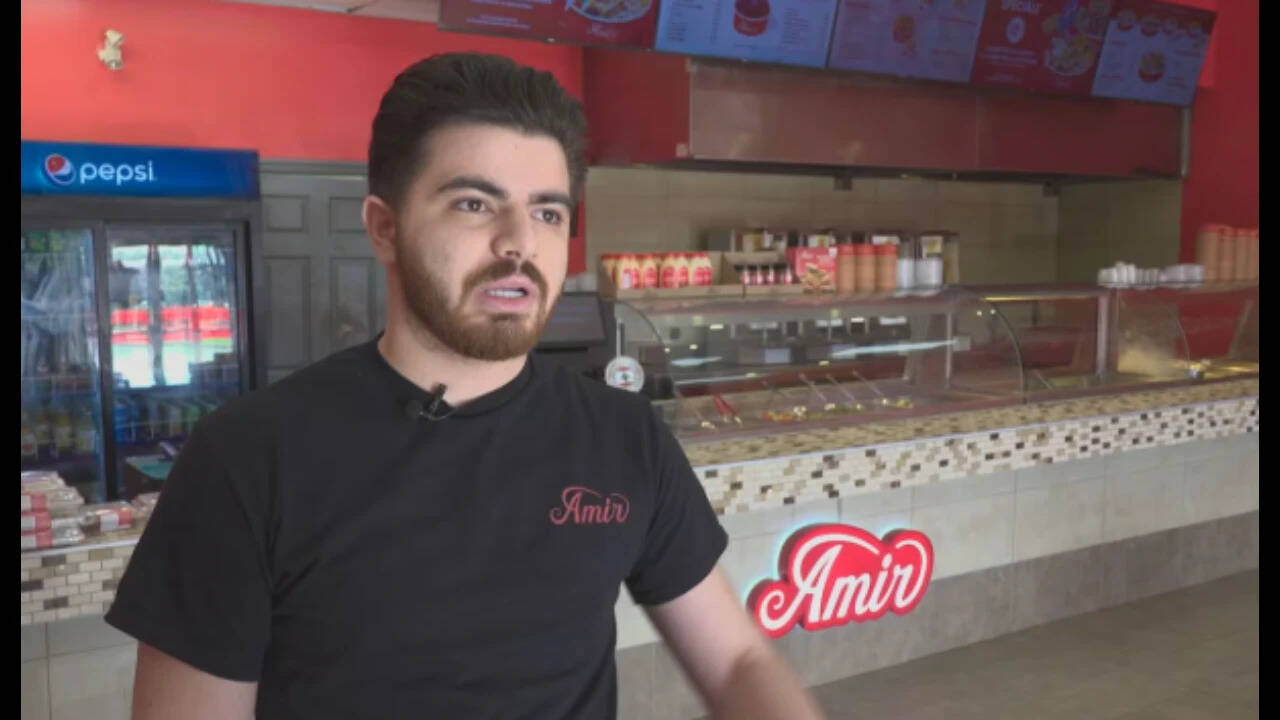
A dispute over meat portioning in a Montreal shawarma restaurant did not escalate into a physical assault and a xenophobic tirade by accident. It followed a predictable operational and psychological failure chain: perceived value discrepancy triggers acute frustration, physical spatial vulnerabilities allow boundary breaches, and latent interpersonal bias converts a transactional dispute into targeted harassment. Understanding this sequence is essential for multi-unit restaurant operators, loss-prevention strategists, and urban policy analysts seeking to mitigate frontline violence without degrading service speed.
The Economics of Portion Perception and Transactional Friction
Quick-service restaurants (QSRs) operate on razor-thin contribution margins, typically ranging from 15% to 25% before fixed occupancy costs. Protein—specifically spit-roasted meats like shawarma—represents the single largest variable cost on the income statement, often accounting for 30% to 35% of total food cost. To protect unit economics against inflationary supply shocks, operators standardize portion weights using calibrated scoops, digital scales, or strict visual slicing protocols.
Friction occurs at the exact point where standardized portion control collides with subjective customer expectation. Behavioral economics explains this clash through Prospect Theory, developed by Daniel Kahneman and Amos Tversky. Customers evaluate transactions against an internal reference point—in this case, a mental image of a "generous" shawarma wrap or platter. When the actual portion falls below that expectation, the customer does not experience a minor reduction in utility; they experience an acute loss. Because losses loom roughly twice as large as equivalent gains in human cognition, a $2.00 perceived deficit in meat triggers an emotional response disproportionate to the financial stakes.
In high-volume, counter-service environments, this transactional friction compounds through three operational bottlenecks:
- Visual Transparency: Unlike full-service dining where plating happens behind closed doors, QSR assembly lines put protein rationing directly in the customer's line of sight. Watching a worker shake excess meat off a pair of tongs creates an immediate, visceral sense of deprivation.
- Sunk-Cost Impatience: By the time a customer reaches the assembly station, they have already invested time in commuting, queuing, and ordering. Walking away means forfeiting that sunk time, trapping the dissatisfied buyer in a high-stress negotiation.
- Asymmetric Information: Customers rarely understand food-cost percentages or supplier price volatility. They interpret strict portioning not as operational survival, but as personal stinginess or deliberate shortchanging.
The Escalation Matrix From Dispute to Assault
Standardized reporting of retail altercations typically reduces complex interpersonal breakdowns to a flat chronology: argument, jump over the counter, assault, verbal abuse. In reality, an incident like the Montreal altercation moves through four distinct, observable phases of escalation. Recognizing these phases allows operators to intervene before physical contact occurs.
Phase 1: The Anchoring Dispute
The interaction begins with a verbal challenge over product specifications ("There isn't enough meat"). At this stage, the conflict remains strictly transactional. The customer attempts to renegotiate the value exchange through social pressure. If the frontline worker responds with rigid policy enforcement ("That is our standard portion") rather than de-escalation framing, the customer's ego becomes tied to the outcome.
Phase 2: Spatial Boundary Breach
The defining physical shift in the Montreal incident occurred when the customer vaulted over the service counter. In retail architecture, the counter functions as a psychological and physical buffer zone—a "territorial boundary" in environmental psychology. Crossing this threshold signals a total collapse of social norms. Once an aggressor enters the back-of-house or prep zone, the dynamic shifts from a customer-service dispute to a territorial invasion. Frontline staff lose their spatial advantage, access to panic hardware may be blocked, and proximity to commercial kitchen hazards (knives, hot oil, vertical broilers) spikes the lethality risk of the encounter.
Phase 3: Kinetic Violence
Physical assault follows boundary breaches when the aggressor encounters resistance from management or staff attempting to defend their workspace. Without formal conflict-management training, workers instinctively rely on defensive posturing or physical blocking, which an agitated aggressor interprets as a challenge to fight.
Phase 4: Ideological Weaponization
The transition from physical violence to xenophobic remarks—demanding that an immigrant manager "return to his country"—represents the final stage of escalation. Social psychologists categorize this behavior as displaced aggression combined with out-group derogation. Under high arousal and anger, cognitive inhibition fails. The aggressor reaches for the most accessible status differentiator to assert dominance and humiliate the target. In diverse urban centers like Montreal, where immigrant entrepreneurs form the backbone of the independent food-service sector, ethnic and national origin become immediate verbal weapons when a customer feels powerless or disrespected in a commercial exchange.
Architectural and Operational Vulnerabilities in QSR Design
Most independent and regional QSRs are engineered exclusively for throughput speed and equipment density, leaving massive blind spots in physical security. When an incident turns violent, three structural flaws consistently amplify the damage.
First, low counter heights and wide pass-throughs facilitate easy vaulting. Standard service counters sit at 36 to 42 inches high—a trivial obstacle for an adult male with basic mobility. Without overhead sneeze guards extending vertically to at least 60 inches, or ceiling-mounted acrylic partitions, the barrier is purely symbolic.
Second, staff isolation during off-peak hours removes natural deterrence. Labor scheduling algorithms minimize payroll during mid-afternoon lulls or late-night shifts, often leaving one line worker and one manager on duty. Criminological research on routine activity theory demonstrates that the absence of "capable guardians"—whether additional staff, security personnel, or a crowded dining room—dramatically lowers the perceived cost of committing an assault.
Third, reactive communication protocols delay emergency response. When a worker is actively defending themselves or a colleague behind a narrow prep line, reaching a wall-mounted phone or digging a personal mobile device out of an apron pocket is nearly impossible. Every second of delay between the counter breach and law enforcement dispatch increases the duration of physical exposure.
The Structural Limits of Frontline De-escalation
Corporate risk consultants frequently prescribe verbal de-escalation training as a universal remedy for customer aggression. While verbal judo and active listening reduce friction during Phase 1 (The Anchoring Dispute), relying solely on staff communication skills carries severe operational limitations.
- Cognitive Load Under Threat: Frontline QSR workers earn near-minimum wage and manage high-velocity tasks—monitoring cooking timers, operating POS terminals, assembling orders. Expecting an untrained or lightly trained employee to execute nuanced psychological validation techniques while being screamed at ignores the biological reality of acute stress responses (cortisol and adrenaline flooding), which impair prefrontal cortex function.
- The Asymmetric Incentive Problem: A customer experiencing an acute anger episode or intoxication operates outside rational cost-benefit constraints. No verbal script can reliably deter an individual determined to breach a physical barrier.
- Margin Erosion via Capitulation: If management trains staff to immediately yield to every portion complaint by adding free protein, word spreads quickly within local neighborhoods. The restaurant suffers chronic food-cost leakage and trains its customer base that aggressive behavior yields financial rewards.
Tactical Protocol for High-Friction Service Environments
Operators cannot eliminate customer dissatisfaction, nor can they single-handedly eradicate societal prejudice. They can, however, re-engineer their physical environments and operating procedures to break the escalation chain before a transactional complaint becomes a criminal assault.
1. Re-engineer the Physical Barrier
Retrofit low-profile service counters with continuous, reinforced polycarbonate partitions extending at least 66 inches from the floor, leaving only a 12-to-14-inch pass-through slot at the bottom for payment and food handoff. This eliminates the possibility of a spontaneous counter vault without requiring the installation of heavy, prison-style security glass that alienates regular diners.
2. Implement the "Two-Ounce Buffer" Policy
Eliminate public arguments over microscopic protein variances. Establish an internal operational rule: if a customer challenges a portion size during assembly, the line worker is authorized to add a pre-measured "recovery scoop" (approximately 1.5 to 2 ounces of protein) once, without debate, while stating clearly: "I want to make sure you're taken care of today; here is a bit extra on us." At an average wholesale protein cost of $4.50 to $6.00 per pound, two ounces costs the operator roughly $0.55 to $0.75. Absorbing a $0.75 variable cost anomaly is infinitely cheaper than a worker's compensation claim, property damage, a viral social media crisis, or lost operating hours.
3. Enforce Strict Non-Engagement Post-Breach
Train all staff and shift managers on a binary spatial rule: If a customer crosses the counter, workers do not engage physically to defend property or territory. Staff must immediately evacuate through the rear kitchen exit, abandoning the cash register and prep line. Protecting human life takes absolute precedence over protecting equipment or daily cash drops.
4. Deploy Wearable Silent Panic Hardware
Replace stationary under-counter panic buttons with wearable Bluetooth or radio-frequency panic fobs clipped directly to the shift manager's belt or lanyard. Pressing the fob must trigger an immediate, silent priority dispatch to local police alongside automated activation of high-resolution, audio-enabled ceiling cameras positioned directly over the service line. Clear, forensic-grade audio and video evidence is critical for prosecuting both physical assault and hate-crime enhancements under Canadian Criminal Code provisions (such as Section 718.2, which mandates harsher sentencing when an offense is motivated by bias, prejudice, or hate based on race, national, or ethnic origin).
5. decouple Portioning from Visual Scrutiny
Where kitchen layouts allow, adjust the assembly line angle or raise the prep-table shroud so customers cannot micromanage the exact weight of each tong grab. Standardize protein distribution using weighed portion cups filled during prep hours rather than eyeballing slices off a vertical spit during peak rush. Pre-portioned cups guarantee uniform unit economics, accelerate ticket times, and remove the visual trigger of a worker shaking meat back into the pan.