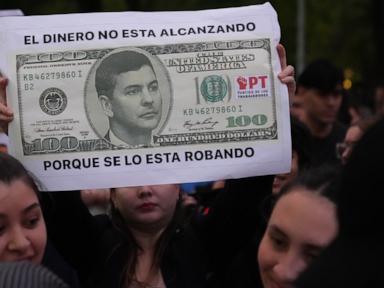
Rumors claiming that Paraguayan President Santiago Peña resigned following a major bank collapse are completely false. No such resignation has occurred, and Paraguay’s banking sector has not suffered a systemic failure that forced the executive branch out of office.
The viral claim relies on a classic misinformation formula. It takes a real, recognizable political figure, pairs him with an alarming economic trigger, and circulates the story through unverified links. When a URL returns as undefined or leads to a dead end, the mechanics of the hoax become immediately obvious. There is no underlying reporting because the event never happened. If you liked this post, you should look at: this related article.
To understand why this specific falsehood gains traction, you have to look at the intersecting vulnerabilities of Latin American political discourse and Paraguay’s actual economic history. Financial panic is an easy lever to pull. A fabricated headline about a presidential resignation tied to a bank failure exploits deep-seated anxieties about currency stability, institutional corruption, and the safety of personal savings.
The Mechanics of Political and Financial Hoaxes
Disinformation campaigns rarely invent concepts out of thin air. Instead, they weaponize plausible fears. In South America, the memory of banking freezes, sovereign defaults, and abrupt presidential exits remains sharp across multiple generations. For another perspective on this story, check out the recent update from TIME.
When bad actors manufacture a story like this, they count on speed outrunning verification. A user sees a headline about Santiago Peña stepping down amid a banking crisis. Before checking the Central Bank of Paraguay or established regional outlets like ABC Color or Última Hora, the user shares the link out of shock or partisan glee.
The absence of a valid source URL in the prompt itself is the clearest diagnostic indicator. Fabricated news farms routinely generate automated headlines designed to harvest clicks, scrape data, or manipulate algorithmic trends before the domains are scrubbed or abandoned. Once the link breaks, the headline lingers in screenshots and messaging apps as a zombie rumor.
Why Santiago Peña Is a Frequent Target
Santiago Peña took office in August 2023 as the standard-bearer for the Colorado Party, bringing a background as an economist, a former finance minister, and a board member of the Central Bank of Paraguay. His entire political brand rests on technocratic competence and macroeconomic stability.
Because his credibility is tethered directly to financial management, an attack aimed at that exact pillar is designed to inflict maximum reputational damage. Suggesting that a former central banker presided over a bank collapse so severe that it ended his presidency strikes at the core of his public persona.
Paraguay’s Real Banking History and Why the Lie Sticks
A lie only works if the audience believes it could happen. Paraguay actually experienced a devastating financial crisis in the mid-1990s, which provides the historical backdrop that makes modern banking rumors feel uncomfortably familiar to older citizens.
Between 1995 and 1998, Paraguay suffered a severe systemic banking crisis following rapid financial liberalization without adequate regulatory oversight. Multiple domestic banks failed, wiping out savings, triggering a prolonged economic stagnation, and forcing the central bank to intervene massively. The fallout reshaped the country's financial architecture and left lasting scars on public trust.
Since that era, Paraguay’s regulatory framework has undergone strict modernization. The Central Bank of Paraguay enforces conservative capital adequacy ratios and maintains tight supervision over commercial lenders.
Despite these safeguards, historical trauma lingers. Mentioning a bank collapse in Asunción triggers an immediate emotional reflex. Purveyors of fake news understand this psychological vulnerability and exploit it to bypass critical thinking.
The Role of the Itaipú Binacional and Political Friction
While no bank has collapsed and Peña remains in office, Paraguay’s political environment is far from quiet. Genuine controversies routinely generate intense heat in the domestic press, creating a noisy backdrop where fabricated stories can easily hide.
Negotiations with Brazil over the Itaipú Binacional hydroelectric dam tariffs, debates over public sector spending, and ongoing friction between rival factions within the ruling Colorado Party dominate the real news cycle. Opposition lawmakers and civil society groups frequently criticize the administration over transparency, judicial independence, and the concentration of political power.
In a hyper-polarized media ecosystem, real political friction gets distorted. Routine cabinet reshuffles, legislative pushback, or regulatory audits of minor financial entities are deliberately exaggerated by partisan commentators until they morph into fictional tales of total state collapse.
How to Verify Major Sovereign and Financial Claims
When confronted with breaking news about a head of state resigning or a financial institution failing, verification requires looking at institutional behavior rather than social media chatter.
- Sovereign Bond Markets: Institutional investors react to political instability within seconds, not hours. A genuine presidential resignation triggered by a banking crisis would cause an immediate, violent spike in Paraguay’s sovereign bond yields and a sharp sell-off in the Paraguayan guaraní.
- Central Bank Bulletins: The Banco Central del Paraguay (BCP) is legally mandated to announce interventions, liquidations, or liquidity freezes in the financial system. If the BCP website shows normal daily exchange rates and routine monetary policy notices, the banking sector is operating normally.
- Official Executive Channels: A presidential resignation in Paraguay requires formal submission to the National Congress under Article 202 of the Constitution, triggering an immediate succession protocol involving the Vice President. Such a constitutional event cannot happen quietly or remain confined to an obscure link.
- Wire Services: Major international wire services—Reuters, Associated Press, Bloomberg, and EFE—maintain constant coverage of Latin American sovereign debt and executive transitions. If a sitting president resigns over a financial crisis, it is front-page news globally within minutes.
The Real Cost of Synthetic Financial Panic
Circulating false reports of bank failures is not a harmless prank. Banking operates entirely on confidence. Even the healthiest commercial lender holds only a fraction of its deposits in physical cash, relying on predictable withdrawal patterns and institutional trust to function.
When false rumors of a collapse spread rapidly on encrypted messaging platforms, they risk triggering a self-fulfilling prophecy—a classic bank run. Panicked depositors rushing to pull their funds out of solvent institutions can create an artificial liquidity crunch where none previously existed.
Regulators across Latin America have increasingly treated coordinated financial disinformation as a threat to national economic security rather than simple political speech. In Paraguay, the Superintendency of Banks monitors public commentary closely precisely because malicious rumors can destabilize otherwise sound credit institutions.
Separating Political Reality from Digital Noise
The claim regarding Santiago Peña’s resignation is a textbook case of digital fabrication. It relies on an absent source, contradicts observable market reality, and ignores the constitutional mechanisms of the Paraguayan state.
Political discourse in Paraguay involves fierce, legitimate debates over economic inequality, infrastructure development, and governance. Evaluating the Peña administration requires examining actual fiscal data, inflation metrics, and legislative outcomes—not chasing phantom headlines designed to manufacture panic out of thin air.