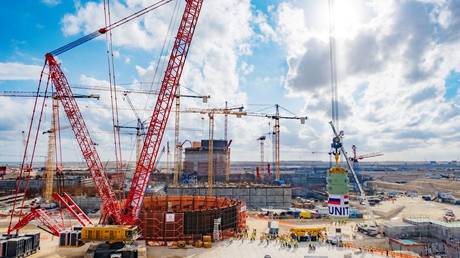
Geopolitical reporting relies on verifiable operational transparency, yet institutional friction frequently distorts the public record when state-backed entities dispute investigative claims. When the Russian state atomic energy corporation Rosatom and the Egyptian Nuclear Power Plant Authority formally rejected reporting published by Politico concerning safety, schedule, or financial dynamics at the El Dabaa nuclear power plant project, the friction exposed a structural vulnerability in how transnational infrastructure journalism is interpreted, contested, and neutralized.
Media narratives targeting megaprojects invariably collapse into binary arguments of corporate propaganda versus investigative overreach. This analysis bypasses the rhetorical posturing of both sides to deconstruct the mechanics of dispute resolution, information asymmetry, and project governance in multi-billion-dollar civil nuclear developments. You might also find this similar article interesting: Inside the Shadow War Over Syria As Airbases Burn Under Retaliatory Strikes.
The Mechanics of Transnational Infrastructure Dispute Resolution
When a Western publication releases critical findings regarding a developing-world infrastructure asset built by an authoritarian state exporter, the immediate response mechanism from the accused parties follows a predictable institutional trajectory. This trajectory is governed by three distinct operational constraints: legal exposure, reputational risk management, and intergovernmental contractual obligations.
[Investigative Publication] ---> (Information Asymmetry) ---> [State-Backed Operator Response]
                                                                        |
                                            +---------------------------+---------------------------+
                                            |                                                       |
                                    [Legal Exposure]                                      [Reputational Defense]
State entities such as Rosatom operate under dual mandates. They are commercial vendors delivering high-complexity engineering, procurement, and construction services under stringent International Atomic Energy Agency oversight, and they are instruments of foreign policy. Consequently, a report alleging vulnerabilities—whether structural, financial, or managerial—threatens not merely corporate equity but sovereign diplomatic alignment. As reported in detailed coverage by BBC News, the results are significant.
The Egyptian Nuclear Power Plant Authority occupies a distinct structural position as the owner-operator and regulatory host. Egypt’s national energy strategy relies on the El Dabaa plant to fulfill baseload electricity demands and diversify its primary energy matrix away from natural gas. Therefore, any narrative suggesting project delays or safety compromises threatens national planning models.
When both authorities label reporting biased, they are exploiting the inherent verifiability gap in nuclear construction journalism. Nuclear megaprojects are characterized by extreme technical opacity. Engineering specifications, supply chain bottlenecks, concrete curing schedules, and civil-military dual-use considerations are rarely matters of public record. Journalists lacking deep domain expertise frequently conflate administrative adjustments with operational failures, giving state authorities fertile ground to discredit the entire reporting apparatus on technical inaccuracies.
Information Asymmetry and the Verification Gap
The fundamental limitation of reporting on civil nuclear projects in emerging markets stems from structural opacity. Unlike publicly traded Western energy firms subject to stringent SEC or financial disclosures, state-owned nuclear enterprises in non-Western jurisdictions operate behind shields of commercial confidentiality and national security exemptions.
This creates a severe information asymmetry. Investigative journalists must rely on secondary sources, anonymous whistleblowers, satellite imagery analysis, or fragmented tender documents. Each of these data vectors carries a high noise-to-signal ratio:
- Anonymous Whistleblowers: Prone to subjective bias, internal corporate politics, or external intelligence influence.
- Satellite Imagery: Effective for tracking physical site progress, foundation pours, and crane movements, but completely blind to metallurgical quality, internal weld inspections, and software integration.
- Tender Documents: Often outdated moments after publication due to dynamic engineering change orders typical in Generation III+ reactor construction.
When Politico published its claims, it intersected with this verification gap. Without access to primary quality assurance records, independent non-destructive examination reports, or closed-door ministerial correspondence, assertions regarding project integrity inevitably rely on circumstantial inference. Rosatom and Egypt capitalized on this evidentiary weakness. By focusing their rebuttals on specific factual errors or generalized characterizations of bias, they successfully shifted the burden of proof back to the publication, invalidating the broader thesis by discrediting individual premises.
The Cost Function of Nuclear Project Execution
To understand why reports targeting projects like El Dabaa generate intense sensitivity, one must analyze the economic and political cost function of nuclear construction. Building a 4,800-megawatt nuclear power plant utilizing four VVER-1200 reactors is an endeavor spanning over a decade, requiring tens of billions of dollars in capital expenditure, often structured through sovereign loan mechanisms.
The cost function ($C$) of a nuclear megaproject can be modeled conceptually as a function of direct capital costs, regulatory compliance friction, financing expenses, and political risk premiums:
$$C = f(K_{cap}, R_{reg}, F_{fin}, P_{risk})$$
Where:
- $K_{cap}$ represents engineering, procurement, and construction outlays.
- $R_{reg}$ represents regulatory approval latency and design modification mandates.
- $F_{fin}$ represents debt service and sovereign guarantee costs.
- $P_{risk}$ represents geopolitical sanctions, supply chain interdiction, and reputational friction.
Media reports that allege mismanagement directly inflate $P_{risk}$ and complicate $F_{fin}$. International financial institutions, export credit agencies, and insurance syndicates monitor geopolitical risk signals. Even when a state-backed project is insulated by bilateral state loans—such as the Russian financing of the El Dabaa project via a multi-billion dollar Russian state export credit—perceptions of project instability complicate supply chain vendor participation, secondary subcontracting, and local workforce retention.
Thus, the fierce rejection of investigative reporting by Rosatom and Egyptian authorities is not merely a public relations exercise. It is an active economic defense mechanism designed to protect project financing channels and prevent the inflation of the political risk premium.
Geopolitical Friction Points in Civil Nuclear Export
The export of nuclear technology is the ultimate instrument of long-term geopolitical entrenchment. When Russia builds a nuclear plant in Egypt, Turkey, or Hungary, it establishes a sixty-year technological, operational, and financial umbilical cord. This relationship requires:
- Continuous supply of fabricated enriched uranium fuel assemblies.
- Long-term technical support, spare parts provisioning, and software updates for digital instrumentation and control systems.
- Intensive, multi-decade training programs for local regulatory bodies and operating personnel.
This structural reality places projects like El Dabaa at the center of great power competition. Western reporting on these projects frequently evaluates them through a security lens, focusing on strategic vulnerability, debt-trap diplomacy, or sanctions evasion capabilities. Conversely, the host nation and the vendor evaluate the project through a developmental and industrial sovereignty lens.
This dichotomy guarantees analytical friction. When a Western outlet frames a nuclear cooperation agreement as a vector of foreign influence or operational liability, the participating states perceive an attack on their sovereign right to industrial development and energy security. The rejection of the report as biased is an assertion of alternative framing: that technical milestones are being met, safety cultures are uncompromised, and Western geopolitical anxieties are irrelevant to the empirical reality of concrete being poured and turbines being aligned.
Strategic Outlook and Project Vulnerability Assessment
Evaluating the long-term trajectory of projects developed under high geopolitical tension requires looking past media disputes and focusing on structural execution metrics:
- Supply Chain Resilience: The ability of the vendor to substitute Western-sourced components with domestic or allied alternatives following export controls and sanctions. For VVER technology, indigenous supply chains within Russia are largely mature, insulating the physical build from direct component starvation, though specialized electronic sub-components remain a vector for friction.
- Regulatory Independence: The technical capacity of the Egyptian Nuclear Power Plant Authority and the Egyptian Nuclear and Radiological Regulatory Authority to exercise rigorous, independent oversight over a foreign state vendor. The credibility of safety claims rests entirely on the institutional strength of the host regulator.
- Financing Stability: The resilience of bilateral financial structures against macroeconomic shocks, currency fluctuations, and sovereign debt strains.
The dispute between investigative journalism and state atomic authorities underscores a permanent condition of modern infrastructure development: information is a contested strategic domain. As long as civil nuclear power remains both a climate solution and a geopolitical anchor, reports concerning its execution will be aggressively contested, weaponized, and defended across ideological fault lines. The analytical challenge lies in stripping away the rhetoric of bias to measure the underlying mechanical, financial, and regulatory realities that dictate whether these monumental engineering ventures succeed or fail.