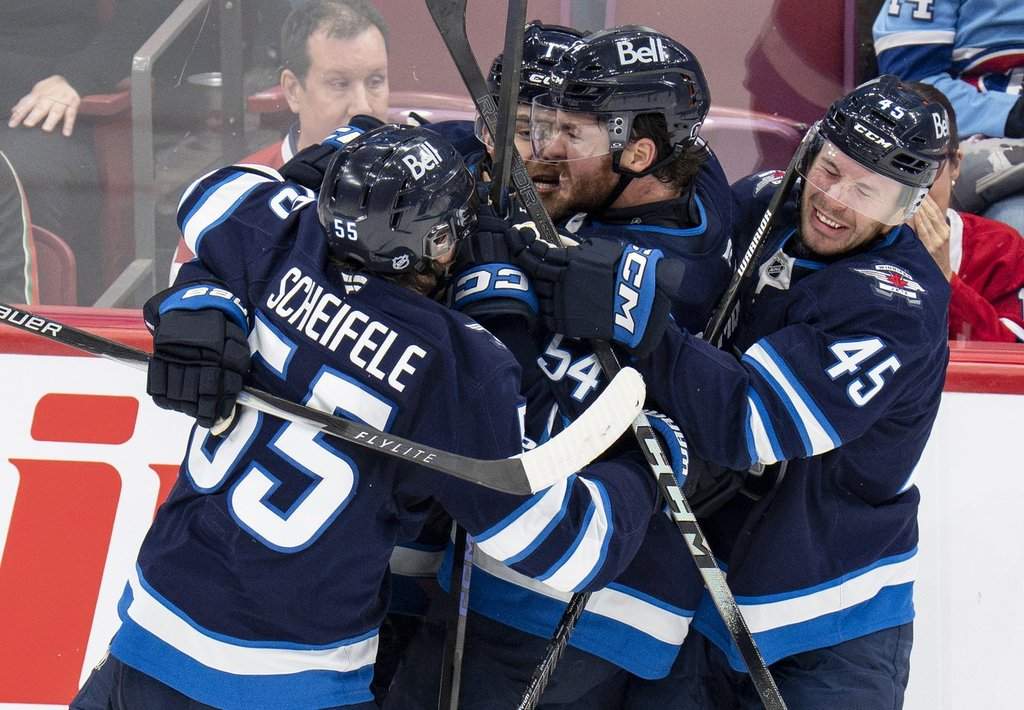
Late-game comebacks in professional ice hockey are rarely products of sudden emotional inspiration; they are structural failures in game-state management by the leading team colliding with desperate risk-allocation by the trailing roster. When the Winnipeg Jets snapped their losing streak with an overtime victory against the Montreal Canadiens following a third-period deficit, the outcome demonstrated how aggressive forechecking pressure exploits conservative defensive shells. Standard sports coverage frames this sequence around momentum and grit. A rigorous operational breakdown reveals a predictable chain of tactical adjustments, fatigue asymmetry, and spatial manipulation across three distinct phases of play.
The Mechanics of Score Effects and Defensive Shell Erosion
In the National Hockey League, leading teams consistently surrender shot share and territorial control in the third period—a documented statistical phenomenon known as score effects. When a team holds a multi-goal advantage entering the final twenty minutes, coaches and players instinctively shift from proactive puck pursuit to defensive containment. This transition alters the spatial geometry of the ice in ways that favor a trailing opponent willing to abandon defensive structure.
The primary mechanism of this shift involves three structural compromises by the leading team:
- Passive Neutral Zone Alignment: Rather than contesting entries at the opposing blue line with an aggressive 1-2-2 or 2-1-2 forecheck, the defending team retreats into a passive 1-1-3 or 1-4 trap. This concedes the defensive zone entry without friction, allowing the trailing team to carry the puck across the blue line with speed rather than dumping it in.
- Low-Slot Collapse: Defensemen and centers drop deeper toward the net front to block shooting lanes. While this reduces immediate royal-road pass attempts, it vacates the high slot and the point. Trailing defensemen gain uncontested time at the blue line to survey the ice, walk the line, and fire screened wrist shots through traffic.
- Icing and Chip-Out Dependency: Under sustained forechecking pressure, fatigued defenders default to flipping the puck out of the zone off the glass rather than executing controlled tape-to-tape breakouts. These low-percentage clearances surrender immediate possession back to the trailing team's defensemen in the neutral zone, creating continuous wave attacks without line changes.
For Montreal, protecting a late lead required maintaining puck possession through short, controlled passes out of the defensive zone. Once their breakouts degraded into glass-and-out clearances, Winnipeg established offensive zone cycle time. Each extended shift compounded Montreal's fatigue, reducing their ability to close out on shooters or win board battles.
Asymmetry in Risk Allocation During the Third Period
A trailing team operating under a losing streak faces an asymmetric risk profile. Losing by three goals carries the exact same standings penalty as losing by one goal. This reality strips away the utility of conservative positioning and mandates high-variance offensive activation.
Winnipeg's third-period surge relied on three specific tactical overrides to standard even-strength play:
- Weak-Side Defenseman Activation: In standard neutral-zone and offensive-zone structure, the weak-side defenseman holds the blue line to prevent odd-man rushes the other way. Trailing late in the game, that defenseman pinches aggressively down the boards or dives into the backdoor slot. This creates a temporary four-on-three or five-on-four overload below the faceoff dots, forcing the defending team's wingers to collapse low and leaving the opposing point completely open.
- Net-Front Screening and Tip Geometry: Shooting from the perimeter against a set NHL goaltender yields a low conversion rate unless the goaltender's sightlines are obstructed or the puck's trajectory changes late. Winnipeg prioritized funneling pucks from the perimeter toward high-traffic areas, placing multiple forwards directly in the goaltender's crease-line to create rebound chaos and deflection angles.
- Shortened Bench Rotation: Rather than rolling four lines equally to preserve energy, coaching staffs compress the bench during a comeback push. Top-six forwards and offensive defensemen absorb disproportionate ice time, maximizing the skill differential on the ice during every offensive zone faceoff.
This tactical pressure exploits the psychological vulnerability of a team trying not to lose. Defenders stop reading the play proactively and begin reacting to puck movement. Once defenders chase the puck rather than holding their spatial assignments, passing lanes open across the slot, turning low-danger perimeter possession into high-danger scoring chances.
The Structural Vulnerability of Empty-Net Situations
Pulling the goaltender for an extra attacker fundamentally alters the mathematics of hockey. Shifting from five-on-five to six-on-five increases the attacking team's shot-generation rate exponentially, though it simultaneously exposes an unguarded net to sixty-foot clearing attempts.
Success in six-on-five scenarios depends on puck retrieval rather than pure shooting accuracy. Because the defending team has five skaters packed into the house—the prime scoring area between the faceoff dots and the goal line—direct shots rarely find clean lanes. The extra attacker functions primarily as a retriever along the half-walls and behind the goal line.
When Winnipeg deployed the extra skater, the objective was winning the secondary puck battle after the initial shot was blocked or deflected. With six skaters distributed around the perimeter and at the net front, the attacking team outnumbers the defenders along the boards. Every rimmed puck or rebound becomes a high-probability recovery for the offense, preventing the defending five from organizing a clean clearance. Montreal's failure to secure a clean possession and exit the zone under six-on-five pressure directly enabled the game-tying sequence, converting a near-certain regulation win into a single-point salvage operation.
Three-on-Three Overtime as a Possession Monopoly
Once regulation expires, NHL overtime shifts to a five-minute, three-on-three sudden-death format. This ruleset eliminates traditional positional hockey and replaces it with a continuous possession game governed by man-to-man coverage, spatial isolation, and line-change timing.
In three-on-three play, surrendering the puck without generating a high-danger scoring chance is a critical tactical error. A missed shot that rims around the boards and exits the zone immediately triggers a three-on-two or two-on-one rush in the opposite direction.
To execute a winning overtime possession cycle, a team must manage three distinct operational variables:
- Regrouping Over Forcing: When a rush is stalled at the opposing blue line, high-performing overtime units do not dump the puck in. They peel back into the neutral zone or even back into their own defensive zone to maintain possession, allowing tired skaters to execute a staggered line change while keeping the puck away from the opponent.
- Pick-and-Roll Spatial Manipulation: With only six skaters on an NHL ice surface measuring 200 feet by 85 feet, individual defenders have vast expanses of ice to cover. Offensive players use scissor routes and subtle picks at the blue line to force defensive switches. Any miscommunication between defenders during a switch creates an immediate two-on-one isolation against the goaltender.
- Goaltender Involvement as a Fourth Skater: In overtime, the goaltender acts as a puck-handling outlet to break forechecking pressure, enabling quick up-ice transitions before the opponent can reset their defensive coverage.
Winnipeg entered overtime with the structural advantage of compressed bench momentum and the psychological relief of having erased a multi-goal deficit. Montreal entered overtime suffering from the acute cognitive fatigue of a blown late lead—a state that frequently induces defensive hesitation and missed man-to-man assignments. In three-on-three hockey, a single half-second delay in tracking a cutting forward results in a clean breakaway or a backdoor tap-in.
Breaking a Losing Streak Through Tactical Validation
Losing streaks in professional hockey are rarely caused by a complete absence of talent; they are typically sustained by execution errors under stress, declining shooting percentages, and defensive overcompensation. When a team loses consecutive games, players begin gripping their sticks tighter, leading to forced passes, missed assignments, and a reluctance to hold the puck for the extra fraction of a second required to let a play develop.
A comeback victory of this magnitude snaps a losing streak not through magic, but through empirical validation of the coaching staff's aggressive systems. When weak-side pinches, net-front traffic, and compressed-bench rotations directly produce goals in a high-leverage environment, player trust in the tactical framework is restored. Conversely, for the team that surrenders the lead, the loss exposes systemic flaws in their defensive zone breakout structure and late-game composure that film sessions alone cannot immediately repair.
Limitations of High-Variance Comeback Strategies
While aggressive third-period activation and early goaltender pulls worked for Winnipeg in Montreal, relying on late-game deficits as a repeatable winning formula is mathematically unsustainable.
- Regression to the Mean on Shooting Percentage: Multi-goal third-period comebacks require an unusually high shooting percentage on a concentrated volume of shots, paired with near-flawless goaltending at the other end to prevent an insurance goal. Over an 82-game season, teams trailing by two or more goals entering the third period lose the vast majority of those contests.
- Physical Attrition from Compressed Rotations: Over-relying on top-six forwards and top-pair defensemen to rescue games accelerates cumulative fatigue. Across a condensed NHL schedule, burning out primary minutes-eaters in November degrades five-on-five efficiency in March and April.
- Defensive Vulnerability on Turnovers: Aggressive weak-side pinches leave the defensive blue line exposed. Against elite transitional teams that excel at flipping the ice quickly, this exact strategy frequently turns a two-goal deficit into a four-goal blowout via odd-man rushes.
Operational Directives for Sustaining the Turnaround
To convert a single dramatic overtime win into sustained standings points, Winnipeg's coaching staff must apply their third-period urgency to the opening twenty minutes of subsequent games rather than waiting for a scoreboard deficit to force their hand. Establish aggressive F1/F2 forechecking pressure from the opening puck drop to force opposing defensemen into the same hurried, glass-and-out clearances Montreal executed late in the game. Simultaneously, Montreal must audit their defensive zone exit routes under heavy pressure, instituting mandatory short-support options for their defensemen so that late leads are protected through controlled puck possession rather than passive shell defense.