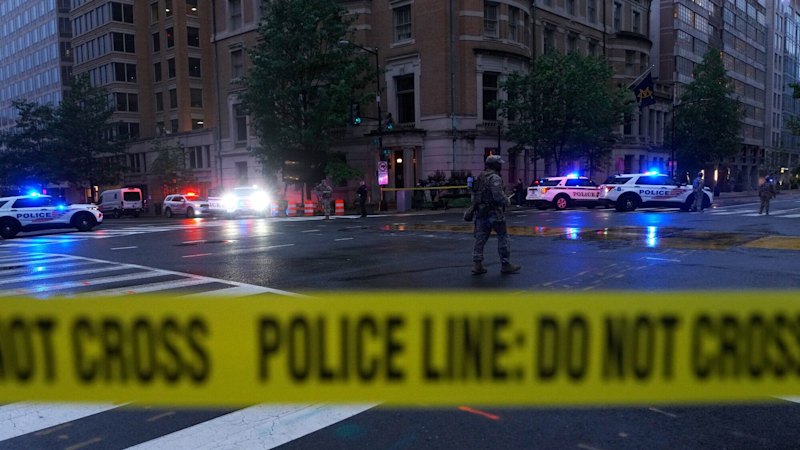
The lethal engagement at the White House perimeter on May 23, 2026, highlights a critical reality in modern executive protection: physical checkpoints are designed to absorb and neutralize threats, but the predictive mechanisms intended to mitigate those threats beforehand remain fundamentally constrained. When 21-year-old Nasire Best approached a United States Secret Service (USSS) checkpoint at 17th Street and Pennsylvania Avenue NW, removed a handgun from his bag, and fired three rounds, he triggered a textbook kinetic response. Within seconds, agents fired roughly 30 rounds, neutralizing the threat. Yet, Best was already a known variable, flagged across multiple federal databases with a documented operational history at that exact location.
To analyze this incident requires moving past the sensationalism of the suspect's delusions and examining the structural breakdown between threat identification and threat mitigation. This event exposes the tactical trade-offs inherent in urban perimeter defense and the systemic bottlenecks that prevent law enforcement from converting behavioral telemetry into preventive intervention.
The Strategic Triad of Perimeter Defense
The White House security architecture relies on a series of concentric rings designed to degrade a threat's momentum before it can reach a primary protectee. The intersection of 17th Street and Pennsylvania Avenue NW sits approximately 300 meters from the executive residence. At this outer boundary, security operations rely on three distinct pillars:
- The Physical Barrier Layer: Fixed magnetometers, guard booths, and hardened turnstiles designed to funnel pedestrian traffic and enforce an immediate pause in movement.
- The Human Sentinel Layer: Heavily armed USSS Uniformed Division officers trained in behavioral observation and rapid-fire engagement.
- The Digital Telemetry Layer: Surveillance infrastructure linked to real-time database lookups, facial recognition, and automated threat-tagging systems.
On May 23, the physical and human sentinel layers performed as engineered. The checkpoint acted as a kinetic filter. When Best initiated his attack at approximately 6:00 PM, the system absorbed the initial shock—resulting in an injured bystander but zero law enforcement fatalities—and responded with decisive counter-fire.
The structural failure did not occur at the checkpoint; it occurred in the failure of the digital telemetry and legal frameworks to prevent a highly predictable actor from reaching that checkpoint in the first place.
The Behavioral Telemetry Funnel and the Escalation Loop
A retrospective analysis of Best’s interactions with federal law enforcement reveals a clear, multi-stage escalation loop. Threat assessment frameworks typically categorize an individual's trajectory toward targeted violence through a series of measurable behavioral indicators. Best's documented operational history fits perfectly within this model.
[June 2025: Traffic Obstruction / Delusional Claims]
                     │
                     ▼
[Involuntary Psychiatric Commitment (PIW)]
                     │
                     ▼
[July 2025: Restricted Area Breach / Turnstile Bypass]
                     │
                     ▼
[Judicial Stay-Away Order Issued]
                     │
                     ▼
[Dec 2025: Digital Threats & Ideological Shift]
                     │
                     ▼
[May 2026: Armed Kinetic Engagement]
Stage 1: Probing and Reconnaissance (June 2025)
Best first entered the federal threat matrix on June 26, 2025, when he obstructed vehicular traffic near 15th and E Street NW. During this encounter, he flagged down agents, made erratic statements claiming to be "God," and inquired about access protocols. This behavior represents a classic reconnaissance phase, where an actor tests the boundaries of a secured environment. Following this incident, he was involuntarily committed to the Psychiatric Institute of Washington.
Stage 2: Tactical Penetration (July 2025)
Two weeks after his release, on July 10, 2025, Best escalated from verbal inquiry to physical penetration. He bypassed a restricted pedestrian control point through an exit turnstile lane before being intercepted by USSS personnel. When confronted, he stated he wanted to be arrested and claimed to be "Jesus." This action resulted in a judicial stay-away order, legally barring him from the White House complex grounds.
Stage 3: Digital Manifestation and Intent (December 2025)
By late 2025, Best’s behavioral profile shifted from localized disruption to explicit targeted intent. On December 9, 2025, social media accounts linked to Best—including a TikTok profile later flagged by open-source intelligence analysts—posted a photograph of the 2024 Butler, Pennsylvania assassination attempt against Donald Trump. The text overlay read: "Man cuh aint have no aim if it was me behind the [gun emoji] it woulda been a totally different story." Concurrently, his digital footprint included assertions that he was "the real Osama bin Laden" alongside his ongoing messianic delusions.
The Institutional Bottleneck: Why Prevention Fails
The core analytical question is clear: if an individual has twice breached or disrupted the White House perimeter, violated a federal stay-away order, and broadcast explicit intent to assassinate a protectee online, how does he manage to walk onto 17th Street with a loaded firearm undetected?
The answer lies in the legal and operational friction that governs pre-crime intervention in democratic societies.
The First Amendment and Intent Thresholds
Law enforcement agencies handle thousands of digital threats daily. The legal threshold required to execute a pre-emptive arrest for an online statement is exceptionally high. Vague, uncoordinated social media posts—even those referencing past assassination attempts—are frequently categorized as protected speech or non-actionable hyperbole unless they detail a specific time, place, and capability. Best’s digital behavior was classified as a mental health manifestation rather than an active, coordinated conspiracy, lowering its priority in automated triage queues.
The Limitations of Geofencing and Surveillance
While the Metropolitan Police Department and federal partners maintain an extensive network of cameras across the District of Columbia, tracking every individual subject to a stay-away order in real time is a logistical impossibility. Geofencing mobile devices requires active warrants or continuous carrier data feeds, which are rarely maintained indefinitely for individuals categorized as "emotionally disturbed persons" rather than active terrorists. Consequently, a stay-away order functions as a retrospective legal mechanism rather than a proactive physical shield; it provides a basis for immediate arrest after an individual is spotted, but it does not prevent them from arriving.
The Weapon Procurement Blind Spot
Prior to May 23, Best had no documented history of violence or weapon possession during his law enforcement encounters. His previous arrests were characterized by passive resistance and a desire to be detained. Because his prior commitments were psychiatric rather than felony convictions, and because gaps persist between state-level mental health reporting and the National Instant Criminal Background Check System (NICS), individuals in Best's demographic frequently retain the ability to acquire secondary-market or unregulated firearms, bypassing traditional federal firewalls.
Comparative Threat Environments and Strategic Projections
The May 23 shooting is not an isolated tactical anomaly; it represents the second major breach attempt at a high-profile Washington venue within a 30-day window. On April 25, 2026, a separate assailant, Cole Tomas Allen, successfully infiltrated a security checkpoint at the Washington Hilton during the White House Correspondents’ Association Dinner, discharging a 12-gauge shotgun and wounding a USSS agent before being subdued.
When contrasted, these two events map two entirely distinct threat profiles that modern security infrastructure must simultaneously defend against.
| Variable | The Opportunistic Insider / Delusional Actor (Nasire Best) | The Methodical Out-of-State Assailant (Cole Tomas Allen) |
|---|---|---|
| Tactical Preparation | Low. Openly paced the perimeter, carried a weapon in a standard bag, lacked tactical gear. | High. Traveled cross-country via rail, checked into the venue hotel, utilized a long gun. |
| Behavioral Footprint | High. Multiple prior local arrests, explicit local stay-away orders, overt physical signaling. | Low. No prior local law enforcement contact, structured digital footprint (scheduled-send emails). |
| Operational Intent | Chaotic / Suicide-by-Cop. Sought arrest or divine validation; lacked a clear escape or penetration vector. | Targeted Assassination. Explicitly stated intent to eliminate the President and administration officials. |
| Systemic Deficit | Inter-agency communication and real-time tracking of known local threats. | Kinetic screening efficiency at temporary off-site venues. |
The intersection of these two distinct threat vectors creates an compounding strain on USSS resources. While methodical actors like Allen require deep investigative, cross-state counter-intelligence, chaotic actors like Best demand hyper-localized, real-time tactical surveillance.
To address the vulnerability exposed by the Best engagement, federal protective services must transition from a reactive posture—relying on agents to win a gunfight at a turnstile—to an integrated, high-density telemetry model. This requires deploying continuous facial recognition arrays across a three-block radius of the White House complex, tied directly to an automated alarm system for any individual flag-tagged with an active judicial stay-away order. Until the legal and technical infrastructure allows for the real-time interception of known perimeter violators before they reach physical magnetometers, the outer gates of the executive complex will remain the default arena for lethal engagements.