Most living things deteriorate as they get older. Cells break down, immune systems falter, and the odds of surviving another year drop steadily toward zero. Ant colonies invert this fundamental law of biology. Long-term demographic tracking of wild harvester ants and leafcutters reveals that older colonies are significantly more likely to survive, expand, and produce reproductive offspring than younger ones. Rather than succumbing to senescence, an established ant colony becomes more resilient over time because it operates as a superorganism, replacing aging individual workers while retaining collective infrastructure, territorial dominance, and institutional memory.
The implications stretch far beyond entomology. Evolutionary biologists have spent decades trying to understand why some organisms experience negligible senescence, the technical term for aging without functional decline. While naked mole rats and certain tortoise species achieve this at the individual level, social insects achieve it through collective architecture. They bypass biological decay not by stopping cellular aging in their bodies, but by externalizing their survival mechanisms into a decentralized network of replaceable parts.
The Superorganism Advantage
To understand how an ant colony cheats time, you first have to stop looking at the individual ant. A single worker has a lifespan measured in months, sometimes a year or two depending on the species and her caste. She wears down. Her mandibles dull from cutting leaves or crushing seeds, her exoskeleton scratches, and her navigational accuracy degrades.
Yet the colony itself functions like a single, sprawling mammal. In this framework, individual workers are akin to skin cells or red blood cells. They are produced in vast numbers, perform specific metabolic or defensive tasks, and are discarded when they expire. The queen serves as the reproductive organ, tucked deep underground away from predators and temperature swings.
Because the colony continuously generates fresh workers to replace the old, the collective organism never suffers from cumulative cellular damage. When a young colony starts out, it is fragile. A single newly mated queen digs a shallow chamber, lays a few dozen eggs, and starves herself to feed the first brood using energy metabolized from her own obsolete wing muscles. At this stage, a heavy rainstorm, a wandering beetle, or a competing ant scout can wipe out the entire enterprise in minutes.
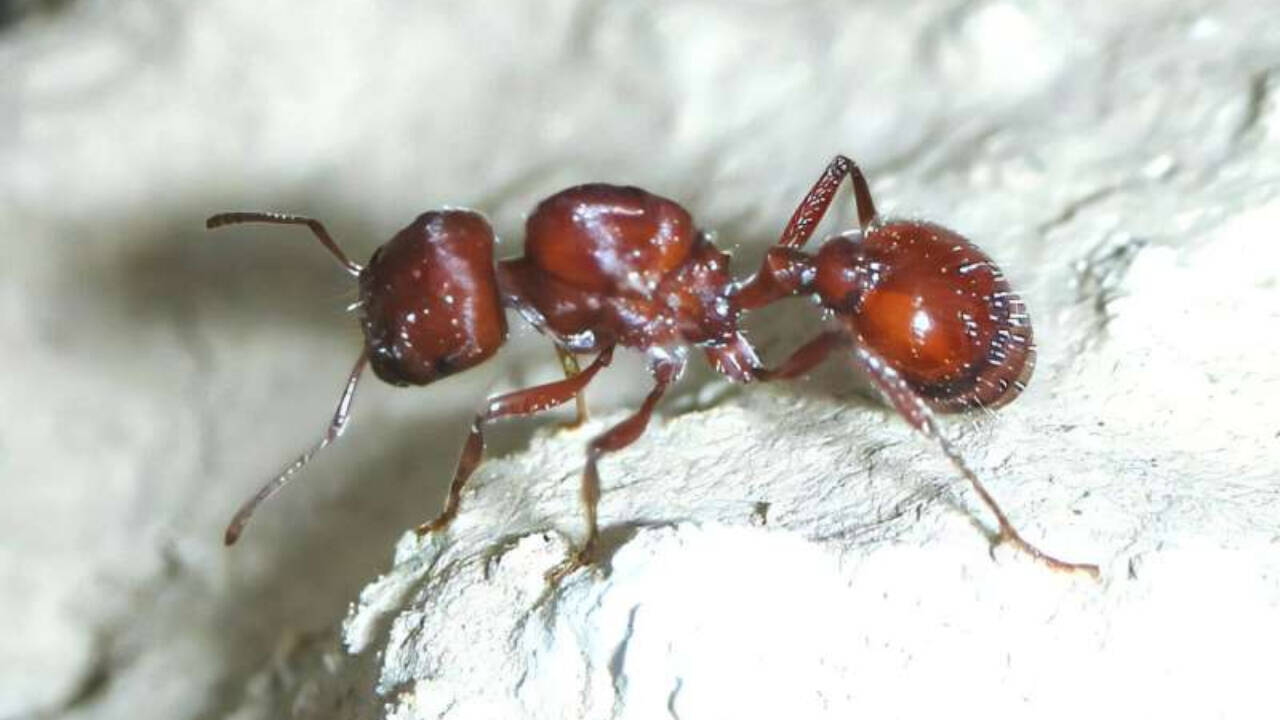
If the colony survives those brutal first two years, the math changes entirely. By year five or ten, the population swells into the tens of thousands. The nest extends meters beneath the surface, buffered against droughts and freezes. Mortality rates plummet. In ecological field studies tracking red harvester ants (Pogonomyrmex barbatus) over decades, researchers found that once a colony reaches maturity, its annual survival probability stabilizes at remarkably high levels, often exceeding 90 percent year over year.
Infrastructure and Territorial Compound Interest
Survival is only half the equation. Older colonies also out-reproduce their younger neighbors, pumping out swarms of winged males and virgin queens every mating season. This reproductive surge happens because established colonies enjoy the biological equivalent of compound interest.
A young colony must spend nearly all its caloric income on basic survival and growth. Every drop of nectar and every insect carcass brought back to the nest goes toward building the workforce and excavating living quarters. There is zero surplus energy available for reproduction.
An older colony already owns the real estate. Its subterranean galleries are dug, its fungal gardens or seed granaries are stocked, and its foraging trails are cleared of debris. Because the foundational infrastructure is already paid for, the colony can redirect incoming calories directly into producing reproductive alates.
Territory plays an equally decisive role. Ants are fiercely territorial, and borders between neighboring colonies are constantly contested through chemical signaling and border skirmishes. A massive, established colony commands prime foraging grounds simply through overwhelming numbers. Younger colonies are pushed to the margins, forced to harvest poorer resources or risk fatal encounters with superior forces. Over time, the rich get richer.
The Myth of Queen Immortality
A common misconception is that an ant colony lives forever simply because the queen lives forever. While ant queens do possess extraordinary lifespans compared to solitary insects—some Lasius niger (black garden ant) queens have been documented living nearly 30 years in captivity—they are not immortal. Even a queen eventually runs out of stored sperm from her single mating flight, or succumbs to age-related decline.
When a monogynous colony (one with a single queen) loses its monarch, the clock starts ticking. Without new eggs, the existing workforce gradually dies off, and the colony collapses within a year or two.
However, many successful ant species have evolved a workaround that eliminates even this single point of failure. Polygyny, the practice of housing multiple reproductive queens within a single nest, allows a colony to recruit new queens continuously. When an older queen dies, younger queens—often daughters mated within or near the nest—step seamlessly into her role.
In extreme cases, this creates supercolonies that span hundreds of miles and persist for centuries. The Argentine ant (Linepithema humile) has formed massive, interconnected networks across southern Europe, California, and Japan. Because workers move freely between nests and multiple queens constantly replenish the population, these supercolonies have effectively severed their connection to biological aging. They do not die of old age; they only die if their habitat is destroyed or a specialized pathogen sweeps through the population.
How Collective Memory Outlives the Individual
Beyond physical infrastructure and reproductive redundancy, older colonies possess an intangible asset that young colonies lack: collective memory.
An individual ant does not have a map of the forest in her head. She operates on simple local rules, following pheromone trails and responding to tactile cues from nestmates. Yet the colony as a whole remembers where the best food sources were last season, which routes flood during spring rains, and where hostile neighbors reside.
This memory is stored externally in the environment and dynamically maintained through chemical communication. Trunk trails—highways cleared of vegetation and saturated with persistent pheromones—guide new generations of foragers directly to reliable food patches. Older workers, who tend to take on the riskiest foraging duties outside the nest, subtly adjust these trails based on changing conditions before passing the baton to younger recruits.
Consider a hypothetical scenario involving a mature leafcutter colony in a tropical forest. A tree that provided prime foliage for three years suddenly develops toxic defensive compounds. Older foragers detect the chemical shift, stop depositing recruitment pheromones along that branch, and redirect traffic toward a different tree a hundred meters away. Within days, the entire colony's foraging architecture shifts. New workers hatching months later will never even know the toxic tree existed; they will simply follow the established chemical highway to the safe food source. The knowledge survives the death of every single individual who originally discovered it.
The Vulnerability of Scale
It would be a mistake to view older ant colonies as invincible. Their evolutionary strategy trades individual resilience for collective scale, and that scale introduces specific, catastrophic vulnerabilities.
The primary threat to an established, aging colony is disease. High population density, genetic similarity among nestmates, and constant physical contact create ideal conditions for fungal pathogens and parasites. A young, sparse colony might evade a soil-borne fungus simply because its footprint is small. A massive, 15-year-old colony excavating deep into the earth is almost guaranteed to encounter pathogens eventually.
Ants counter this with aggressive social immunity. Workers groom each other obsessively, apply antimicrobial secretions from specialized glands, and brutally quarantine or dismember infected nestmates. Some species even line their nest chambers with tree resin to inhibit bacterial and fungal growth. Still, when a novel pathogen breaches these defenses, the very size that protected the colony from predators accelerates its collapse.
Climate shifts and sudden habitat disruption also hit older colonies harder than expected. Because a mature colony has invested decades into a specific location—digging meters down to reach stable water tables and thermal zones—it cannot easily relocate. If a severe multi-year drought drops the water table below the deepest chambers, or if agricultural development tears up the topsoil, a massive colony cannot simply pack up and move like a small, mobile nomadic species.
Rethinking the Biology of Aging
Standard evolutionary theory struggles to explain why organisms age at all. The classic mutation accumulation theory suggests that natural selection weakens after an organism reproduces, allowing harmful late-life mutations to pile up in the genome. Another model, antagonistic pleiotropy, argues that genes boosting early-life fertility often cause late-life decay, and evolution favors immediate reproduction over long-term survival.
Ant colonies shatter both assumptions because selection acts primarily at the colony level, not the individual level. A gene that makes a queen live 20 years instead of two doesn't just give her a slight advantage; it exponentially increases the reproductive output of the entire superorganism over decades. Consequently, natural selection actively weeds out late-life decay in queens and favors traits that stabilize the collective over long timeframes.
Researchers studying the genetics of ant longevity have found that queens upregulate DNA repair mechanisms and antioxidant production far more aggressively than workers, despite sharing the exact same genome. The difference lies entirely in epigenetics—which genes are turned on or off based on larval nutrition and social environment. An ant larva fed a standard diet becomes a short-lived, disposable worker. The exact same genetic blueprint, fed a richer diet, becomes a long-lived queen capable of anchoring a dynasty.
This proves that biological aging is not an inescapable mechanical breakdown, like a car rusting out from mileage. It is a regulated, malleable program shaped by evolutionary priorities. When survival depends on individual endurance, nature usually takes shortcuts. When survival depends on the persistence of a collective network, nature figures out how to keep the engine running indefinitely.