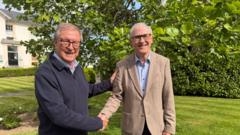
The quiet retirement of the architect behind Guernsey’s premier philanthropic finance initiative marks the end of an era for the Channel Islands. For decades, this sector operated under a simple premise: wealth management was strictly about wealth preservation and growth. The departure of the individual who successfully fused corporate finance mechanisms with charitable endeavors forces a critical re-examination of the jurisdiction's economic model. While the mainstream financial press treats this transition as a routine leadership handover, it actually signals a deeper transformation within offshore financial centers. The survival of these jurisdictions now hinges on their ability to prove societal value beyond tax efficiency.
Moving Beyond the Tax Haven Label
Offshore finance centers have long faced intense scrutiny from global regulators and onshore governments. The traditional model relied heavily on privacy, low taxation, and efficient corporate structuring. However, the survival of places like Guernsey required a shift in strategy. It was no longer enough to be a passive conduit for global capital. Learn more on a related topic: this related article.
The integration of charitable frameworks into the core financial ecosystem provided a new template. This was not merely corporate social responsibility or a marketing gimmick designed to soften a corporate image. It was a structural realignment. By creating dedicated vehicles that allowed high-net-worth individuals and institutional funds to deploy capital directly into philanthropic projects, the jurisdiction carved out a distinct niche.
This model worked because it used the exact same infrastructure that managed billions in private equity and trust funds. The legal frameworks, the compliance mechanisms, and the accounting standards were applied to charitable capital with the same rigor as commercial investments. It proved that philanthropy did not have to be inefficient, and that structured finance did not have to be entirely predatory. More journalism by MarketWatch highlights related views on this issue.
The Mechanism of Structured Philanthropy
To understand why this retirement matters, one must look at how these financial vehicles actually operate. Most people view charity through the lens of direct donations—writing a check to a local cause. The Guernsey model treated charitable capital as an asset class.
Consider a hypothetical scenario where a family trust holds $50 million in assets. Under standard conditions, a portion of the returns might be distributed to various charities annually, a process often plagued by high administrative overhead and fragmented oversight. The structured approach instead establishes a dedicated foundation within the financial center, governed by the same strict fiduciary duties as a commercial trust. This foundation can issue micro-loans, fund large-scale infrastructure in developing regions, or provide liquidity to non-profit organizations, all while preserving the principal capital through conservative reinvestment.
The genius of this system lies in its scalability. By utilizing standard corporate structures, the charity operates with minimal friction. It mitigates the risk that usually deters major donors from committing large sums to international development.
The Conflict Between Profit and Purpose
The expansion of this sector has not been without friction. There is an inherent tension at the heart of philanthropic finance. Traditional wealth managers are trained to maximize returns and minimize risk. Their bonuses, their reputations, and their fiduciary duties are tied directly to the balance sheet.
When you introduce charitable objectives into the mix, the metrics change. Success is no longer measured solely by a percentage yield. It is measured by social outcomes that are notoriously difficult to quantify. This creates a cultural clash within institutions.
- The Traditionalists: View philanthropic arms as cost centers that distract from the core business of capital accumulation.
- The Modernists: Argue that without these structures, the jurisdiction will lose the next generation of clients who demand ethical deployment of their wealth.
This divide is widening. The executive who just stepped down served as the bridge between these two factions, possessing both the technical financial credibility to satisfy the traditionalists and the ethical commitment to drive the charitable mission forward. Without that specific individual balancing the scale, there is a distinct possibility that these programs could be hollowed out, reduced to mere compliance exercises or public relations campaigns.
Regulatory Pressures and Global Standards
The transition comes at a time when international regulatory bodies are tightening the screws on offshore centers. The OECD and the European Union continually update their criteria for economic substance and transparency. Every entity registered in a jurisdiction like Guernsey must prove it has a real, tangible presence and serves a legitimate economic purpose.
Philanthropic finance structures have historically provided an excellent defense against critics. They demonstrate that the jurisdiction possesses genuine expertise and infrastructure dedicated to global good. However, if these entities lose their driving force, they risk falling into stagnation.
Regulators are increasingly skeptical of structures that appear to exist primarily on paper. If a philanthropic foundation cannot demonstrate active management and clear, verifiable outputs, it will face the same regulatory headwinds as an empty holding company. The challenge for the successor is to maintain operational integrity under an increasingly hostile global regulatory framework.
The Succession Vacuum in Niche Markets
Finding a replacement for a pioneer in a niche field is an exceptionally difficult task. In major financial hubs like London or New York, talent pools are deep, and executives move frequently between institutions. In smaller jurisdictions, the entire ecosystem often relies on a handful of key individuals who possess a unique combination of local influence and global vision.
The skills required to run a financial charity are highly specific. The leader must understand complex trust law, international tax compliance, and fund administration. Simultaneously, they must navigate the nuanced world of non-governmental organizations, humanitarian logistics, and impact measurement.
Most executives are trained in one world or the other. The corporate lawyer rarely understands the operational realities of a medical clinic in a developing nation. The charity director rarely understands the nuances of a Guernsey regularized cell company. The departure of someone who lived at the intersection of both worlds leaves a void that cannot be easily filled by a standard recruitment process.
The Future of Offshore Capital Deployment
The departure of this key figure happens against a backdrop of shifting global wealth dynamics. The multi-generational transfer of wealth currently underway is changing what clients expect from their financial advisors. Younger inheritors are less interested in absolute secrecy and more interested in visible, measurable impact.
If the jurisdiction fails to sustain its philanthropic financial infrastructure, this capital will simply move elsewhere. Jurisdictions like Singapore and Switzerland are aggressively developing their own impact investment and philanthropic frameworks, backed by heavy state support and massive financial incentives.
Guernsey's historical advantage was its agility and the close collaboration between its regulatory bodies and the private sector. That agility, however, depended heavily on individual leadership and personal relationships. The system must now prove that it can function as an institutionalized process rather than a cult of personality. The mechanisms are in place, the legal structures exist, but the strategic direction remains uncertain.
The real test for the island’s financial sector over the next decade will not be whether it can attract more traditional funds. The real test is whether it can maintain its status as a credible destination for purposeful capital without the guiding hand of the man who built the foundation. The transition is not just a change in personnel; it is a test of structural permanence.