Dust.
It coats everything. It settles in the deep creases of calloused hands, dulls the aggressive yellow paint of the police barricades, and hangs in the heavy air like a physical manifestation of exhaustion. When thousands of people walk toward the seat of their government, they do not arrive in silence. They arrive in a storm of their own making.
But today, the highway to India's parliament is no longer a road. It is a fortress.
The state has arranged its defense with cold, geometric precision. First, the shipping containers, stacked two high and filled with sand, turning a public artery into a dead end. Next, the concrete Jersey barriers, chained together and anchored to the asphalt. Then, the concertina wire, unspooled in tight, vicious loops designed to catch clothing and tear flesh. Finally, the riot police. Rows upon rows of synthetic armor, clear shields, and lathis.
This is what it looks like when a government decides it can no longer hear its citizens. It stops listening. It starts building.
There is a word circulating in the air-conditioned television studios and encrypted chat groups, a term used to describe this swelling tide of humanity pressing against the concrete.
Cockroaches.
It is an ugly, calculated word.
We must pause and examine this word because language is never accidental in the theatre of power. When a broadcaster or a politician looks at a crowd of thousands—farmers, laborers, mothers, and sons—and labels them an infestation, they are performing a very specific psychological trick. They are attempting to alter the basic rules of engagement.
If the people on the highway are citizens with grievances, then the state has a moral obligation to listen, to negotiate, to compromise. But if they are insects? You do not negotiate with a swarm. You exterminate it. You block it. You crush it.
The metaphor is designed to strip away the human element, to turn a desperate plea for survival into a pest control problem. It makes the tear gas easier to justify. It makes the baton strikes feel like public sanitation rather than violence.
But metaphors shatter when they hit reality. Let us strip away the rhetoric and look at the actual flesh and bone standing on the asphalt.
Consider a hypothetical marcher. We will call him Raj. He is not a political operative. He is not an anarchist. He is fifty-four years old, and he has spent thirty of those years pulling wheat and rice from a plot of land that is slowly turning to dust.
Raj is here because the arithmetic of his life has broken down.
The cost of diesel goes up. The cost of fertilizer goes up. The minimum support price for his crops remains stubbornly flat. He owes money to a local moneylender at an interest rate that would make a Wall Street banker blush. Last month, his neighbor drank pesticide because the shame of bankruptcy was heavier than the fear of death.
Raj did not walk for three days in the blistering heat because he wants to overthrow the state. He walked because staying home meant waiting for his own inevitable ruin.
Look at his hands. They are cracked, stained with soil, trembling slightly from dehydration. These are the hands that feed the nation. Today, the nation has deployed water cannons to push those hands away.
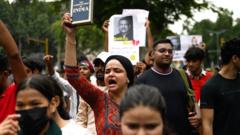
If you have never stood in a crowd of fifty thousand desperate people, the scale is nearly impossible to comprehend. The television cameras pull back to show a sea of bodies, a faceless mob. But on the ground, a protest of this magnitude is not a single organism. It is a sprawling, chaotic, deeply human ecosystem.
There are community kitchens, langars, bubbling with giant vats of dal and rice, feeding anyone who holds out a plate. There are makeshift medical tents where off-duty doctors wrap blistered feet and flush tear gas from bloodshot eyes. There are old men sitting on the hoods of tractors, sharing bidis and stories of protests from their youth.
This is not an infestation. It is a displaced city.
The tension at the front line is a physical weight. The distance between the barricades and the front row of marchers is perhaps twenty feet. It is a no-man's-land filled with discarded plastic bottles, shattered glass, and the lingering, peppery stench of chemical irritants.
On one side: the marchers. Agitated, chanting, pushing against the unyielding metal.
On the other side: the police.
This is where the narrative grows unbearably tragic. Look closely at the young men behind the polycarbonate shields. They are sweating inside their heavy riot gear. Their eyes are wide. Their knuckles are white around their batons.
Who are they?
They are Raj's nephews. They are the sons of farmers and laborers from the very same villages the marchers left behind. They joined the police force for the same reason Raj is protesting: survival. A government job means a pension. It means a steady paycheck. It means escaping the crushing cycle of agricultural debt.
The state has engineered a masterful, devastating confrontation. It has taken the rural poor, dressed half of them in riot gear, and ordered them to beat the other half.
The boys in uniform are terrified. The men in the crowd are furious. Both are trapped in a system that views them as entirely disposable. The men in the air-conditioned rooms, the ones who casually drop words like cockroach into the public discourse, are nowhere near the flying stones and the choking smoke.
The Anatomy of the Clash
The break happens suddenly. It always does.
A surge in the crowd. A misheard order. A plastic water bottle hurled through the air, bouncing harmlessly off a plastic shield.
It does not matter what the spark is. The dry tinder has been piled high for months.
Pop. Pop. Pop.
The tear gas canisters arch through the blue sky, leaving trails of thick, white smoke. They hit the asphalt with a metallic clatter and begin spinning violently, hissing out clouds of burning, blinding vapor.
Chaos.
The crowd fractures. People run blindly, tears streaming down their faces, coughing violently as the gas sears their lungs. The front line of the police steps forward, moving in a synchronized, mechanical rhythm. The batons come down. The dull thud of heavy wood striking human shoulders and backs.
Screams. Sirens. The roar of the crowd turning from a chant of defiance into a howl of pain.
Through it all, the concrete barriers remain completely immovable. They do not care about the minimum support price of wheat. They do not care about the debt. They do not care about the blood on the road. They just stand there, doing exactly what they were designed to do: stop movement. Stop progress. Stop the conversation.
This is the ultimate failure of a representative system. When parliament is surrounded by steel and concrete, it ceases to be a house of the people. It becomes a bunker.
The smoke begins to clear. The wind pushes the gas into the neighboring fields.
The crowd has been pushed back, but they have not dispersed. They regroup fifty yards down the highway. The medical tents are overflowing now. Men are pouring water into their eyes, binding their bruised arms with strips of torn cloth.
They sit on the asphalt. They wait.
They are not going anywhere. They have nowhere else to go. The farms are failing, the banks are calling, and the only thing they have left is the sheer, stubborn mass of their collective bodies.
The media will broadcast the footage of the clash. Pundits will point to the broken barricades and the thrown stones as proof that the crowd is unruly, dangerous, a pestilence that must be controlled. They will use their sterile, insectoid metaphors.
But down on the highway, beneath the fading sun, the truth is entirely different.
A young protester helps an older man to his feet. A woman passes a cup of water to a stranger. A few yards away, a riot policeman lowers his shield, letting it rest on the ground for just a moment, his chest heaving as he stares across the empty space at the people he was ordered to strike.
The dust rises again, swirling in the hot wind, coating the steel, the concrete, and the unbreakable will of the thousands who remain.