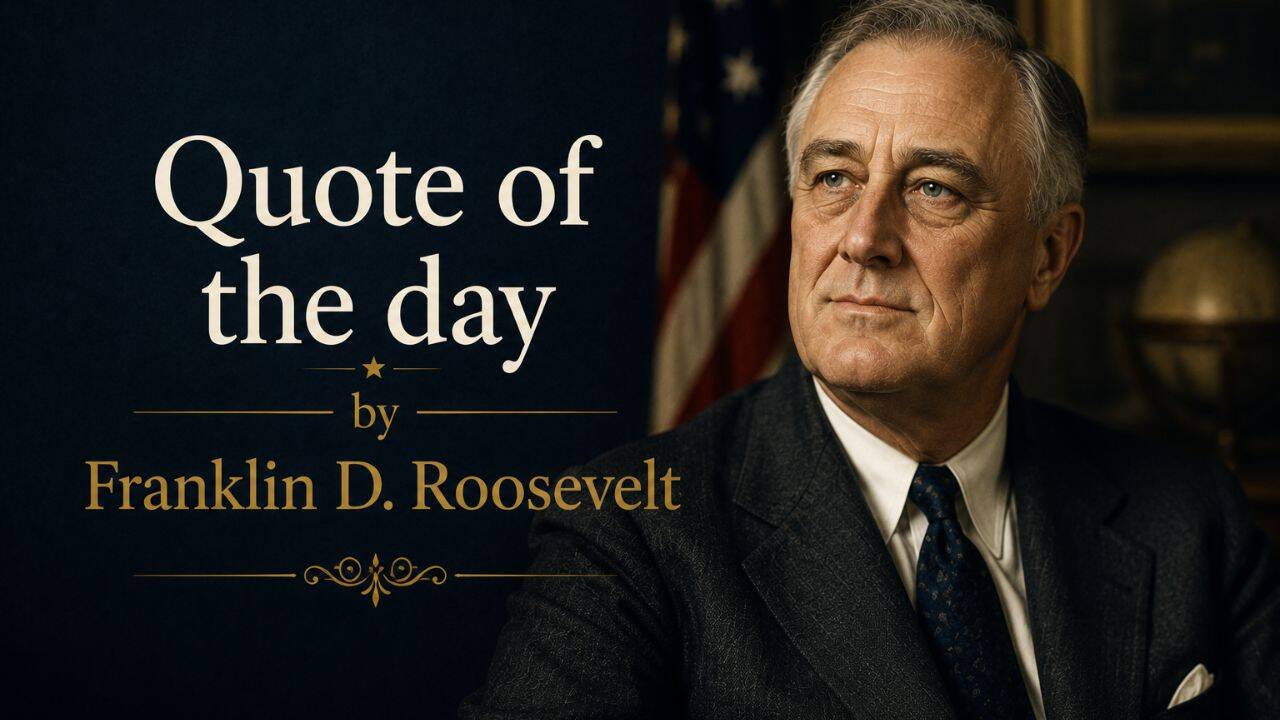
The rain in Washington on April 15, 1939, did not care about the fate of the Western world. It streaked the tall windows of the White House, blurring the budding green of the capital into a gray smear. Inside, a man sat in a heavy oak chair, his legs encased in steel braces that bit into his flesh.
Franklin Delano Roosevelt could not walk to the window to watch the storm.
Outside those walls, a different kind of storm was gathering. Across the Atlantic, a dictator’s boots were clicking against concrete, carving up borders with the casual stroke of a fountain pen. Fear was the primary global currency. The American economy was still gasping for air after a decade of brutal depression. The collective psyche of a generation was bruised, brittle, and deeply convinced that the future was something to be feared, not shaped.
When Roosevelt cleared his throat to speak to the Pan American Union that day, he was not just addressing diplomats. He was talking to a clerk in Ohio who had spent three years looking for steady work. He was talking to a mother in Oklahoma whose farm had literally blown away in the dust. He was talking to a world that felt utterly helpless, trapped in the gears of a cruel, uncaring destiny.
"Men are not prisoners of fate," the President said, his voice carrying over the crackle of shortwave radio, "but only prisoners of their own minds."
We hear a quote like that today, superimposed over a sleek background on social media, and we shrug. It feels like a platitude. It sounds like the kind of cheap optimism sold by motivational speakers who have never missed a meal. But when a man who cannot stand without steel clamping his knees tells you that you are not a prisoner, the words lose their hollow ring. They take on weight. They demand an accounting.
The Invisible Jailer
Consider Thomas.
Thomas is not a historical figure; he is a composite of three different people who sat across from me in a coffee shop last month, staring into the dark depths of an untouched Americano. He is forty-two. He spent fifteen years building a career in mid-level logistics management, a job that required him to predict the unpredictable. Then, a series of corporate restructurings, driven by automated algorithms he didn’t fully understand, made his department obsolete.
Thomas did not lose his mind. He lost his script.
For six months, Thomas woke up at 6:00 AM, sat at his kitchen table, and stared at a blank digital application portal. He had options. There were industries adjacent to his that were starving for his specific brand of operational wisdom. But Thomas wouldn't apply.
"The market is cooked," he told me, his voice flat. "Everything is automated now. There’s no point. The system is rigged against people my age."
When we look at our lives from the inside out, our fears always look like facts. Thomas wasn't lying. He genuinely believed he was looking at an objective reality. He had built a pristine, logical cage out of rejection letters, economic headlines, and late-night worry. The bars were thick. They were made of undeniable truths about a changing economy.
But the door wasn't locked. He just refused to touch the handle because he was certain it would shock him.
This is the subtle trap Roosevelt was diagnosing. Fate is an easy villain. It is comforting to believe that a cosmic hand has dealt us a losing card, because if the universe is responsible for our stagnation, we are absolved of the terrifying responsibility of trying. If the economy, or our upbringing, or our genetics, or our terrible boss has written the script, we can simply sit in the audience and boo.
The reality is far more uncomfortable. The walls we crash into most violently are the ones we painted onto the canvas ourselves.
The Anatomy of the Mental Cell
How do we manufacture these prisons? It rarely happens during a crisis. It happens in the quiet intervals between them.
Human brains are pattern-recognition machines. We are biologically wired to look at a chaotic world and find order. If a child is bitten by a dog, the brain quickly notes: Dogs equal pain. It is a magnificent survival mechanism for a creature dodging predators on a savannah. It is a catastrophic liability for a human being trying to navigate the complexities of modern life.
When we experience a failure—a failed marriage, a bankrupt business, a public humiliation—our minds immediately go to work building a protective wall. We tell ourselves stories to ensure we never feel that specific pain again.
“I am not the kind of person who can run a business.”
“People will always leave if they get too close.”
“Creativity is for youth; I need to stay in my lane.”
These statements feel like wisdom. They present themselves as hard-won maturity. In truth, they are just architectural blueprints for a cell.
Look at what happened in the years leading up to Roosevelt’s speech. The Great Depression was not just a financial collapse; it was a psychological obliteration. When the banks closed in 1933, people didn't just lose their money; they lost their belief in the concept of tomorrow. They stopped investing, not just financially, but emotionally. They hoarded scraps. They shrank their worlds down to the perimeter of immediate survival.
Roosevelt’s entire political project was not just about passing laws or building dams; it was an aggressive, psychological intervention. He understood that you could inject all the money you wanted into the banking system, but if the citizens still believed the future was a trap, the currency would just rot in vaults.
He had to change the internal architecture of the nation.
The Difference Between Bad Luck and Captivity
To be clear, bad things happen.
This is not an argument for radical manifestation or the delusion that structural inequality, disease, and sudden tragedy do not exist. To suggest that every obstacle can be overcome by a simple shift in mindset is a form of cruelty.
Roosevelt knew about tragedy. He was a athletic, charismatic man who was struck down by a paralytic illness at the age of thirty-nine. He spent years trying every conceivable therapy, buying an entire resort in Warm Springs, Georgia, in the desperate hope that the mineral waters would jumpstart his dead nerves. They didn't. He never walked unaided again.
That is fate. The virus was fate. The paralysis was fate.
The prison, however, would have been staying at his estate in Hyde Park, hidden away from a world that didn't like to look at weakness. The prison would have been accepting the consensus of his peers that his political life was over. The prison would have been letting the physical limits of his body dictate the boundaries of his intellect and his ambition.
He accepted the reality of his legs, but he rejected the reality of the cage.
We confuse our circumstances with our identity. A circumstance is a storm; a prison is the belief that because it is raining today, we must live underwater forever.
When Thomas finally stopped looking at his career as a series of automated rejections, something shifted. It wasn't a sudden miracle. He didn't get a million-dollar job offer the next morning. Instead, he did something small and incredibly difficult: he admitted he was terrified. He called an old colleague from an entirely different industry, someone he had assumed would be too busy to talk to him.
They had lunch. The colleague didn't have a job opening, but he had an idea. He pointed Thomas toward a small logistics consultancy that was struggling precisely because they didn't have anyone who understood how to manage human teams through a transition.
The algorithm hadn't changed. The economy hadn't changed. Thomas had simply stopped treating his assumptions as laws of physics.
Bending the Bars
If we are the authors of our own confinement, it follows that we also hold the key. But knowing the door is unlocked is different from walking through it. The air inside the cage is stale, but it is warm. We know exactly where the walls are. Freedom, on the other hand, is drafty. It requires us to tolerate the cold wind of uncertainty.
To break out of a self-imposed prison, we have to become actively skeptical of our own internal monologues. We have to treat our deepest, most cynical convictions not as truth, but as hypotheses that require testing.
The next time you find yourself saying “I can’t,” or “That’s just how things are,” or “It’s too late for me,” pause. Look at the statement. Is it a fact, like the gravity that keeps your feet on the floor? Or is it a bar you forged yourself to keep from having to try and fail?
The rain eventually stopped in Washington on that April day in 1939. The speech ended, the radio signals faded into the ether, and the world marched onward toward a conflict that would test humanity to its absolute limits. Roosevelt could not cure his illness, nor could he single-handedly stop the march of war.
But he could refuse to sit quietly in the dark.
We are all carrying our own heavy steel braces. We are all looking out at landscapes that seem volatile, indifferent, and impossibly steep. The world will give us plenty of genuine reasons to despair. It does not need our help.
The sky outside your window is wide, unpredictable, and entirely indifferent to your hesitation. Step out into the weather.