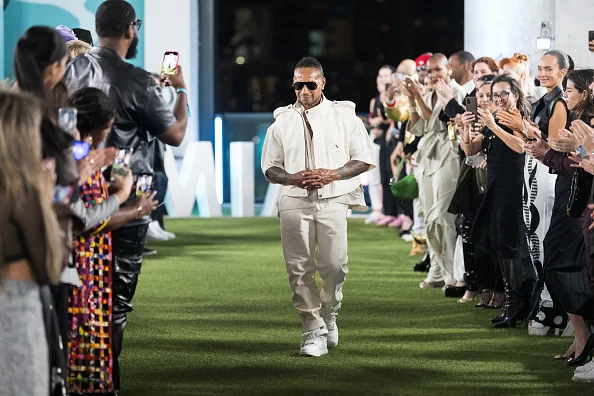
Most fashion retrospectives treat the rise of Karl Kani as a nostalgic tale of lucky timing and celebrity proximity, completely missing the underlying mechanics of capital, distribution, and intellectual property. Carl Williams did not merely dress hip-hop royalty; he engineered a vertical supply chain that bypassed traditional retail gatekeepers during a period when legacy department stores viewed urban apparel as a temporary anomaly rather than a structural market shift. The central thesis of Kani's career is simple: cultural relevance without equity control is a depreciating asset, whereas ownership of the underlying intellectual property converts transient subcultural adoption into durable enterprise value.
To understand how an independent designer from Brooklyn captured a dominant share of the early 1990s menswear market—and why controlling his narrative decades later is a calculated strategic move—requires stripping away the mythology of streetwear. It demands analyzing the exact operational bottlenecks, licensing traps, and brand-equity recovery mechanisms that define the business of subcultural fashion.
The Arbitrage of Subcultural Aesthetics
In the late 1980s and early 1990s, legacy American menswear brands operated on a rigid top-down design cycle. Corporations dictated silhouettes from Midtown Manhattan showrooms, completely disconnected from the acoustic and sartorial shifts occurring in New York, Los Angeles, and Atlanta. This disconnect created a massive market inefficiency. Consumers in urban centers were purchasing oversized garments from heritage workwear or European luxury houses and manually altering them to fit an emerging silhouette dictated by hip-hop's visual grammar.
Williams recognized this friction early. Rather than waiting for legacy retailers to validate the aesthetic, he executed a classic supply-side arbitrage:
- Direct-to-Consumer Prototyping: Operating initially out of Brooklyn and subsequently relocating to Los Angeles, Williams utilized small-batch manufacturing to test silhouettes directly against street-level demand. By reducing the feedback loop from nine months to a matter of weeks, he eliminated the inventory risk that paralyzed larger apparel houses.
- Silhouette Standardization: Instead of forcing consumers to buy triple-extra-large shirts that hung awkwardly at the shoulders, Kani engineered patterns specifically calibrated for the baggy aesthetic—wider cuts through the torso and leg paired with proportional shoulder seams and higher-grade denim weights.
- Earned Media Velocity: Traditional fashion houses allocated up to 15% of gross revenue toward print advertising in publications like GQ and Esquire. Kani bypassed paid media entirely. By placing garments directly onto artists like Tupac Shakur, Biggie Smalls, Snoop Dogg, and Dr. Dre at the exact moment music videos became the primary global distribution channel for youth culture, his customer acquisition cost dropped to near zero.
This model proved that cultural proximity could outperform institutional capital. When Tupac Shakur appeared in a Karl Kani ensemble, the brand did not just gain an endorsement; it acquired an implicit validation that no Madison Avenue agency could replicate. The consumer was not buying cotton and denim; the consumer was buying proximity to an authentic cultural vanguard.
The Structural Vulnerability of Rapid Scaling
While cultural adoption was instantaneous, operational scaling introduced severe structural vulnerabilities. When an independent apparel brand experiences exponential demand without an established balance sheet, it hits a predictable cash-flow wall. Manufacturing upfront inventory for national department store purchase orders requires massive working capital, while retail buyers typically operate on Net-60 or Net-90 payment terms.
To bridge this liquidity gap, early streetwear pioneers frequently turned to licensing agreements or external distribution partnerships. The mechanics of these deals often follow a deceptive trajectory:
- The Liquidity Injection: A larger apparel conglomerate offers immediate manufacturing capacity, global logistics, and upfront capital in exchange for a percentage of wholesale revenue or partial equity.
- Quality Dilution: To maximize gross margins across high-volume retail doors, the licensing partner inevitably substitutes lower-grade fabrics, simplifies stitching details, and floods mid-tier department stores with overproduced inventory.
- Brand Equity Erosion: Streetwear relies on perceived scarcity and tribal exclusivity. The moment a brand becomes ubiquitous in discount retail channels, its core tastemakers abandon it for the next emergent label.
The operational failure of most first-generation hip-hop apparel brands—including FUBU, Cross Colours, and Sean John—stemmed from this exact sequence. They optimized for short-term wholesale volume at the expense of long-term brand scarcity. Once the department stores inevitably pivoted to the next trend, the founders were left with diluted trademarks and bloated overhead.
Karl Kani navigated this trap differently by maintaining tight, long-term control over his core trademarks, even as international licensing—particularly in Europe and Japan—became a major revenue driver. While domestic US trends fluctuated wildly between slim-fit luxury, skatewear, and athleisure during the 2000s and 2010s, Kani preserved the brand's foundational identity in overseas markets where 1990s hip-hop iconography was treated as permanent heritage rather than a passing fad.
Intellectual Property and the Founder Narrative
The decision by Carl Williams to step into the foreground and tell his own story—through memoirs, archival exhibitions, and direct media appearances—is not an exercise in vanity. In modern brand management, founder provenance is a primary moat against commoditization.
When streetwear transitioned from a subcultural insurgency into a multi-billion-dollar luxury sector during the late 2010s, luxury conglomerates like LVMH and Kering absorbed the aesthetic codes of 1990s urban fashion. High-end houses began selling oversized hoodies and heavy denim at 10x markups, often without crediting the architects who established the category. For an independent heritage brand, silence during this historical revisionism is fatal; it allows conglomerate marketing machines to erase the origin story and claim the aesthetic as their own invention.
By actively asserting authorship over the category, Williams executes three distinct strategic functions:
- Historical Anchoring: Establishing an indisputable timeline proves that the brand is an originator rather than a retro revivalist. In consumer psychology, originators command pricing power and archival respect that derivative brands cannot buy.
- B2B Leverage: When negotiating collaborations with contemporary luxury houses, sneaker giants, or global retailers, documented cultural provenance shifts the negotiation from a standard licensing fee to a co-branded heritage partnership. Collaborators are forced to pay a premium for the legitimacy that only a founder-led archive can provide.
- Direct-to-Consumer Retention: Modern digital retail allows heritage brands to bypass department store buyers entirely. By pairing archival re-issues with founder storytelling, Kani converts passive nostalgia into high-margin, direct-to-consumer e-commerce transactions.
This approach has clear limitations. Nostalgia has a strict demographic ceiling; consumers under twenty-five rarely buy garments solely because their parents wore them in 1994. Relying exclusively on archival storytelling risks turning a living fashion label into a museum gift shop. To avoid stagnation, heritage storytelling must serve as an acquisition funnel that introduces younger cohorts to contemporary cuts and modern fabrications, rather than trapping the brand in permanent retrospection.
The Economics of Independent Longevity
Evaluating Karl Kani's trajectory requires separating gross revenue peaks from net enterprise durability. Many apparel brands generate $100 million in a single year only to file for bankruptcy thirty-six months later due to inventory overhang and debt service. Surviving across four decades in apparel requires a fundamentally different operational discipline:
- Low Fixed Overhead: Avoiding expensive flagship retail leases in high-rent corridors preserves cash reserves during cyclical downturns in fashion preferences.
- Geographic Diversification: Cultivating strong distribution networks in Tokyo, Berlin, and London cushions the business against domestic North American retail contractions.
- Trademark Autonomy: Retaining clean ownership of the parent intellectual property ensures that every licensing deal, capsule collection, and media project flows back to a single cap table, unburdened by predatory private equity debt.
Legacy media profiles often frame Kani as "the godfather of streetwear," a title that sounds flattering but subtly implies retirement or obsolescence. In reality, his longevity demonstrates the superiority of capital preservation and trademark control over hyper-growth venture scaling. While venture-backed streetwear labels burn through millions in customer acquisition costs to manufacture artificial hype, Kani operates on pre-paid cultural equity accumulated over thirty years.
Strategic Execution for Heritage Brands
For founders, brand operators, and investors managing culturally significant intellectual property, the operational blueprint derived from Carl Williams' career dictates a specific sequence of moves. Do not surrender equity to solve temporary supply-chain bottlenecks; utilize structured licensing with strict quality-control clauses and territorial boundaries instead. Document and monetize the brand's origin story aggressively before external conglomerates co-opt the aesthetic, using archival releases to fund contemporary product development. Finally, anchor the business in direct-to-consumer channels and international markets where subcultural history is valued as permanent canon, ensuring the enterprise remains profitable regardless of domestic trend cycles.