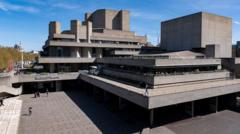
Institutional durability requires a structural synthesis of physical asset management, artistic output capacity, and financial adaptation. When public infrastructure reaches a half-century milestone, survival ceases to be a function of initial design merit and becomes an exercise in operational resilience. The National Theatre on London's South Bank, occupying its concrete home since the 1970s, offers a definitive case study in institutional longevity under shifting economic and cultural constraints. Deconstructing the mechanics of this venue reveals how cultural assets manage capital intensity, spatial efficiency, and public utility over extended temporal horizons.
The Economic Mechanics of Brutalist Infrastructure
The physical plant designed by Denys Lasdun represents a massive fixed-capital investment. Operating a multi-auditorium facility comprising the Olivier, the Lyttelton, and the Dorfman spaces generates a rigid cost structure. Fixed overhead expenses—including climate control for sprawling concrete volumes, statutory maintenance, and technical staging infrastructure—remain invariant regardless of ticket yield.
The economic model relies on balancing three distinct variables:
- Direct public subsidy via arts funding bodies.
- Earned revenue through box office turnover and commercial transfers.
- Private philanthropy and corporate sponsorship.
When state support contracts in real terms, the asset base becomes a financial liability unless offset by commercial monetization. The South Bank complex solved this structural vulnerability by integrating public spaces directly into the urban fabric. By treating foyers as open civic zones rather than exclusive ticket-gated corridors, the institution maximizes foot traffic conversion rates into secondary spending inside restaurants, bars, and bookshops.
Capital Allocation and Maintenance Debt
Managing a Grade II star listed brutalist structure introduces unique engineering bottlenecks. Raw concrete facades weather according to environmental exposure, and internal mechanical systems require systematic replacement cycles. Deferring maintenance on high-capacity theatrical rigging or electrical grids creates catastrophic failure risks that threaten production continuity.
To counteract infrastructural degradation, the institution utilizes targeted capital campaigns and specialized training pipelines. Establishing dedicated technical academies, such as mechanical and electrical maintenance apprenticeships, internalizes the cost of asset upkeep. Training specialized labor pools directly mitigates the scarcity of technicians capable of servicing aging theatrical plant machinery.
Operational efficiency depends on the ratio between reactive repairs and preventive capital expenditures. Facilities built with board-marked concrete demand continuous envelope inspections to prevent water ingress and thermal bridging. Organizations operating legacy cultural real estate must ring-fence capital expenditure funds independently of seasonal box-office fluctuations to prevent structural decay.
The Multi-Auditorium Production Matrix
A single monolithic stage imposes severe programming constraints. The National Theatre’s architectural layout splits risk across three distinct scales:
- The Olivier Theatre: High-capacity amphitheatre optimized for large-scale spectacles and classical revivals, demanding massive audience volume to achieve break-even occupancy.
- The Lyttelton Theatre: Proscenium-arch layout balancing intimacy with commercial transfer potential.
- The Dorfman Theatre: Flexible studio space engineered for low-cost, high-turnover new writing and experimental staging.
This tri-partite configuration diversifies artistic risk. While the large house absorbs high fixed costs through blockbuster audience numbers, the small studio functions as an incubator for intellectual property that can later be monetized in commercial West End transfers. The revenue loop generated by successful commercial transfers injects private capital back into the core non-profit programming budget, subsidizing the development of risk-heavy artistic works.
Digital Distribution and Audience Expansion
Physical capacity limits annual ticket sales to a fixed mathematical ceiling defined by seat count and performance frequency. To break this supply constraint, the institution pioneered high-definition cinema broadcasting. Digital distribution alters the unit economics of theatrical performance by transforming a localized, perishable event into a scalable digital asset.
The cost structure of digital transmission involves high initial capture expenses followed by near-zero marginal costs of distribution per screen globally. This strategy achieves two distinct operational goals:
- It unlocks international revenue streams from geographic markets completely orthogonal to the physical South Bank location.
- It functions as a top-of-funnel marketing engine, driving brand equity and increasing physical tourism conversion when international audiences travel to London.
Strategic Asset Reinvestment
Sustaining a premier performing arts institution across decades requires continuous adaptation of public engagement models. Anniversary milestones function as operational inflection points to test public-private funding appetite and refresh civic utility. Deploying temporary architectural installations on the Queen's Walk and expanding digital archives via open-access platforms maintain public mindshare without requiring heavy capital expenditure on permanent structures.
Future viability is dictated by the velocity of technical adaptation and the discipline of asset preservation. Cultural institutions must treat their physical premises not merely as static backdrops for artistic creation, but as dynamic balance sheet assets that require rigorous maintenance scheduling, multi-channel revenue distribution, and continuous optimization of human capital. Allocate capital reserves toward preventative infrastructural maintenance while decoupling revenue growth from physical seat inventory via scalable digital distribution channels.