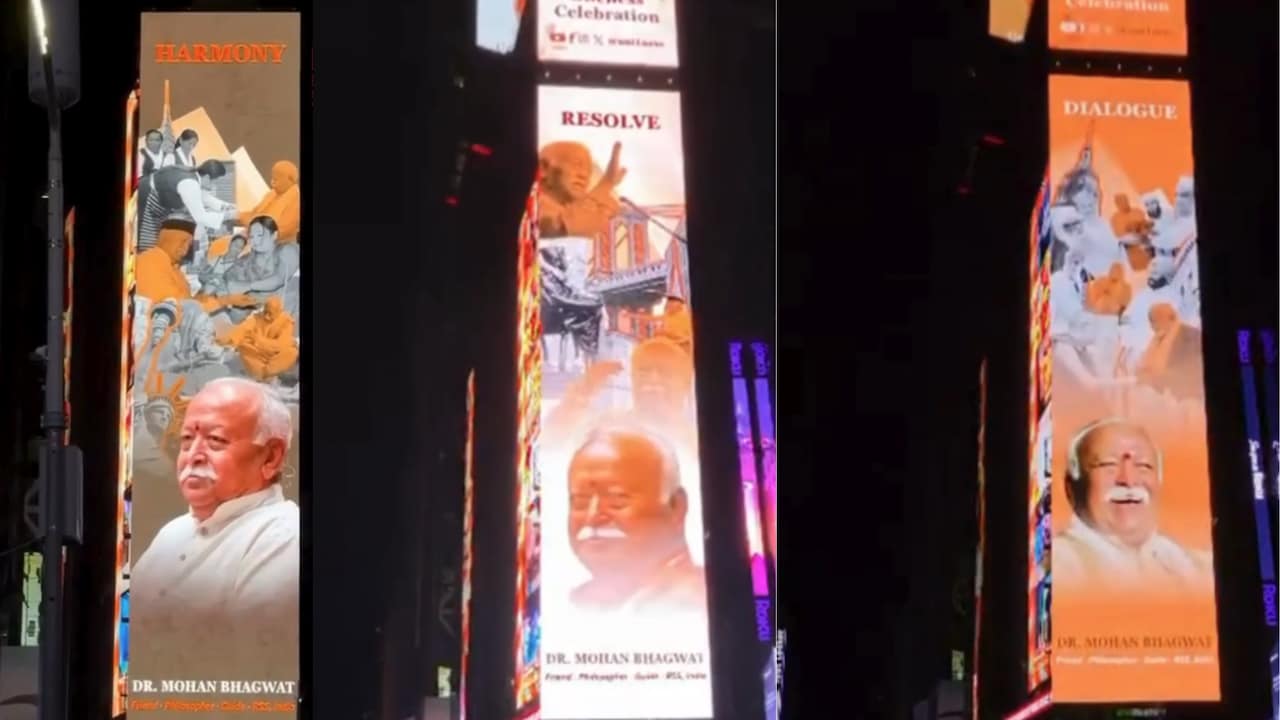
Transnational political movements increasingly rely on high-cost, high-visibility public relations infrastructure to project legitimacy across sovereign borders. When digital billboards in Times Square display the likeness of Rashtriya Swayamsevak Sangh chief Mohan Bhagwat ahead of an address at Madison Square Garden, the intervention functions as more than mere advertising. It represents a calculated exercise in diaspora signaling, designed to anchor an ideological apparatus within Western metropolitan centers. Analyzing this strategy requires dissecting the mechanics of cross-border image curation, the friction of municipal governance, and the economic utility of mobilizing expatriate populations.
The deployment of capital for public displays in high-density urban nodes follows a strict cost-utility logic. Times Square functions as a global attention sink. Securing screen space in this corridor guarantees hyper-visible saturation, capturing both local foot traffic and international media loops. For an organization celebrating its centenary through global outreach tours spanning North America and Europe, the tactical objective is audience capture. By juxtaposing images of leadership with terms like resolve, harmony, and dialogue, the campaign attempts preemptive framing. It substitutes abstract ideological contention with sanitized corporate-style messaging, neutralizing potential pushback before the primary address occurs.
This mode of transnational outreach operates through three distinct structural layers. The first layer involves infrastructure acquisition, utilizing diaspora-led entities such as the American Hindus for Engagement and Dialogue to organize, fund, and legally anchor large-scale events. The second layer centers on ideological rebranding, shifting the public discourse from domestic political friction in South Asia to universalist civilizational frameworks like Vasudhaiva Kutumbakam. The third layer targets institutional validation, attempting to secure acceptance within Western civic spaces by framing criticism of majoritarian politics as a threat to minority diaspora security.
Resistance to these interventions highlights the friction points of modern municipal politics. Public opposition from figures such as New York City Mayor Zohran Mamdani underscores the jurisdictional limits municipal authorities face when confronting private commercial contracts. Because billboard rentals and venue bookings operate within standard commercial frameworks, local governments lack the legal mechanisms to preemptively cancel gatherings based on ideological opposition. This creates a regulatory vacuum where foreign political movements can lease prime urban real estate without direct state interference, forcing critics to rely on counter-protests and civil society mobilization rather than administrative bans.
The economic and social dynamics of the Indian diaspora amplify the efficacy of this outreach. Expatriate communities often maintain deep psychological ties to their country of origin while enjoying the protections of Western pluralistic legal systems. Organizations capitalize on this duality by presenting cultural heritage events as benign celebrations of identity, thereby lowering the barrier to entry for diaspora members who might otherwise distance themselves from contentious political affiliations. This dynamic turns the diaspora into an economic and political buffer, capable of projecting influence back toward the homeland while insulating the parent organization from direct foreign regulatory scrutiny.
Evaluating the net outcome of such high-visibility campaigns requires measuring shifts in media narrative velocity rather than immediate conversion metrics. When an organization projects its leadership onto central Manhattan screens, the primary return on investment is the generation of polarized debate across mainstream and digital platforms. This polarization forces institutional stakeholders, from human rights coalitions to international religious freedom commissions, to respond, inadvertently amplifying the reach of the original message.
Track the structural evolution of transnational political campaigns by auditing how diaspora-funded public relations efforts transition from cultural branding to institutional lobbying, and measure the friction coefficients of municipal pushback against foreign ideological imports in global cities.