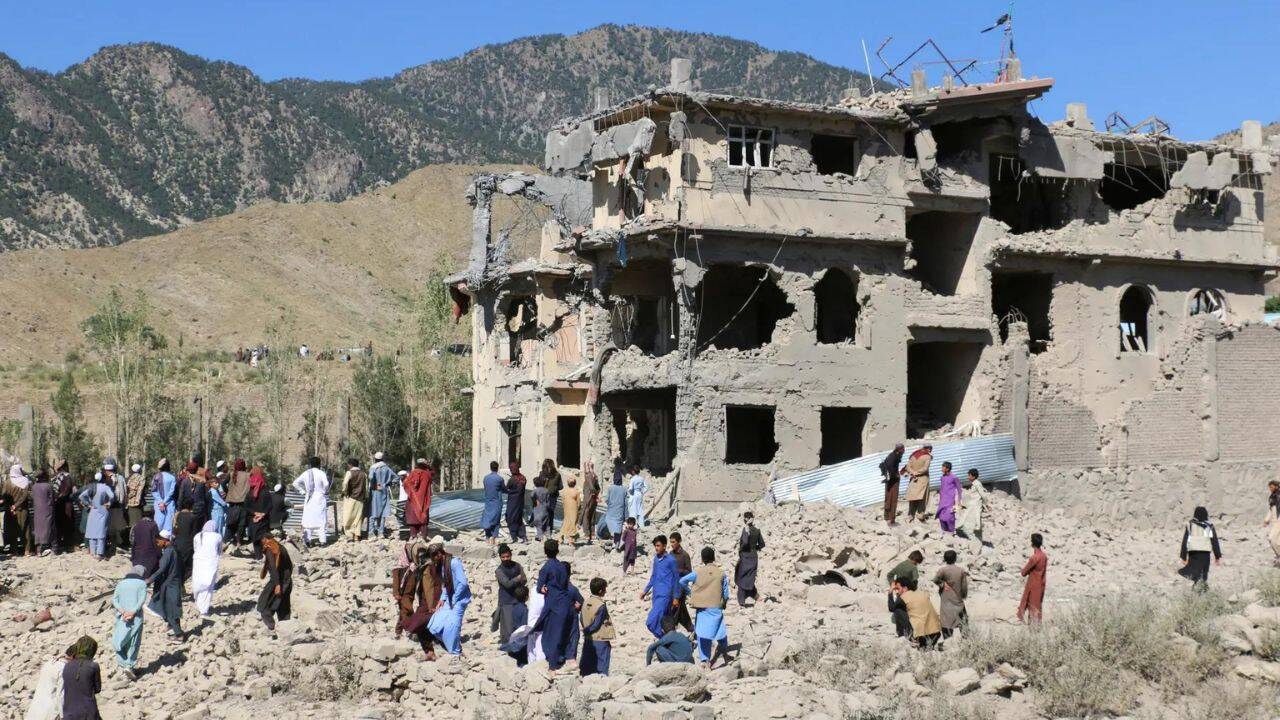
The border between Pakistan and Afghanistan does not feel like a line drawn on a map by British diplomats a century ago. It feels like dust, cold ridges of stone, and the unpredictable whistle of the wind through the Hindu Kush. At night, the sky here is so dark that the stars look like ice. People in the border villages of Khost and Paktika go to bed early because electricity is a luxury and the rhythm of life is still dictated by the sun.
When the first explosion ripped through the dark, it did not sound like a distant rumble. It felt like a sudden drop in air pressure, a violent slap that shattered glass miles away and woke children before they even understood they were afraid.
The initial instinct of any community facing disaster is to run toward the fire. It is an ancient, hardwired human impulse. If your neighbor’s roof collapses, you grab a shovel. If a scream pierces the night, you move toward it. In the tribal areas along the Durand Line, this communal obligation is even stronger, woven into a code of survival that has outlasted empires.
But modern warfare exploits this exact human virtue.
The strategy is known to military planners as a double tap. The first strike hits a target. It creates chaos, destruction, and casualties. Then, the planners wait. They watch through the thermal optics of a drone or look at the clock, calculating exactly how long it takes for a crowd to form. Ten minutes. Fifteen minutes. Enough time for brothers, uncles, and neighbors to scramble over the rubble with flashlights and bare hands.
Then comes the second strike.
The Midnight Sky Breaks
The strikes launched by Pakistan late at night targeted what Islamabad claimed were safe havens for the Tehreek-e-Taliban Pakistan, an insurgent group that has escalated attacks across the border. To the policymakers in Islamabad, the operation was a geometric exercise in national security, a precise response to the killing of seven Pakistani soldiers in a security post days earlier. On paper, it was an issue of sovereignty and deterrence.
On the ground, sovereignty looks like a collapsed mud-brick home.
Consider a family sleeping in a village in Paktika. Let us call the father Kamran—a name common in the region, representing the countless men who till the thin soil of these valleys. When the first missile struck a nearby house, Kamran did not think about geopolitics. He did not think about the strained relations between the Taliban government in Kabul and the military brass in Rawalpindi.
He thought about his cousins who lived down the track.
The air smelled instantly of pulverized concrete, cordite, and burning timber. Kamran ran out into the cold night, his sandals slapping against the dirt road. Other flashlights were already bobbing in the dark. Voices shouted through the dust, calling out names to see who would answer from the debris. Someone brought a tractor to pull away a heavy beam.
For twelve minutes, these men were not combatants or political pawns. They were simply human beings trying to pull other human beings out of a hole in the earth.
The second explosion was louder because there was no warning, no initial shock to prepare the ear. It struck the exact same coordinate. The flash blinded Kamran temporarily, and the blast wave knocked him flat into the dirt, filling his mouth with iron-tasting dust. When the sound subsided, the shouting had stopped. There was only the low, agonizing groan of the wounded and the hiss of ruptured metal.
The Evolution of the Second Tap
To understand why this happens, we have to look past the immediate horror and examine the cold logic of modern counter-insurgency. The double-strike tactic is not new, nor is it unique to any single military. It was used extensively by the United States during the height of its drone campaign in the tribal areas of Pakistan a decade ago. It has been used in Syria, in Ukraine, and across various theaters of asymmetric conflict.
The military rationale is brutal but straightforward. In an asymmetric war, the enemy does not wear uniform or hold a traditional front line. They blend into the civilian population. A single strike might miss the high-value target or only wound them. By striking the same location a second time, the attacking force aims to ensure the destruction of the target, while also targeting the network of people who come to aid them, assuming that those who rush to help an insurgent are likely insurgents themselves.
But this logic contains a profound flaw. It assumes that in a small village, under the sudden terror of an aerial bombardment, the people running toward the flames are checking political affiliations before they dig. They are not. They are responding to the fundamental law of the desert: today it is them, tomorrow it is you.
The consequence of this strategy is the total erosion of trust. When a community learns that helping the wounded is a death sentence, the fabric of society begins to unravel. Neighbors hesitate before helping neighbors. Parents keep their children inside while a nearby house burns. The sky ceases to be a natural phenomenon and becomes a source of permanent, ambient anxiety.
The Invisible Stakes
The tension between Pakistan and Afghanistan is often analyzed through the lens of macro-politics. Analysts speak of leverage, cross-border terrorism, and the strategic depth that Pakistan has sought for decades in its western neighbor. Since the Taliban returned to power in Kabul, the relationship has curdled from cautious optimism into open hostility. Pakistan accuses Kabul of harboring militants who launch deadly raids into its territory; Kabul denies this, pointing to its own internal security struggles.
Yet, the true cost of these strikes is measured in the radicalization of the survivors.
When a state uses advanced weaponry to strike across an international border, it sends a message of power. But when those strikes utilize tactics that maximize casualties among first responders, the message received on the ground is entirely different. It tells the young men of these villages that the international rules of war do not apply to them. It tells them that their lives are considered acceptable collateral damage in a game played by men in air-conditioned rooms hundreds of miles away.
The cycle is self-sustaining. A cross-border raid kills soldiers in Pakistan. Public anger demands a response. The military launches an airstrike. The double tap kills local villagers alongside the intended targets. The funerals are held the next day, attended by hundreds of angry, grieving young men. The insurgent groups stand at the edge of the cemetery, ready to hand out rifles and promises of vengeance.
A week later, another security post is attacked.
The Reality of the Dust
The morning after the strikes, the sun rose over Khost and Paktika, revealing the true geometry of the damage. Images that trickled out through local journalists showed deep craters surrounded by scattered household items—a child's shoe, a torn quilt, a broken plastic kettle. The Pakistani government maintained that the operation successfully eliminated key militant commanders. The Afghan government claimed that only civilians, mostly women and children, were killed.
The truth usually lies buried somewhere in the middle of those two conflicting statements, but for the people living along the Durand Line, the distinction matters less every day. They are trapped in a geographic vice, caught between an insurgent group that operates from their shadows and a foreign military that strikes from the clouds.
Kamran survived the second blast with shrapnel wounds and a ruptured eardrum. His cousin did not. As the dust settled and the helicopters rumbled back toward the east, the village was left with the task of burying their dead in the rocky soil. There were no grand political speeches at the gravesites, only the quiet, rhythmic thud of shovels hitting the earth.
The wind from the mountains blew across the fresh mounds, erasing the footprints of those who had run to help, leaving only the quiet, heavy certainty that the sky would eventually break again.