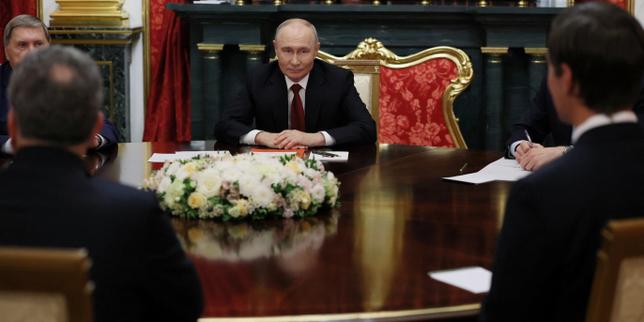
Diplomatic interventions in protracted attritional conflicts succeed or fail based on the asymmetry of baseline incentives, not the frequency of high-level communiqués. When United States envoys Steve Witkoff and Jared Kushner spent over three hours in the Kremlin with Russian President Vladimir Putin, public reports defaulted to diplomatic theater: characterizing the exchanges as "substantive, constructive, and extremely frank". Beneath this standard diplomatic lexicon lies a rigid economic and military cost-benefit structure. Deconstructing the mechanics of this visit reveals the structural limits of third-party mediation when both belligerents operate under incompatible terminal objectives.
The Asymmetry of Strategic Thresholds
To understand why a three-hour Kremlin session fails to yield an immediate breakthrough, one must examine the divergence between Washington's political timeline and Moscow's operational calculus. The White House operates under a time-compressed incentive structure driven by domestic political friction and competing foreign commitments, notably in the Middle East. Consequently, American strategy prioritizes velocity: freezing the conflict line, reducing resource drain, and establishing a visible diplomatic win.
Russia's operational calculus evaluates the conflict through a different set of variables. The Kremlin's baseline demands—formal cession of four administrative regions and structural prohibitions against Western security alliances—are treated by Moscow as non-negotiable core requirements rather than opening bargaining positions. Because Russian military planning accounts for sustained domestic industrial mobilization and incremental tactical gains along the 1,250-mile frontline, the opportunity cost of pausing operations remains low. Putin’s opening framing of the crisis as "not simple" functions as a signaling mechanism: Washington's proposed settlement vectors do not yet alter the slope of Russia's projected military returns.
The Mechanics of Temporary De-Escalation
The immediate tactical outcome of the Moscow meetings was not a peace treaty, but a localized, reciprocal three-day cessation of strategic capital strikes targeting Kyiv and Moscow. This mechanism exposes the transactional nature of contemporary escalation management.
- The Signaling Variable: Ceasefires of this duration serve primarily as operational safety buffers for diplomatic transit rather than precursor steps toward a permanent demilitarization zone.
- The Information Asymmetry: By communicating terms directly in Moscow before transiting to Kyiv to brief Ukrainian leadership, the envoys act as information conduits, testing whether parameters acceptable to one side can be mapped onto the operational baseline of the other.
- The Capital Protection Trade: Both belligerents calculated that executing long-range drone and missile strikes against command centers during active high-level mediation would incur unacceptable diplomatic penalties with the mediating power, prompting a temporary suspension of strategic aerial campaigns without shifting frontline infantry deployments.
Economic Diversification as a Negotiating Vector
A critical analytical oversight in standard reporting is the integration of bilateral economic discussions into a security mediation framework. Kremlin aide Yuri Ushakov explicitly noted that the talks extended beyond the Ukrainian theater to encompass potential major Russian-American economic projects.
This linkage introduces a parallel bargaining set. By inserting commercial and economic incentives into the diplomatic track, Moscow attempts to decouple normalization from territorial concessions. For the strategy to work under analytical scrutiny, the prospective economic utility offered by the United States must outweigh the projected domestic and geopolitical gains of continued territorial acquisition. Historically, in high-stakes interstate conflicts, long-term commercial propositions rarely supersede immediate existential security objectives. The inclusion of these topics indicates an attempt by Moscow to broaden the agenda, thereby increasing the complexity and duration of negotiations—a classic delaying tactic that diffuses pressure for immediate military concessions.
The Interlocking Friction of Multi-Party Constraints
Negotiation velocity is bound by structural bottlenecks across all capitals involved. Kyiv faces an acute deficit of critical interceptor missiles for advanced air defense systems, driven in part by competing global demands on Western supply chains. This hardware scarcity constrains Ukraine's defensive depth, forcing reliance on asymmetric long-range drone campaigns targeting domestic Russian energy infrastructure and logistics nodes to impose economic friction on Moscow.
When the U.S. delegation presents settlement ideas in Kyiv following the Moscow leg, Ukrainian leadership evaluates these proposals through the lens of attrition sustainability. If Western security guarantees are perceived as legally or operationally porous, any enforced territorial freeze becomes an asymmetric tactical pause favoring Russian force regeneration. Therefore, the structural obstacle to a settlement is not a deficit of creative diplomatic formulas, but the absence of an enforcement mechanism that guarantees long-term security without requiring either party to compromise its foundational survival doctrine.
Execute subsequent diplomatic phases through direct, secure military-to-military communication channels to clarify precise cease-line coordinates, decoupling high-level political posturing from localized tactical de-escalation protocols.