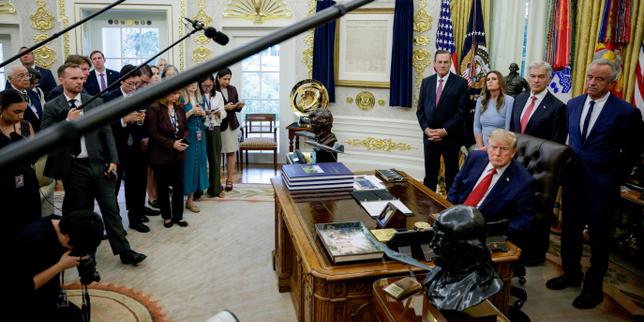
The modern executive branch operates not merely as an administrative apparatus, but as an information engine where access functions as the primary currency of power. When the administration restricted CNN, MS NOW, and Politico from White House grounds and designated briefings, observers framed the move through the lens of political theater. That interpretation mistakes the symptom for the architecture. Institutional credential revocation is a calculated exercise in audience segmentation, information routing, and legal friction generation.
The Cost Function of Institutional Access
To understand why executive administrations frequently target specific journalistic entities, one must examine the cost-benefit matrix of institutional proximity. The White House press pool exists to solve a logistical problem for both parties: the executive needs a transmission belt to reach broad electorates, and journalists need physical proximity to verify statements and capture unscripted interactions.
However, when the perceived utility of a hostile outlet's coverage shifts from neutral reporting to net reputational damage, the executive's cost function changes. The traditional administrative response involves verbal rebukes or selective leaks. Direct physical exclusion alters the equation by imposing operational costs on the targeted organizations:
- Resource Depletion: Banned outlets must divert legal and editorial resources to challenge the restriction in federal courts, shifting capital away from investigative reporting.
- Narrative Friction: Without real-time access to the Oval Office or press briefing rooms, reporters rely on secondary accounts, delaying immediate fact-checking and allowing the administration's primary framing to anchor public perception unchallenged.
- Signaling Efficacy: Exclusion acts as a costly signal to friendly networks and base supporters, demonstrating dominance over traditional media gatekeepers.
The mechanism relies on a stark asymmetry. The executive possesses the constitutional and logistical authority to control property access, whereas media organizations must rely on slow, reactive litigation to establish a First Amendment violation. Even when federal courts intervene or issue injunctions, the procedural delay allows the administration to achieve its short-term communication objectives.
The Three Pillars of Executive Information Control
Executive information strategies are sustained by structural realities rather than fleeting executive temperament. The control of public narrative relies on three distinct operational pillars.
The first pillar is alternative channel saturation. Modern communication technology permits executives to bypass traditional journalistic filters entirely, delivering unedited messaging directly to target demographics via digital platforms and sympathetic broadcast partners. When access is revoked from mainstream outlets, the administration does not suffer an informational vacuum; it simply routes output through channels with lower friction and higher receptivity.
The second pillar is the selective definition of the press corps. The White House press pass has historically been treated as an administrative entitlement managed by professional associations or institutional longevity. By shifting the criteria toward behavioral compliance and editorial alignment, the executive transforms a public utility into a discretionary privilege. This creates a compliance incentive for remaining outlets, subtly altering the baseline aggressiveness of questioning across the entire briefing room.
The third pillar is judicial timeline arbitrage. Legal challenges brought by media coalitions depend on establishing irreparable harm to First Amendment rights. Yet, the judicial process operates on a timeline measured in months or years, while the political cycle operates in days. An exclusion policy can achieve its strategic lifespan long before a definitive appellate ruling restores permanent access, rendering the legal victory largely symbolic for daily news cycles.
The Mechanics of Retaliatory Litigation
The confrontation between media organizations and the executive branch generates a predictable legal and economic feedback loop. When outlets file suit alleging viewpoint discrimination and violations of due process, the administration's legal defense typically rests on executive discretion regarding property management and security.
This dynamic creates a secondary market for political attention. The litigation itself becomes part of the content ecosystem, reinforcing the ideological identity of both the administration and the media companies. For the outlets, fighting the ban validates their role as indispensable democratic watchdogs to their subscribers. For the executive, fighting the outlets solidifies their anti-establishment credentials among constituents who distrust legacy media institutions.
Strategic Implications for Information Markets
The long-term consequence of routine press exclusion is the balkanization of political reality. When physical access to the seat of government is mediated strictly by ideological alignment, the shared baseline of facts required for democratic accountability deteriorates. Citizens no longer consume competing interpretations of identical events; they consume entirely different selections of events.
The strategic playbook established by these executive actions demonstrates that institutional norms regarding press freedom are remarkably fragile when confronted with an administration willing to absorb the short-term friction of litigation for the long-term benefit of narrative dominance. Future administrations will observe the efficacy of this friction-heavy approach, utilizing credential management not merely as a logistical tool, but as a core instrument of political leverage.
This video provides additional context regarding the administration's announcement and the initial media response to the White House press restrictions.