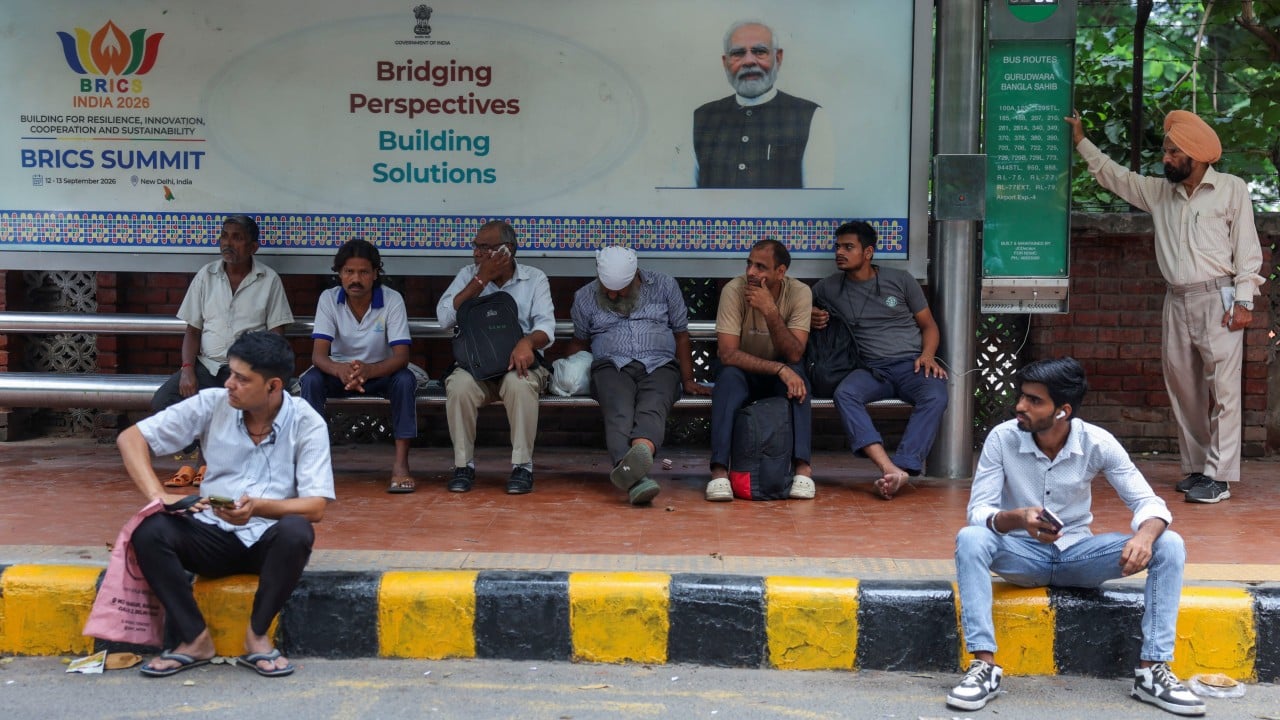
Managing a multilateral institution dominated by strategic rivals while preserving an independent foreign policy vector requires a precise calculus of institutional benefits versus geopolitical costs. As New Delhi hosts the BRICS summit, Indian foreign policy faces a structural paradox. The grouping provides an essential platform to project leadership across the Global South, yet it carries the inherent risk of becoming a vehicle for Sino-Russian ambitions aimed at institutionalizing opposition to Washington.
To evaluate this dynamic without relying on diplomatic platitudes, observers must deconstruct the mechanics of India's participation into three distinct operational vectors: institutional utility, counter-balancing constraints, and monetary sovereignty. You might also find this related story useful: Inside the Artillery Shift Changing the Math Across the Taiwan Strait.
The Three Vectors of Multilateral Friction
The core utility of BRICS for New Delhi lies in functional economic cooperation and institutional reform, rather than security alignment. India utilizes the platform to press for structural adjustments within traditional global governance architectures, such as the United Nations Security Council, multilateral development banks, and international financial oversight bodies. However, this functional agenda runs parallel to an alternative vision pushed aggressively by Beijing and Moscow: the transformation of the bloc into an explicit counter-weight to Western hegemony.
[Institutional Utility] ---> Focus: Global South, Development Finance, Governance Reform
[Geopolitical Risk]     ---> Focus: Sino-Russian Anti-Western Bloc Formation
[Monetary Vector]       ---> Focus: Cross-Border Payments vs. Dollar Hegemony
This structural divergence creates a severe cost function for Indian statecraft. When Beijing leverages peripheral border tensions to extract diplomatic compliance, New Delhi absorbs localized friction to keep the summit schedule intact. The strategic cost of this approach is the potential perception of policy incoherence. If the domestic audience and external allies observe India sitting alongside nations under heavy Western sanctions while simultaneously expanding security ties with Washington through frameworks like the Quad, the operational credibility of strategic autonomy is tested to its limits. As extensively documented in recent reports by Reuters, the results are widespread.
The Monetary Trap and Settlement Mechanics
Financial architecture represents the most volatile terrain within the bloc. Discussions surrounding de-dollarization, local currency settlement mechanisms, and integrated digital asset rails create acute systemic exposure for New Delhi.
While Indian policymakers support reducing transaction costs through initiatives linking domestic fast-payment systems like UPI with international equivalents, formalizing an anti-dollar coalition invites immediate secondary sanctions and punitive tariffs from Western capitals. Washington has explicitly signaled zero tolerance for currency substitution strategies that threaten the global dominance of the greenback.
Consequently, India's financial strategy must operate within tight parameters:
- Promote bilateral trade settlement in national currencies only where structural trade surpluses or balanced ledgers prevent the accumulation of unconvertible currency reserves.
- Decouple technological efficiency plays—such as Central Bank Digital Currency (CBDC) bridges—from political declarations aimed at dismantling the international financial clearing architecture.
- Retain clear institutional firewalls between domestic financial regulatory compliance and the alternative lending models promoted by the New Development Bank.
Managing the Internal Cleavages
Beyond the primary friction with China, the internal composition of an expanded BRICS introduces multi-vector instability. The inclusion of new member states with acute regional rivalries—such as the diplomatic and geopolitical friction between Iran and the United Arab Emirates—threatens to paralyze consensus building.
When minilateral groupings expand without shared ideological or security convergence, decision-making velocity approaches zero. For India, acting as a bridge between antagonistic states within the same summit framework dilutes its diplomatic capital. Consensus documents risk being watered down into procedural irrelevance, or worse, co-opted to reflect priorities entirely detached from New Delhi's core national interests, such as counter-terrorism cooperation, supply chain resilience, and economic fugitive extradition frameworks.
To prevent these multilateral mechanisms from operating against its strategic interests, New Delhi must shift from defensive damage control to active agenda-setting. The operational imperative is to restrict the bloc's scope strictly to technical, developmental, and logistical domains while insulating Indian foreign policy from any institutional drift toward a formal anti-Western alignment.
Ensure bilateral border stability remains non-negotiable by decoupling functional summit participation from territorial concessions, thereby denying rival capitals the leverage to trade multilateral success for localized geopolitical gains.


