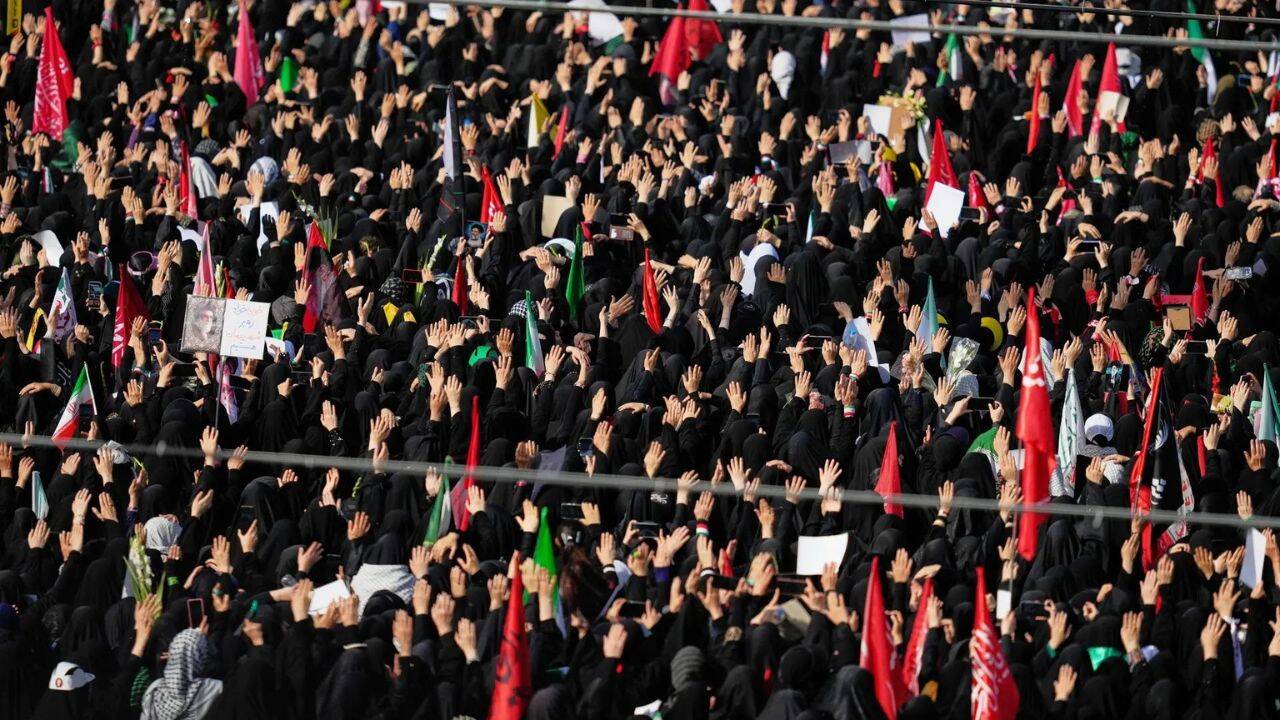
The week-long state funeral for former Supreme Leader Ali Khamenei serves as a foundational exercise in political risk mitigation and structural projection for the Islamic Republic. Following his death in late February during the opening phase of conflict, the delay in executing the final rites underscores a calculated administrative pause, allowing for a temporary stabilization of domestic and regional security parameters under an uneasy ceasefire. The state apparatus faces a multi-dimensional optimization problem: executing a highly visible, resource-intensive public assembly across five cities and two nations to signal regime continuity while simultaneously managing systemic logistical bottlenecks, extreme ambient heat, and acute security vulnerabilities.
Internal planning directives reveal the severe operational stresses under which the state is acting. A confidential brief coordinated by the Iranian Red Crescent and the national crisis management agency sent to First Vice President Mohammad-Reza Aref sets the baseline contingency for potential casualties during the multi-city procession between 1,500 and 3,000 fatalities. Far from representing an unintended breakdown of control, this quantitative threshold represents the calculated margin of acceptable friction within the state’s crowd-mobilization matrix. Recently making news recently: The Unheard Cries Beyond the Border.
The Dual-Objective Framework: Narrative Projection vs. Operational Capacity
The structural design of the funeral itinerary operates on a dual-objective framework designed to maximize visibility while absorbing localized civic friction. By routing the procession through Tehran, Qom, Najaf, Karbala, and Mashhad, the regime attempts to anchor the succession narrative within deep historical and religious networks. However, this expansive geographic distribution introduces severe strains across three core operational parameters: supply chain resilience, transport throughput, and urban containment.
The Crowd Dynamics and Micro-Climate Variable
Managing a multi-million-person assembly requires specialized architectural and environmental planning, elements historically prone to failure within regional state funerals. The 2020 funeral procession for Qasem Soleimani in Kerman resulted in at least 56 crush deaths and hundreds of injuries, illustrating the systemic vulnerability of high-density corridors. In the current Tehran and Mashhad deployments, the threat of crowd surges is compounded by seasonal ambient heat, which significantly increases the risk of dehydration, heat stroke, and mass panic. Further insights on this are detailed by TIME.
The state’s response to these environmental factors rests on a massive resource allocation strategy. The Basij volunteer force has mobilized a centralized bread production infrastructure, generating 50 million loaves nationwide, backed by 16 mobile industrial bakeries deployed in the capital to prevent local food security deficits. Simultaneously, the Tehran Municipality has requisitioned public infrastructure, deploying 11,000 municipal buses and converting regional schools and mosques into temporary hydration and shelter hubs. The scale of this deployment indicates that the primary threat vector identified by planners is not active domestic sabotage, but rather the compounding effect of structural failures within the basic supply chain.
Capital Allocation and District Budgets
The financial expenditure required to sustain this logistical network deepens existing domestic economic imbalances. Data from state-linked journalists indicates a total capital outlay for the Tehran leg of the ceremonies at approximately 15 million euros, with Qom and Mashhad allocated five million euros each. On a micro-operational level, each administrative district in Tehran has been granted between 500,000 and 650,000 euros specifically for three days of localized event management.
This capital allocation strategy generates a secondary structural challenge: public friction. Directing significant capital reserves into non-productive state ritual during a period of acute economic hardship creates a bottleneck in social compliance. To counter potential low voluntary attendance, the state has shifted from an incentive-based mobilization model to a mandatory compliance framework. Directives issued to the Tehran Grand Bazaar, fitness centers, and real estate unions mandated complete business closures through mid-week, utilizing the Basij Organization for Guilds to enforce compliance under the explicit threat of permanent commercial sealing.
The Security Deficit and Political Fracture Lines
The physical assembly acts as a volatile arena for ongoing internal elite friction and ideological realignment. While the public-facing slogan "We must avenge" seeks to establish an external focus for national grief, nightly assemblies within Tehran have revealed deep fissures regarding the state's strategic direction. Hardline factions have used the crowds to publicly challenge the active US-Iran memorandum, directing explicit threats at high-level negotiators, including Foreign Minister Abbas Araghchi and Parliament Speaker Mohammad Bagher Ghalibaf.
The presence of heavily armed non-state actors and hardline religious speakers within the crowds highlights a structural breakdown in the state's monopoly on violence during mass events. The internal security apparatus must balance two conflicting requirements:
- Allowing sufficient ideological expression to validate the regime's militant credentials.
- Preventing localized political violence from disrupting the elite succession process, specifically concerning the visibility and security of the new Supreme Leader, Ayatollah Mojtaba Khamenei.
The implementation of temporary airspace restrictions over Tehran and Mashhad points to a broader defensive posture against external threats, yet the immediate vulnerability remains grounded in domestic crowd mechanics.
The Succession Transition Strategy
The strategic utility of the funeral rests on its capacity to formalize institutional continuity. By keeping the body of the late Supreme Leader unburied for over four months, the interim council successfully decoupling the immediate shock of leadership loss from the logistical execution of the succession. The funeral is the closing phase of a prolonged political transition, transforming a disruptive wartime event into an organized display of systemic permanence.
The strategic choice of Mashhad's Imam Reza shrine for the final burial location anchors the future administration within a traditional base of spiritual authority, independent of the volatile political crosscurrents of the capital. The calculated acceptance of a high casualty margin—up to 3,000 dead—reflects an administrative calculus that prioritizes the symbolic performance of state power over absolute civilian safety. The regime operates under the premise that a controlled tragedy within a state-sanctioned ritual reinforces the narrative of martyrdom, whereas an empty street or a cancelled procession explicitly signals structural collapse. The final operational success of the transition will not be measured by the avoidance of casualties, but by the uninterrupted maintenance of institutional control across the entire geographic corridor of the mourning cycle.