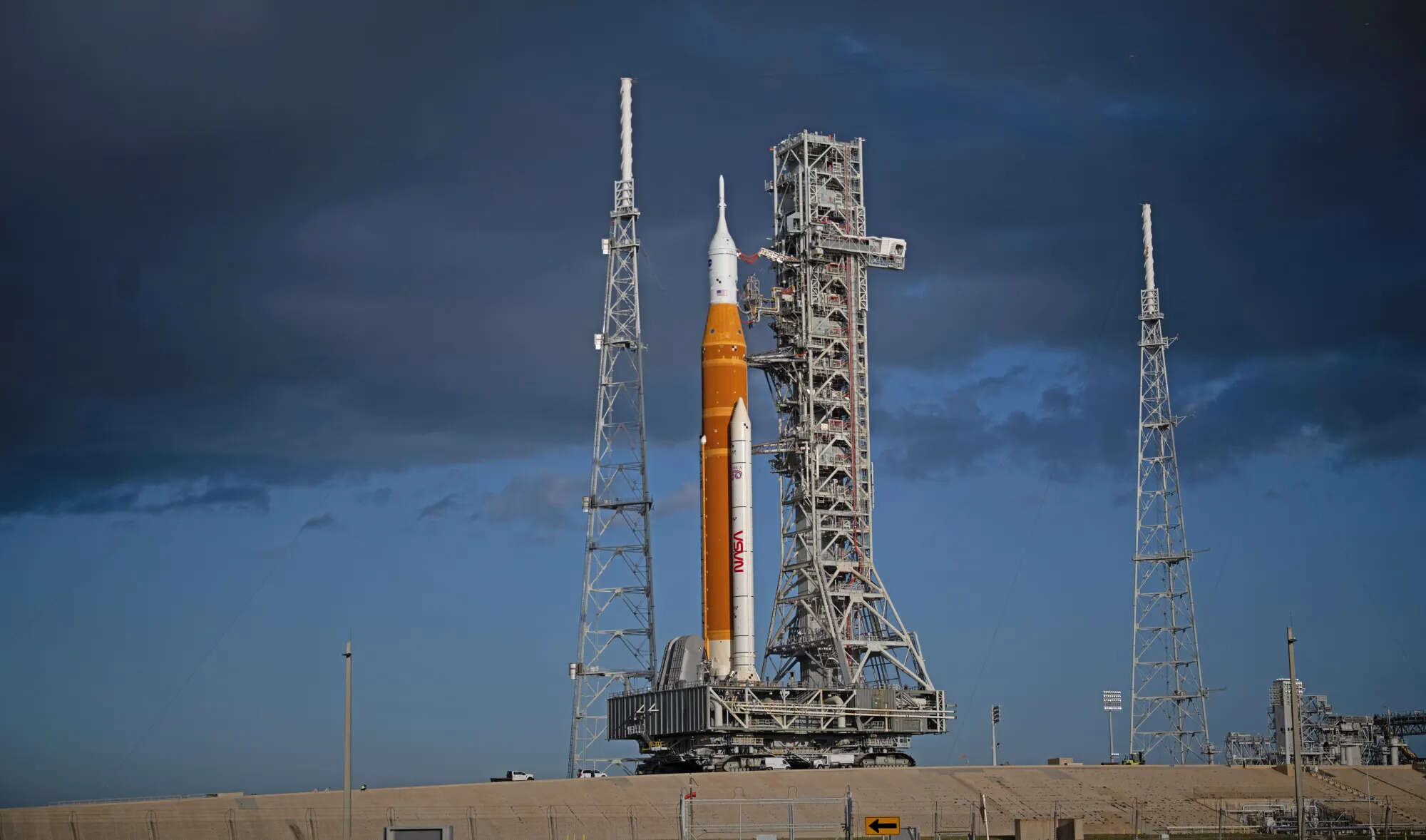
NASA wants you to focus on the "80% go" weather report. They want you to stare at the orange insulation of the Space Launch System (SLS) and feel a nostalgic pang for the Apollo era. They are selling you a "return to the Moon" as if we ever left because of a lack of rockets.
The premise is a lie.
Artemis II isn't a bold step toward Mars. It is a multibillion-dollar lap of honor for a disposable architecture that was obsolete before the first weld was finished. We are about to risk four highly trained lives to prove we can do in 2026 what we did with slide rules in 1968, only this time it costs $4.1 billion per launch.
If you think this is about science, you aren't paying attention to the balance sheet.
The SLS Debt Trap
The "lazy consensus" among space journalists is that SLS is the "only rocket capable" of sending humans to the Moon right now. That is technically true only because NASA spent a decade and $24 billion ensuring no other taxpayer-funded alternative existed.
SLS is a jobs program disguised as a heavy-lift vehicle. It uses Space Shuttle Main Engines (RS-25s) that were designed to be reused, then throws them into the Atlantic Ocean. It is the equivalent of flying a Boeing 747 from New York to London and scuttling the plane in the Thames upon arrival.
Industry insiders know the math doesn't track. When you look at the cost-per-kilogram to Low Earth Orbit (LEO), SLS sits at roughly $25,000 to $30,000. For comparison, SpaceX’s Falcon Heavy—a flight-proven, largely reusable system—operates at a fraction of that. Even the nascent Starship aims to bring that cost down to double digits.
By tying Artemis II to SLS, NASA has anchored our lunar ambitions to a fiscal anchor. Every dollar spent on an SLS launch is a dollar not spent on surface habitats, nuclear power on the Moon, or actual deep-space transit. We are burning the furniture to keep the house warm for one night.
The Orion Life Support Mirage
The media loves to talk about the Orion capsule as the "most advanced spacecraft ever built." Let’s look at the actual hardware.
During Artemis I, the uncrewed test flight, the heat shield eroded in ways NASA engineers didn't predict. "Charring" and "liberated material" are the polite ways of saying the shield didn't behave. For Artemis II, they are betting that a few tweaks and a crew of four can handle any "off-nominal" thermal events.
But the real issue isn't the heat shield. It's the mission profile. Artemis II is a "free-return trajectory." This sounds safe. It sounds conservative. In reality, it’s an admission that the Service Module provided by the European Space Agency (ESA) doesn't have the delta-v (velocity change capability) to do much else while carrying a fully loaded crew.
We are sending humans 10,000 kilometers past the far side of the Moon just to let gravity whip them back home. It’s a high-altitude flyby. There is no landing. There is no orbit. There is no docking. It is a $4 billion selfie.
Why the "Go" Probability is Irrelevant
The headlines scream "80% chance of favorable weather." This is a classic distraction. In the aerospace world, weather is the easiest variable to solve. You wait. You scrub. You go the next day.
The real "Go/No-Go" that nobody wants to discuss is the software integration. Orion’s flight software is a Frankenstein’s monster of heritage code and new flight systems. During the Apollo days, the hardware was the bottleneck. Today, the bottleneck is the millions of lines of code required to make ancient Shuttle-era boosters talk to modern digital avionics.
If a sensor disagrees with a heuristic model during the Trans-Lunar Injection (TLI), the mission doesn't just "fail." It becomes a crisis of orbital mechanics. Unlike LEO missions, there is no "quick abort" once you are on your way to the Moon. You are committed to a multi-day journey. If the life support system (ECLSS) hiccups on day two, those four astronauts are in a very expensive coffin until physics brings them back to Earth.
The Myth of the "Meaningful Step"
NASA argues that Artemis II is a "critical flight test" to validate systems for Artemis III—the actual landing.
This is a logical fallacy.
Testing a car by driving it around the block (Artemis II) does not prepare you for a cross-country trek through a desert (Artemis III). The complexities of a lunar landing—descent stages, ascent stages, dust mitigation, 1/6th gravity docking—are not being tested on this mission.
We are skipping the hard parts and celebrating the easy parts.
If we were serious about a sustained lunar presence, Artemis II would be a mission to deliver infrastructure. It would be a flight to test fuel transfer in orbit. It would be an uncrewed landing of a power station. Instead, we are prioritizing "human interest" stories because NASA knows that pictures of smiling astronauts in blue flight suits are the only way to keep Congress writing checks.
The Geopolitical Ego Trip
We aren't going back to the Moon to stay. We are going back because China is going.
The "Artemis Accords" are a desperate attempt to frame the rules of the lunar road before the China National Space Administration (CNSA) sets up shop at the South Pole. This isn't exploration; it's staking a claim.
If we were honest about the "humanity" of the mission, we would be building an international coalition that includes everyone, not just "partners" who agree to American terms. By turning the Moon into a theater for a second Cold War, we ensure that the first sign of a budget crisis or a mission failure will result in another 50-year hiatus.
I’ve seen this play out in the defense industry for decades. You build a "prestige" platform, you make it too big to fail and too expensive to fly, and eventually, a politician with a calculator kills it. SLS is the F-35 of space—except you can't even reuse the parts.
Stop Asking if the Mission is Ready
The question isn't whether the hardware can survive the trip. The question is whether the mission is worth the opportunity cost.
Imagine a scenario where we took the $100 billion projected for the Artemis program through 2030 and put it into a competitive, fixed-price contract for lunar delivery services. We wouldn't have one rocket; we would have a fleet. We wouldn't have one capsule; we would have a dozen.
Instead, we have Artemis II.
It is a mission designed to look like progress while moving at the speed of bureaucracy. It is a high-stakes gamble on 1970s architecture wrapped in 2020s marketing.
When the countdown hits zero and those four RS-25 engines ignite, don't cheer for the "return to the Moon." Cheer for the bravery of four individuals who are sitting on top of a giant, orange monument to missed opportunities.
The Moon isn't a destination for Artemis II. It’s a backdrop for a press release.
Next time you see a headline about "80% go," ask yourself what we are actually going for. If the answer is just "to prove we can," then we’ve already lost the lead.
Turn off the livestream. Demand a roadmap that doesn't involve throwing the engines away.