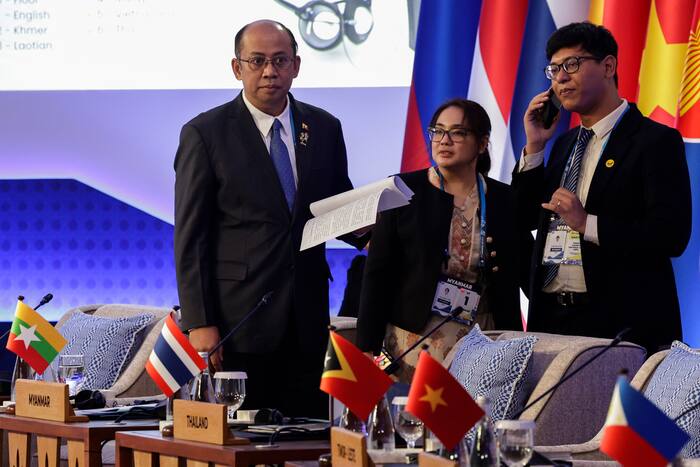
Every major wire service just ran the exact same story. Southeast Asian leaders met, issued a stern condemnation of the violence in Myanmar, and extended the ban barring junta chief Min Aung Hlaing from high-level regional summits. The mainstream press treats this as a display of diplomatic backbone.
They are completely wrong.
I have spent over a decade watching regional diplomatic architecture buckle under the weight of its own procedural theater. When journalists frame ASEAN’s non-political representation rule as a punitive sanction, they fall for the oldest trick in Southeast Asian statecraft: mistaking an empty chair for a spine. Extending the summit ban does not isolate Myanmar’s State Administration Council (SAC). It insulates them. By locking the generals out of the room while leaving the economic arteries wide open, ASEAN has built a diplomatic pressure valve that relieves Western outrage without costing the junta a single bullet, kyat, or square mile of territory.
If you want to understand why Myanmar’s civil war drags on while regional summits produce nothing but recycled press releases, stop reading the communiqués. Look at the incentives.
The Myth of Diplomatic Isolation
The lazy consensus in international reporting goes like this: ASEAN abandoned its sacred principle of non-interference by barring Myanmar’s top brass, proving the bloc finally takes the crisis seriously.
That narrative collapses the second you examine what the ban actually restricts. Since October 2021, ASEAN has restricted Myanmar’s representation at summits and foreign ministers' meetings to "non-political" figures—usually mid-level civil servants from the Ministry of Foreign Affairs. Naypyidaw routinely refuses to send anyone, leaving an empty placard behind.
On paper, this looks like regional ostracization. In practice, it is a gift to Min Aung Hlaing.
Consider what happens when a dictator sits at a regional summit table. He faces direct, unscripted confrontation from peers like Malaysian Prime Minister Anwar Ibrahim or Singaporean diplomats who have publicly excoriated the junta’s atrocities. He has to answer why the Five-Point Consensus—the peace plan he personally agreed to in Jakarta in April 2021—remains dead on arrival. He faces press pools, bilateral ambushes, and the immediate humiliation of having his regime’s legitimacy questioned in front of global cameras.
By banning him from the summit, ASEAN removed the one venue where regional leaders could look him in the eye and demand compliance. Naypyidaw gets to play the aggrieved victim of Western-inspired meddling to its domestic audience while avoiding every uncomfortable room in Jakarta, Phnom Penh, or Vientiane. You cannot pressure a regime you refuse to put in a chair, especially when you refuse to replace them with the opposition.
The Empty Chair Fallacy
Notice what ASEAN did not do when it barred the junta. It did not recognize the National Unity Government (NUG), the parallel administration formed by ousted lawmakers and ethnic resistance leaders.
When a regional bloc leaves a seat empty rather than filling it with the democratic alternative, it is not taking a side. It is declaring a recess. It signals to Naypyidaw that the seat belongs to the military—it is merely being held in escrow until the generals clean up their public relations problem.
I have seen international mediators burn years and millions of dollars on similar "quarantine" strategies in conflict zones. The result is always the same: when you deny a regime formal diplomatic etiquette without severing its material lifelines, you harden its resolve while destroying your own visibility into its decision-making. ASEAN diplomats now have fewer backchannels into Naypyidaw than they did three years ago, yet the violence on the ground has escalated exponentially.
Follow the Money, Not the Communiqués
Diplomacy without economic teeth is just creative writing. While Southeast Asian leaders congratulate themselves on extending a travel ban to summit banquets, bilateral trade and investment between ASEAN member states and Myanmar continue to grease the junta’s war machine.
To understand the hypocrisy, you have to separate diplomatic signaling from material enablement.
- Diplomatic signaling is cheap. Issuing a joint statement condemning airstrikes on civilian villages costs a foreign ministry zero political capital.
- Material enablement is profitable. State-linked enterprises, regional banks, and energy conglomerates across Southeast Asia still provide the foreign currency reserves Naypyidaw needs to purchase jet fuel, artillery shells, and spare parts from Russia and China.
Take Singapore. For years, Singaporean financial institutions and registered entities served as critical conduits for arms brokers and dual-use technology procurement destined for Myanmar’s military. While Singapore’s government eventually cracked down on specific banks following intense pressure from UN Special Rapporteur Tom Andrews, the broader regional ecosystem remains porous. Thai energy giant PTTEP continues to operate the Yadana and Zawtika offshore gas projects, funneling hundreds of millions of dollars in hard currency directly into the coffers of the state-owned Myanma Oil and Gas Enterprise (MOGE)—the junta’s single largest source of foreign revenue.
| Diplomatic Theater (What Gets Headlines) | Material Reality (What Fuels the War) |
|---|---|
| Barring Min Aung Hlaing from ASEAN summits | Billions in ongoing cross-border trade with Thailand and China |
| Reaffirming the Five-Point Consensus | Continued natural gas revenues flowing to state-owned MOGE |
| Condemning violence in joint statements | Regional banks facilitating junta-linked procurement networks |
| Appointing a rotating Special Envoy | Zero formal engagement with the National Unity Government (NUG) |
Imagine a scenario where a neighborhood watch bans an arsonist from attending the monthly HOA meeting, while simultaneously selling him gasoline and matches at the corner store. That is ASEAN’s Myanmar policy in a single frame.
Why the Five-Point Consensus Was Designed to Fail
Every time ASEAN leaders extend the summit ban, they ritualistically invoke the Five-Point Consensus. Mainstream outlets report this as the bedrock framework for peace.
Let’s define the Five-Point Consensus accurately: it is a non-binding, five-bullet wishlist drafted in April 2021 that calls for an immediate cessation of violence, constructive dialogue among all parties, mediation by an ASEAN Special Envoy, humanitarian assistance, and a visit by the envoy to Myanmar to meet with all parties.
It contains no timeline. It contains no enforcement mechanism. It contains no penalties for non-compliance. Worse, it operates on the fatal premise that the junta is a good-faith actor capable of mediating a transition away from its own absolute power.
ASEAN operates by the ASEAN Way—a doctrine built on consensus decision-making and strict non-interference in the internal affairs of member states. That framework was engineered in 1967 to prevent interstate wars between newly independent Southeast Asian nations and to contain Cold War insurgencies. It was never designed to stop a member state’s military from committing mass atrocities against its own population.
When you apply a consensus-based conflict avoidance tool to a zero-sum civil war, the aggressor wins by default. Min Aung Hlaing agreed to the Five-Point Consensus in 2021 for one reason: to buy time while his troops consolidated control in the cities and launched scorched-earth campaigns in the borderlands. By keeping the Five-Point Consensus on life support, ASEAN allows the junta to string the region along indefinitely, promising future compliance that never arrives.
The Rotating Chair Trap
The structural flaw runs even deeper. ASEAN’s chairmanship rotates annually among its ten members. Each chair appoints a new Special Envoy on Myanmar, resetting the diplomatic clock every twelve months.
- 2021 (Brunei): Spent months just trying to get an envoy appointed.
- 2022 (Cambodia): Hun Sen went rogue, flew to Naypyidaw on his own, handed the junta a massive propaganda victory, and achieved zero concessions.
- 2023 (Indonesia): Conducted quiet diplomacy with over a hundred stakeholders, only to watch the junta escalate airstrikes in Sagaing and Kayah states.
- 2024 (Laos): Handed the baton to a landlocked authoritarian state economically dependent on Beijing and entirely uninterested in confronting Naypyidaw.
This annual reset guarantees institutional amnesia. Just as one envoy learns who actually controls which border crossing in Shan State, their term expires, and a new bureaucrat starts from scratch. Naypyidaw simply waits out the calendar.
Dismantling the Wrong Questions About Myanmar
When readers search for news on ASEAN and Myanmar, they usually get fed a diet of sanitized questions that miss the actual power dynamics on the ground. Let’s strip away the diplomatic jargon and answer the real questions brutally honestly.
Can ASEAN actually force Myanmar’s military to stop the violence?
No. Not under its current charter, and anyone telling you otherwise is selling you diplomatic fiction. ASEAN has no peacekeeping force, no economic sanctions mechanism, and no expulsion clause in the ASEAN Charter. Even if Malaysia, Indonesia, and Singapore wanted to impose crippling regional sanctions, Thailand, Cambodia, Laos, and Vietnam would veto the move immediately. Geopolitical proximity dictates policy: Thailand shares a 2,400-kilometer border with Myanmar and prioritizes border stability, refugee containment, and energy security over democratic restoration.
Why doesn't ASEAN just kick Myanmar out of the bloc?
Because expulsion would hand Myanmar entirely to China on a silver platter. ASEAN’s primary strategic obsession—far outweighing human rights—is maintaining ASEAN Centrality, the idea that Southeast Asian nations should manage their own neighborhood without becoming pawns in US-China competition. If ASEAN expels Myanmar, Naypyidaw drops all pretense of regional alignment and becomes a full-fledged Chinese client state, giving Beijing unhindered access to the Indian Ocean via the China-Myanmar Economic Corridor. For ASEAN strategists, a genocidal neighbor inside the tent is preferable to a Chinese military outpost on their western flank.
Is the Myanmar junta actually losing the war?
Yes—and that is precisely why ASEAN’s summit ban is so obsolete. Following Operation 1027, launched in late 2023 by the Three Brotherhood Alliance, the Tatmadaw (Myanmar’s military) suffered its worst battlefield defeats in decades, losing control of entire swathes of northern Shan State, key trade crossings with China, and major towns in Rakhine and Chin states. The junta is hemorrhaging territory, morale, and manpower, forcing it to enact a desperate military conscription law that triggered a mass exodus of young people. Yet ASEAN still treats the junta as the sole sovereign authority while treating the resistance forces—who now control over half the country’s territory—as invisible non-state actors.
The Uncomfortable Truth About My Contrarian Stance
Before you assume that tearing down ASEAN’s summit ban means endorsing full engagement with the generals, let’s be clear about the trade-offs.
There is a legitimate downside to abandoning the summit ban without a replacement strategy: optics matter in authoritarian regimes. Min Aung Hlaing craves international legitimacy to project invincibility to his own officer corps. Handing him a podium at an ASEAN summit without strict, verified preconditions would trigger massive backlash from Myanmar’s pro-democracy movement and signal to the resistance that the region has abandoned them.
The flaw is not that ASEAN denied Min Aung Hlaing a seat. The flaw is that ASEAN stopped there and called it a strategy.
What Real Leverage Actually Looks Like
If Southeast Asian leaders actually wanted to end the violence in Myanmar rather than merely protect their own summits from bad press, they would stop managing the optics and start targeting the regime’s center of gravity.
- Formalize Dual-Track Engagement. Stop treating the National Unity Government and Ethnic Resistance Organizations (EROs) like radioactive outcasts. If you bar the junta from the political table, seat the NUG in an observer capacity and establish direct humanitarian and border-trade channels with the resistance groups that actually govern Myanmar’s borders. You cannot deliver aid or secure borders by asking permission from a military that no longer controls the territory.
- Target Jet Fuel and Aviation Parts. The junta survives on the ground only because it dominates the air, using Russian and Chinese fighter jets to flatten schools, hospitals, and villages. ASEAN states—particularly Singapore, Thailand, and Malaysia—must enforce strict customs blacklists on aviation fuel shipments, shell companies, and logistics firms transshipping military-grade parts through regional ports.
- Escrow Gas Revenues. Thailand does not need to cut off its own power grid to choke the junta. Bangkok can mandate that all payments owed to Myanma Oil and Gas Enterprise (MOGE) be placed into a restricted sovereign escrow account—accessible only for verified humanitarian relief or held until a legitimate constitutional government is restored—following the exact precedent used to freeze rogue regime assets globally.
- Ditch the Annual Envoy Carousel. Replace the rotating one-year Special Envoy with a permanent, well-funded ASEAN mediation secretariat staffed by intelligence analysts and conflict negotiators who do not pack their bags every January.
Until Southeast Asian leaders touch the money, the jet fuel, and the border crossings, extending a summit ban is nothing more than rearranging the seating chart while the house burns down.


